Servicing : Gold CoastBrisbaneSunshine CoastToowoomba

Menu
Can You Put Epoxy Flooring Over Tiles?
October 5, 2026
Team
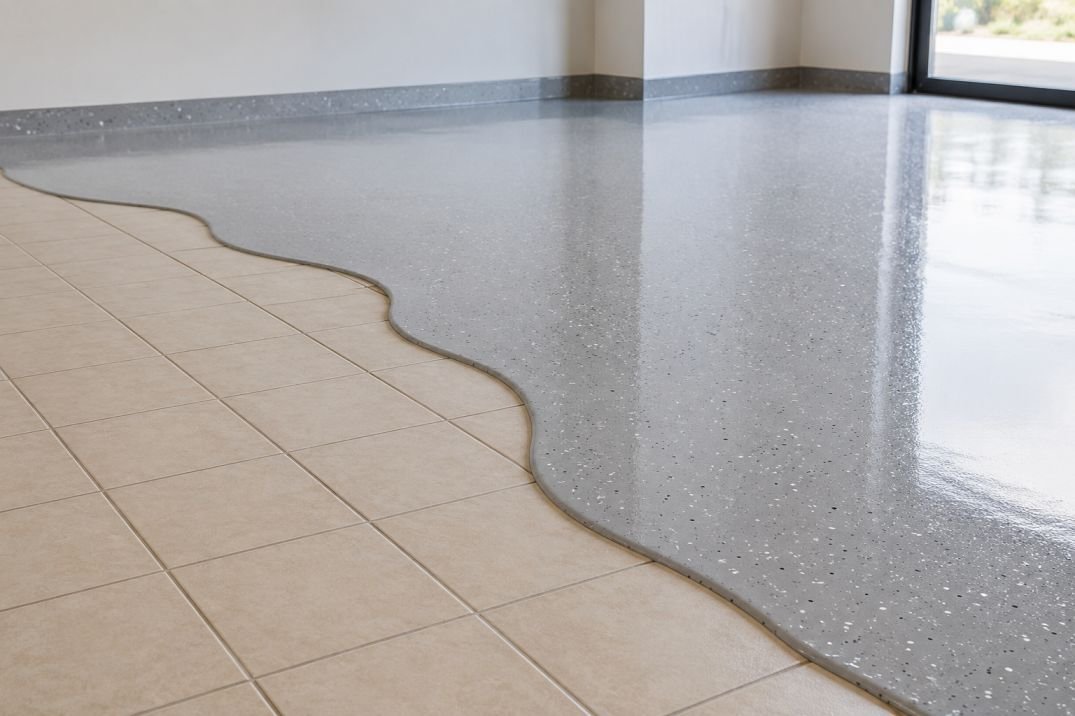
Yes, you can put epoxy flooring over tiles if every tile is firmly bonded, the grout is intact and the glazed surface can be ground back for grip. Hollow-sounding tiles, cracked grout or damp problems rule it out. A ten-minute tap test tells you most of what a quote visit would.
Most failures happen because someone coated a floor that was already moving. Epoxy hides tiles. It doesn’t hold them down. So the question worth asking first is whether your tiles are staying put.
Which tiles are a yes for epoxy?
Tiles are a yes when each one is firmly bonded, none are cracked, the grout is sound and the surface can be ground to remove the glaze. Resin Masters coats over tiles on that basis. Grip matters more than tile size or colour, though very glossy porcelain needs extra scrutiny.
- Every tile sounds solid. Tap each one and hear a dull, even knock rather than a hollow ring.
- No cracked tiles. A cracked tile usually means something underneath has moved.
- Grout is intact. No crumbling, and no cracks running in a line across several tiles.
- You can live with about 5 to 8 mm more floor height. Door clearances and shower transitions need checking first.
Which tiles are a no?
Tiles are a no when any are loose or hollow, when the grout has cracked from movement, or when moisture is coming up through the floor. Resin Masters says hollow-sounding or loose tiles must come out before any epoxy goes on. Coating over them means the coating goes with them when they lift.
- Loose or hollow tiles. These have to be removed and the gap refilled first.
- Cracked grout that follows a line. Resin Masters treats this as a sign of movement in the base.
- Damp or staining. Moisture under tiles pushes a coating up from below, so the cause needs fixing first.
- No spare height. If doors can’t be adjusted and thresholds can’t rise, the answer is no.
How do you check your tiles before you call anyone?
Walk the floor and tap every tile with a coin or your knuckle, listening for a hollow ring. Then check the grout for cracks, look at the edges near doors, and measure clearance under each door. It takes about ten minutes and saves a wasted quote on a floor that needs tile removal first.
- Tap every tile, including the ones at the edges and under mats. Mark any that ring hollow with masking tape.
- Look along the grout for cracks that run across more than one tile.
- Check for damp smells, dark patches or staining near the shower, laundry tub or external doors.
- Measure the gap under doors and the height of any shower hob or threshold.
Take photos of anything doubtful. An installer can tell you a lot from them before visiting, though a proper tap test on site is what settles it.
What happens to the grout lines?
Grout lines show through a thin coating unless they’re filled first. Resin Masters’ over-tile process includes filling grout joints after grinding the tile surface, so the finished floor is smooth. Some owners keep the tile pattern deliberately, and other installers say the process can go either way. Decide before the quote.
Shimicoat says its process can either keep the tile lines visible or conceal them. Filled joints look like a solid slab. Left open, they look like a coated tile floor, and that suits some renovations better.
How is epoxy applied over tiles?
The installer grinds the glaze off the tiles, fills the grout joints and repairs defects, applies a tile-compatible primer, then builds the coating system on top. Resin Masters says over-tile jobs take the same time as coating fresh concrete. Grinding is the step that decides whether the coating holds.
- Assess. Tap and check tiles across the whole floor, plus moisture and floor height.
- Grind. The glossy glaze comes off so the primer has something to grip.
- Repair and fill. Grout joints and small defects are filled and levelled.
- Prime. Resin Masters uses a tile-compatible, moisture-tolerant primer.
- Coat and seal. The colour or flake system goes on, followed by a topcoat.
The same logic applies to any base, and our guide to how to prepare concrete for epoxy explains why grinding beats acid etching.
Will epoxy grip glossy porcelain tiles?
It can, but glossy, dense porcelain is the hardest case. One Brisbane installer’s guide lists poor adhesion on polished or vitrified porcelain as a known risk. Ask any installer how they’ll prepare that specific tile, and get their answer in writing.
The evidence here is thin. Most guides say “grind the glaze” without naming a tile hardness where the method stops working. So treat a very glossy tile as a reason to ask more questions, not as an automatic no.
How much height does epoxy add over tiles?
Epoxy over tiles adds about 5 to 8 mm to the finished floor height, according to Resin Masters. That’s more than the 2 to 3 mm of a standard coating on bare concrete. It matters at door clearances, at shower recesses and wherever the floor meets another surface.
Some doors may need adjusting. The shower recess transition needs a closer look. Resin Masters checks these transitions on the free site visit before recommending the over-tile approach. Our epoxy floor thickness guide covers build height on bare concrete.
Is epoxy over tiles cheaper than taking the tiles out?
Often, yes. You skip demolition, waste and disruption. Resin Masters says over-tile cost is comparable to or slightly above coating fresh concrete, because grinding replaces demolition. Any tile removal that’s needed, such as hollow tiles, is listed as a separate item in the written quote.
Factor | Epoxy over sound tiles | Remove tiles first |
|---|---|---|
Demolition and waste | None | Tile, adhesive and rubble to remove and dispose of |
Floor height | Rises about 5 to 8 mm | Back to slab level plus coating build |
Hidden problems | Stay hidden unless the tap test finds them | Slab is exposed and can be inspected |
Disruption | Grinding dust and noise | Grinding plus demolition dust and noise |
Best when | Every tile is bonded and height is spare | Tiles are hollow, cracked or the base is suspect |
Free, itemised quotes help here. Resin Masters offers a free on-site quote and sends the itemised written price within 48 hours of the visit.
Does epoxy over tiles work in a bathroom or wet area?
Yes, with the right slip specification. Resin Masters specifies AS 4586-rated anti-slip aggregate for bathroom floors and describes R11 for residential wet bathrooms, tested on the installed surface. Ask for that documentation. A bare glossy coat over wet tiles is a slip risk.
One caution. Don’t assume the coating replaces the waterproofing membrane under your tiles. Ask your installer, in writing, what the coating does and doesn’t cover. The site’s bathroom epoxy flooring page sets out its over-tile process, and our guide to slippery epoxy floors explains ratings.
When should you remove the tiles instead?
Remove the tiles when the tap test finds hollow spots, when grout cracks suggest movement, when moisture is present, or when you can’t spare the height. Tile removal costs more upfront but leaves a clean slab that can be inspected, repaired and coated on a known base.
If you’re deciding between a whole new tiled floor and epoxy, our comparison of epoxy vs tiles on the Sunshine Coast sets out the trade-offs.
Who is epoxy over tiles not for?
It isn’t for floors with loose or hollow tiles, ongoing damp, or no room for extra height. It’s also a poor fit if you love the tile pattern and want it visible with a natural texture. In those cases, fix the base first or keep the tiles as they are.
- Anyone with tiles that already rock, ring hollow or have lifted at the edges.
- Floors with cracked grout running across the room.
- Bathrooms where doors and thresholds can’t take an extra 5 to 8 mm.
- Owners who’d rather have a new tile floor than a coated one.
Frequently asked questions
Can you epoxy over cracked tiles?
Not safely. A cracked tile or cracked grout usually signals movement in the base, and a coating won’t stop it. Resin Masters says tiles with cracked grout that indicates movement have to come out before epoxy goes down. Replace or remove them, then coat a stable floor.
Will you still see the grout lines after epoxy?
Only if you choose to. Grout joints can be filled during preparation so the finish reads as one smooth surface. Some owners keep the lines visible for a coated-tile look. Say which you want before the quote, because it changes the preparation.
How long does epoxy over tiles take?
Resin Masters says over-tile installation takes the same time as a fresh concrete job. In bathrooms, light use is typically fine within 48 hours, and full wet-area use is safe after the 7-day chemical cure. Your written quote should state the timeline for your floor.
Is there a warranty on epoxy over tiles?
Resin Masters says every bathroom epoxy floor carries a written 7-year warranty covering delamination or adhesion failure from its preparation or installation. Ask to see the exact wording for an over-tile job before you sign, since tile condition affects what can be promised.
How do I find out if my tiles are suitable?
Do the tap test first, then book a free, no-obligation on-site quote. Resin Masters taps tiles across the whole floor, tests moisture and checks floor height. Any tile removal is listed in the itemised written quote, which arrives within 48 hours of the visit.
Also Read:- Epoxy Flooring for Queensland Homes: A Room-by-Room Guide