
“Bobby was super friendly and extremely knowledgable. Amazing with his craft, the end result was fantastic. 100% recommend to anyone.”
James EdwardsGoogle review
Childcare bathrooms, nappy-change rooms and kitchens are cleaned more often than almost any other floor in a commercial building, and they’re used by children who sit, crawl and walk on them. Resin Masters installs seamless, coved epoxy floors in those rooms for early learning centres, kindergartens and long day care services across Brisbane, the Gold Coast, Logan and Ipswich, usually over a weekend so the centre doesn’t have to close.


What’s the best flooring for a childcare centre? It depends on the room. Playrooms and sleep rooms are usually best with safety vinyl or carpet tiles, which are softer and quieter. Bathrooms, nappy-change areas, kitchens, bottle-prep areas, laundries and wet-weather verandahs are where seamless epoxy works best: no grout, no joins, coved edges at the walls and a slip-resistant finish.
| Room | Epoxy? | What matters most | What we’d usually install |
|---|---|---|---|
| Children’s bathrooms and toilets | Yes | Constant wet mopping, accidents, hygiene, grip | Seamless solid colour, coved edges, textured anti-slip topcoat |
| Nappy-change room | Yes | Cleaning several times a day, nothing for liquids to soak into | Seamless solid colour with integral coving |
| Kitchen and bottle-prep area | Yes | Food safety, hot water, grease | Commercial kitchen system with coving and anti-slip topcoat |
| Laundry | Yes | Water, detergents, floor drains | Solid colour, coved to the drain |
| Entries and wet-weather play areas | Often | Wet shoes, sand tracked in from outdoors | Flake or solid colour with aggregate |
| Verandahs and undercover paths | Often | Rain, sun, children running | UV-stable flake system with aggregate |
| Staff room, office, storage | Optional | Durability, easy cleaning | Solid colour or flake |
| Playrooms, baby rooms, sleep rooms | Usually not | Children on the floor all day, noise, warmth | Safety vinyl or carpet tiles from a vinyl installer |
| Under climbing equipment | No | Fall protection | Rubber softfall or other fall-rated surfacing |
These are the rooms where a floor’s joins become a problem. Tile grout and vinyl seams hold moisture, and once urine and cleaning water get into them, the smell is very hard to remove. An epoxy floor is one continuous surface. Where the floor meets the wall, we form an integral cove so there’s no corner for water to sit in and cleaners can wipe straight up the skirting.
Children’s bathrooms also need grip without a surface that’s rough on small hands and knees. We use a textured topcoat with fine aggregate rather than a coarse, gritty finish, and can arrange AS 4586 testing so you have a documented result (see Slip resistance for little feet below).
If the existing tiles are sound, we can often coat over them after grinding, which adds roughly 5–8 mm to the floor height and avoids the dust and noise of ripping tiles up. Commercial bathroom systems are published at $90–$140 per m². More on our bathroom epoxy flooring page.
A centre kitchen is a commercial kitchen. We treat it the same way: diamond-ground slab, repairs, a coved edge at the walls and around fixed equipment, and a slip-resistant topcoat for the areas around sinks. Laundries are done in the same system, coved down to the floor drain so water can’t get under the edges.
Our standard commercial kitchen system is published at $70–$95 per m². Food-safety and coving details are in our guide to food-safe commercial kitchen flooring with epoxy coving and our summary of commercial kitchen floor requirements in QLD.
Verandahs and undercover paths get rain blowing in, sand from the sandpit and direct sun in the afternoons. A flake epoxy system with aggregate in the topcoat gives grip when wet and hides sand and dirt between sweeps. Where sun reaches the floor, the topcoat has to be UV-stable, because standard epoxy can yellow outdoors.
Epoxy is not a fall surface, so it doesn’t replace softfall under climbing frames, swings or slides.
Australian floor surfaces are tested for slip resistance under AS 4586. Three results are relevant to a childcare centre:
We use low-VOC to near-zero-VOC, 100% solids epoxy. Curing still produces some odour, so the rule is simple: children stay out of the area until we confirm it’s ready, and the room is ventilated before it’s handed back. We can supply safety data sheets for your approved provider, nominated supervisor or WHS file.
Most centres can’t close for a week, so we plan the work around your operating hours:
In Queensland, education and care services must meet the physical environment requirements in the Education and Care Services National Regulations. The ones most relevant to floors are:
Building work, including alterations and repairs, is assessed against the Building Code of Australia, and the Queensland Government advises approved providers to get expert advice from their architect and building certifier. A seamless, cleanable, slip-resistant floor helps you meet the “safe, clean and in good repair” standard, but the floor alone doesn’t make a centre compliant, and we don’t claim it does. See the Queensland Government’s guidance on building standards and physical environment considerations.
Published 2026 ranges, GST included. Your quote depends on the room, the existing floor and the system.
| Area / system | Typical price per m² |
|---|---|
| Solid colour epoxy (storage, staff areas, laundries) | $50–$90 |
| Decorative flake epoxy (entries, verandahs, paths) | $60–$110 |
| Kitchen / bottle-prep system with coving | $70–$95 |
| Children’s bathrooms and nappy-change rooms | $90–$140 |
| Crack and defect repair | add $5–$20 |
| Moisture barrier, where testing shows it’s needed | add $3–$8 |
Coving, coating over tiles, fast-cure systems and weekend work all affect the final figure. More in our epoxy flooring cost guide.
Based in Pimpama, working across South East Queensland:
Also responsible for a school or OSHC site? See epoxy flooring for schools.
Press play to hear customers talk about their new floors, or read what customers are saying about Resin Masters on Google.
White-base flake garage. Our standard flake system over a crisp white base, with a polyaspartic topcoat. The customer does the talking.
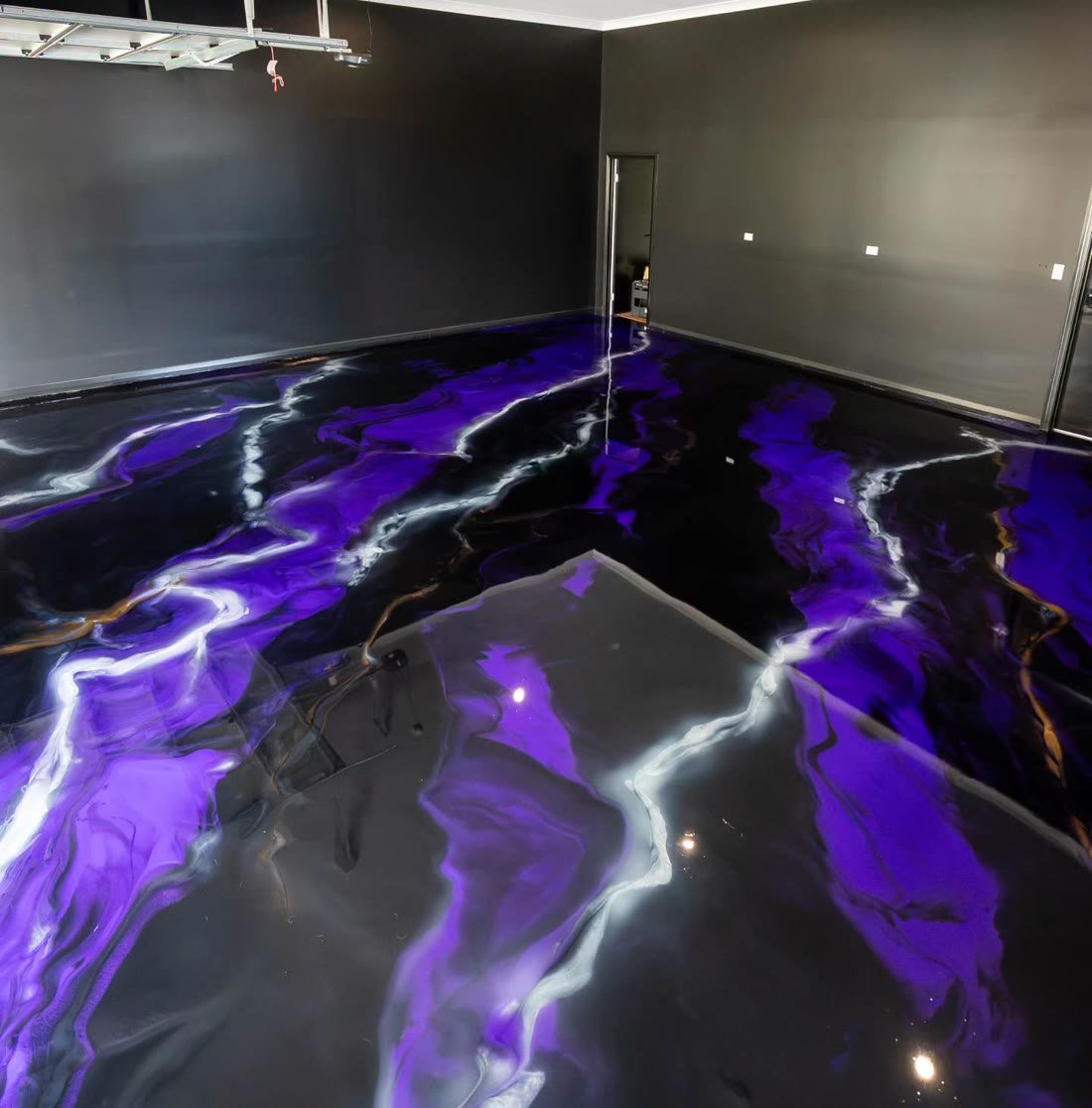
Black and purple metallic. A glossy metallic floor in black and purple, with white veins and a touch of gold. Hear it from the customer.
“Bobby has done an exceptional job for our warehouse here on the Gold Coast. Very clean, and tidy finishing, would not fault!”
Want a floor like these? Send us a photo of the space and we’ll quote it for free.
Get a free quote“Bobby was super friendly and extremely knowledgable. Amazing with his craft, the end result was fantastic. 100% recommend to anyone.”
“Got our outdoor patio sorted before the weekend. The boys were super punctual, easy to deal with, and handled the whole job here in Yarrabilba with zero hassle. Our flake floor looks so amazing. Cheers and Thank you Resin Masters.”
“Had the Resin Masters team out to do my garage floor in Ormeau last week. The old concrete was constantly dusty and had a couple of nasty cracks in it. The boys ground it all back, patched up the cracks, and laid down the full flake epoxy. Honestly looks insane, like a proper showroom. No more dust tracking into the house. Highly recommend these guys if you want a quality finish.”
Rating and reviews from our Google Business Profile.
Once fully cured, yes. Cured epoxy is inert and easy to keep hygienic. Children should stay out of the area while it’s being installed and until we confirm it’s ready.
Usually, yes. That’s why we don’t normally recommend it for playrooms, baby rooms or sleep rooms, where children spend time on the floor. It’s best in bathrooms, nappy-change rooms, kitchens, laundries and wet-weather areas.
Not with the right finish. Children’s bathrooms get a textured topcoat with fine aggregate, and AS 4586 wet barefoot testing can be arranged so you have a documented class.
In most centres, yes. We plan the work so the room can be re-entered when the centre opens, and give you the re-entry time before we start.
Often, if the tiles are well bonded. They’re ground, the grout lines filled, and the epoxy applied over the top, adding about 5–8 mm.
Regulation 103 requires premises to be safe, clean and in good repair, and a seamless, slip-resistant floor supports that. Compliance for the building as a whole is confirmed by your certifier, and we’ll supply product data and any test results they need.
Commercial bathroom systems are published at $90–$140 per m² including GST. The final price depends on the existing floor, coving and whether we’re coating over tiles.
Tell us which rooms need attention and when your centre is closed. We’ll check the floors, test the slab and send an itemised quote for each room.
Other floors we lay for the same kind of space.
Snap the space as it is now, tell us roughly how big it is, and we’ll come back with a free quote.
Turn plain concrete into a luxury floor.