Servicing : Gold CoastBrisbaneSunshine CoastToowoomba

Menu
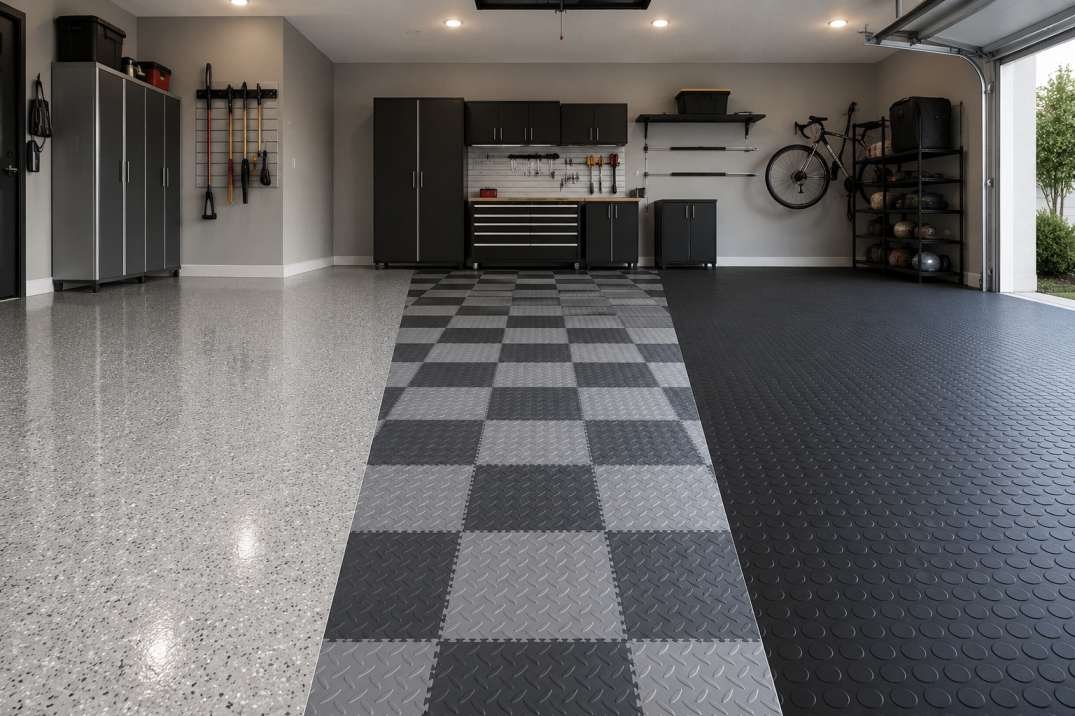
Garage Floor Epoxy vs Tiles vs Rubber Matting — Which Is Best for an Australian Garage?
August 19, 2026
Team
Three options dominate the Australian garage floor market: professional epoxy coating, interlocking or adhesive-set garage tiles, and rubber matting. They occupy very different price points, installation difficulty levels, and performance profiles — and the right choice depends entirely on how your garage is actually used. Every option has its appropriate application. Every option also has conditions where it fails, and understanding those failure modes before you invest is what this guide provides.
Resin Masters installs garage floor epoxy across Brisbane, Gold Coast, Logan, Sunshine Coast, Toowoomba, Ipswich, and Northern NSW. We’re obviously not a neutral party — but we believe the honest comparison between epoxy, tiles, and rubber matting is more useful to you than a biased one. This guide gives you the real performance differences based on Australian climate conditions, vehicle use realities, and 20-year cost comparisons that change the conclusion significantly from the upfront cost numbers alone.
The Three Options — What Each Actually Is
Professional Epoxy Flooring
Professional garage floor epoxy is a multi-layer resin coating system applied over diamond-ground concrete: a 100% solids commercial-grade epoxy base coat that bonds chemically and mechanically to the prepared concrete, sealed with a UV-stable polyaspartic topcoat that provides the surface durability, hot-tyre resistance, and UV stability the coating needs to perform through Australian summers. Resin Masters installs three finish directions: solid colour ($50–$75/m²), seamless flake ($65–$90/m²), and metallic/marble effect ($90–$165/m²). The result is a seamless, non-porous surface from wall to wall, backed by a 7-year warranty.
The critical distinction is between professional-grade 100% solids epoxy and the water-based epoxy products sold through Australian hardware stores. These are not the same product. Water-based epoxy kits produce a thin, permeable film that degrades under vehicle heat and UV exposure within 1–3 years. Professional 100% solids epoxy builds to 2–3mm dense, impermeable film that handles vehicle loads and Australia’s thermal cycling for 12–20 years.
Garage Tiles
Garage tiles fall into two main categories. Ceramic or porcelain tiles: standard building material tiles installed on an adhesive bed over the concrete substrate, with grouted joints. They offer good compressive strength, reasonable appearance, and wide colour availability. The grout joints are the critical limitation — they absorb oil and contamination permanently in vehicle-use environments and crack under vehicle load thermal cycling over years. Polypropylene interlocking tiles: DIY-installable plastic tiles that click together over bare concrete without adhesive. They provide a clean, functional surface at low cost and allow partial replacement of damaged tiles. They have lower compressive strength than ceramic, deform under hot-tyre contact in Queensland summer conditions, and don’t conceal concrete condition or provide chemical resistance.
Rubber Matting
Rubber garage floor matting ranges from thin interlocking rubber tiles to thick rolled rubber flooring. The appeal is immediate: cheap, DIY, no preparation, removable. The limitations specific to Australian vehicle-use garages are significant: rubber softens and deforms under hot-tyre contact conditions in SEQ and Northern NSW’s summer temperatures; petroleum products absorb into rubber compounds over time, permanently staining and degrading the material; and rubber mats trap moisture between the mat and concrete, creating mould conditions and concrete degradation beneath the mat surface.
The Complete Comparison Table — 14 Performance Factors
|
Factor |
Professional Epoxy |
Garage Tiles |
Rubber Matting |
|
Initial cost (double garage ~36m²) |
$1,800–$5,940 installed |
$1,620–$3,420 installed |
$540–$1,800 installed |
|
Installation difficulty |
Professional required |
DIY possible — moderate |
DIY — easy |
|
Surface preparation required |
Diamond grinding — mandatory |
Adhesive bed or floating install |
None — lay on existing concrete |
|
Vehicle load performance |
Excellent — seamless, no joints |
Good — grout can crack over time |
Moderate — mats shift under turning |
|
Oil and chemical resistance |
Excellent — sealed non-porous surface |
Moderate — grout absorbs |
Poor — oil penetrates rubber over time |
|
Hot-tyre resistance |
Excellent (polyaspartic topcoat) |
Excellent — tile doesn’t deform |
Poor — rubber deforms under heat |
|
Slip resistance (wet) |
Excellent — AS 4586 rated |
Variable — polished tile is poor |
Good — textured rubber surface |
|
Moisture from below slab |
Managed with primer selection |
Can lift tiles if severe |
Traps moisture under mat |
|
Maintenance effort |
Low — sweep and mop |
Moderate — grout cleaning |
Low — hose and replace |
|
Longevity (Australian garage) |
12–20 years |
8–15 years (grout) |
3–7 years |
|
7-Year warranty available? |
Yes — Resin Masters |
No — tile warranty only |
No |
|
Stain resistance |
Excellent — wipes clean |
Grout stains permanently |
Oil stains permanently |
|
Visual quality range |
High — flake, metallic, solid |
Moderate — standard tile range |
Basic — functional only |
|
Best for |
Vehicle use garages needing longevity |
Light-traffic or aesthetic applications |
Budget short-term, non-vehicle use |
HOW TO READ THIS TABLE: The epoxy column reflects Resin Masters’ standard specification — 100% solids low-VOC epoxy with UV-stable polyaspartic topcoat. Standard hardware-store water-based epoxy kits would score significantly lower on most factors. The tile column reflects ceramic and porcelain tiles for standard vehicle-use garage conditions. The rubber column reflects standard interlocking or rolled rubber matting under Australian summer vehicle-use conditions.
Where Each Option Wins — Honest Context by Garage Use
Choose Epoxy When: Regular Vehicle Use, Chemical Exposure, Long-Term Investment
Professional epoxy is the correct specification for any garage that sees regular vehicle access, where oil and chemical spills are a realistic occurrence, where the homeowner wants a floor that doesn’t require replacement or significant maintenance within 15 years, and where visual quality is part of the brief. Across Brisbane’s established suburbs, Gold Coast’s prestige estates, Ipswich’s growing Springfield corridor, and Northern NSW’s design-conscious Northern Rivers market, professional epoxy is the specification that homeowners who have previously installed tiles or rubber matting consistently choose on their next property.
Choose Tiles When: Light Traffic, Aesthetic Priority, Budget Constraint
Ceramic or porcelain tile makes sense for garage applications with light, occasional vehicle use where oil exposure is minimal, where the homeowner wants a specific aesthetic (large-format stone-look tile in a prestige garage, for example, where appearance is the overriding brief), or where the project budget makes professional epoxy infeasible and the homeowner accepts the grout maintenance implications. Polypropylene interlocking tiles make sense for covered carports with minimal heat exposure, storage areas, and any non-vehicle-use garage space where a clean, functional surface is needed at minimum cost.
Choose Rubber Matting When: Temporary, Workshop Zones, Non-Vehicle Areas
Rubber matting is appropriate for: workshop standing areas where cushioning underfoot matters for long work sessions; tool storage zones that don’t see vehicle access; temporary solutions while planning a permanent floor; and covered carports in mild climate zones where hot-tyre contact is not a factor. Rubber matting is not appropriate as a vehicle-parking floor solution in any Queensland or Northern NSW garage that experiences summer temperatures — the hot-tyre deformation and moisture trapping problems are predictable within the first 2–3 summers. Get a free Quote!
THE WORKSHOP HYBRID APPROACH: Many active workshop garages benefit from professional epoxy for the full floor, with supplementary rubber anti-fatigue matting in the standing work zones. The epoxy handles vehicle loads, oil spills, and the full-floor maintenance requirement. The rubber mats — positioned over the epoxy in specific work zones — provide standing comfort without the vehicle-contact problems that arise when rubber is used as the primary floor surface. This approach is increasingly common in Resin Masters’ workshop garage installations across Brisbane, Ipswich, and Toowoomba.
The 20-Year Cost Reality — Why the Upfront Comparison Misleads
The upfront cost comparison consistently makes rubber matting appear most cost-effective and professional epoxy appear expensive. The 20-year total cost comparison produces different conclusions.
Rubber matting for a standard double garage (36m²) costs $540–$1,800 upfront. But rubber matting under regular vehicle use in Queensland and Northern NSW requires replacement every 3–7 years as hot-tyre deformation, oil penetration, and UV degradation accumulate. Three replacement cycles over 20 years — each with the same cost and the logistical effort of clearing the garage and laying new mats — totals $1,620–$5,400. And each replacement happens before any improvement in the underlying concrete condition, which has been sealed under moisture-trapping rubber for the entire period.
Ceramic tile installation (double garage) costs $1,620–$3,420 upfront but requires professional re-grouting at approximately Year 8–10 ($800–$1,500) and typically a second re-grouting or significant tile replacement at Year 15 ($1,000–$2,000+). Total 20-year cost: $3,420–$6,920.
Professional solid colour epoxy (double garage) costs $1,800–$2,700 upfront with a 7-year warranty covering any installation-related defect. Maintenance topcoat application at Year 12–15 (if required) costs $400–$900. Total 20-year cost: $1,800–$3,600. For a vehicle-use garage where the floor actually performs under real use conditions, professional epoxy is the lowest 20-year total cost option in most comparison scenarios.
Resin Masters Garage Epoxy — All 7 Locations
Resin Masters installs 100% solids low-VOC commercial-grade garage floor epoxy with UV-stable polyaspartic topcoat across Brisbane, Gold Coast, Logan, Sunshine Coast, Toowoomba, Ipswich, and Northern NSW. Free on-site assessment, 48-hour written quote turnaround, and 7-year warranty on every installation.
|
Brisbane |
Gold Coast |
Logan |
Sunshine Coast |
|
Toowoomba |
Ipswich |
Northern NSW |
Free Quote — 48hr Turnaround |