
“Bobby was super friendly and extremely knowledgable. Amazing with his craft, the end result was fantastic. 100% recommend to anyone.”
James EdwardsGoogle review
School floors take a beating that most commercial floors never see: hundreds of students a day, mopped toilets, spilled paint, canteen grease, lab chemicals and wet shoes coming in from the oval. Resin Masters installs seamless epoxy floors in the parts of a school where those problems are worst, for schools across Brisbane, the Gold Coast, Logan and Ipswich.


Is epoxy flooring a good choice for schools? Yes, for wet, messy and hard-wearing areas: canteens, toilets and change rooms, science labs, art rooms, workshops, cleaners’ rooms and covered walkways. It is seamless, easy to clean, resists chemicals and can be made slip-resistant with aggregate in the topcoat. It is usually not the best choice for general classrooms and libraries, where vinyl or carpet tiles are quieter and softer underfoot. We’ll tell you which rooms are worth coating and which aren’t.

Most schools don’t need one floor everywhere. The table below is how we approach a site walk-through.
| Area | Does epoxy suit it? | Why | What we’d usually specify |
|---|---|---|---|
| Canteen and tuckshop kitchen | Yes | Grease, hot water and daily wash-downs; grout lines trap food | Solid colour epoxy, integral coving at the walls, anti-slip topcoat |
| Student and staff toilets, change rooms | Yes | Constant mopping, urine, water; tiles and grout stain and smell | Seamless solid colour, coved edges, slip-resistant finish |
| Science labs and prep rooms | Yes | Chemical spills and stains | Chemical-resistant system matched to the chemicals used |
| Art, ceramics and design rooms | Yes | Paint, clay, glue, water | Solid colour or flake, easy-clean topcoat |
| D&T, ag and hospitality workshops | Yes | Oil, tools, trolleys, dropped materials | Heavy-duty system, see our workshop flooring page |
| Cleaners’ rooms, stores, plant rooms | Yes | Chemicals, water, trolleys | Solid colour, coved where there’s a floor drain |
| Covered outdoor learning areas (COLAs), walkways, undercover eating areas | Often | Wet shoes, sun, heavy foot traffic | Flake epoxy with a UV-stable topcoat and aggregate |
| General classrooms, libraries, offices | Usually not | Noise and comfort matter more; carpet tiles and vinyl absorb sound | We’ll say so and leave these to a vinyl or carpet installer |
| Under play equipment | No | Fall zones need impact-absorbing surfaces | Rubber softfall or other fall-rated surfacing |
A canteen floor gets mopped with hot water and detergent every day, and food and grease collect in tile grout faster than anywhere else in the school. We install canteen floors as a commercial kitchen system: the slab is diamond ground, defects are repaired, and the epoxy is run up the wall as an integral cove, so there’s no gap between floor and wall for water and food to sit in. The topcoat gets an anti-slip aggregate where staff work at sinks and benches.
Our standard commercial kitchen system is published at $70–$95 per m², and high-spec chemical-resistant kitchens at $90–$120 per m². More detail on coving and food-safety rules is in our guide to food-safe commercial kitchen flooring with epoxy coving.
Tiled school toilets are hard to keep clean: grout absorbs urine and water, cracked tiles hold dirt, and the smell lingers no matter how often cleaners mop. A seamless epoxy floor with coved edges gives cleaners one continuous surface to wash, with nothing for moisture to soak into.
These rooms need a floor that won’t stain or soften when something spills. “Chemical resistant” means different things for different chemicals, so we ask the school which acids, solvents, dyes and cleaners are used in each room and match the system to that list rather than relying on a generic claim. See our guide to chemical-resistant floor coatings for how systems differ.
Art and ceramics rooms mostly need a floor that sheds paint, clay and glue and survives scrubbing. Design and technology, agriculture and hospitality workshops are closer to a commercial workshop: oil, dropped tools and trolleys. For those we use the heavier systems described on our workshop epoxy flooring page.

Covered outdoor learning areas and walkways take wet shoes, leaf litter and some direct sun. A flake epoxy system with aggregate in the topcoat gives grip when wet and hides dirt between cleans, and the topcoat needs to be UV-stable where sun reaches the slab, because standard epoxy can yellow outdoors.
Epoxy is not a fall-zone surface. Areas under play equipment need impact-absorbing surfacing such as rubber softfall, which is a different trade.
In Australia, the slip resistance of new floor surfaces is classified under AS 4586. You’ll see three kinds of result:
The rating a particular area needs depends on how it’s used, and your architect, building certifier or WHS adviser should confirm it for each zone. Standards Australia’s handbook SA HB 198 gives guidance on recommended ratings by location.
What we do: choose the aggregate and topcoat to suit the area (fine polymer beads, aluminium oxide or quartz, depending on the grip needed and how easy the floor has to be to clean), and arrange independent AS 4586 testing where the project needs a documented result. More detail in our guide to choosing slip-resistant epoxy.
Most school floors are done when students aren’t there. Here’s how a typical job is planned:
Our guide to epoxy flooring downtime goes through staging in more detail.
These are Resin Masters’ published 2026 ranges, GST included. Your quote depends on the slab, the access and the system each room needs.
| System | Typical price per m² |
|---|---|
| Solid colour epoxy (stores, art rooms, corridors to wet areas) | $50–$90 |
| Decorative flake epoxy (COLAs, walkways, foyers) | $60–$110 |
| Commercial kitchen / canteen system with coving | $70–$95 (high-spec $90–$120) |
| Commercial toilets and change rooms | $90–$140 |
| Crack and defect repair | add $5–$20 |
| Moisture barrier, where testing shows it’s needed | add $3–$8 |
What changes the price: the condition of the slab or existing tiles, how much coving is needed, whether a moisture barrier is required, chemical-resistance requirements in labs, fast-cure systems, and whether the work has to be done after hours. See our epoxy flooring cost guide for more on each factor.
We’re based in Pimpama and work across South East Queensland:
Looking after an early learning centre or kindy as well? See our childcare centre epoxy flooring page.
Press play to hear customers talk about their new floors, or read what customers are saying about Resin Masters on Google.
White-base flake garage. Our standard flake system over a crisp white base, with a polyaspartic topcoat. The customer does the talking.
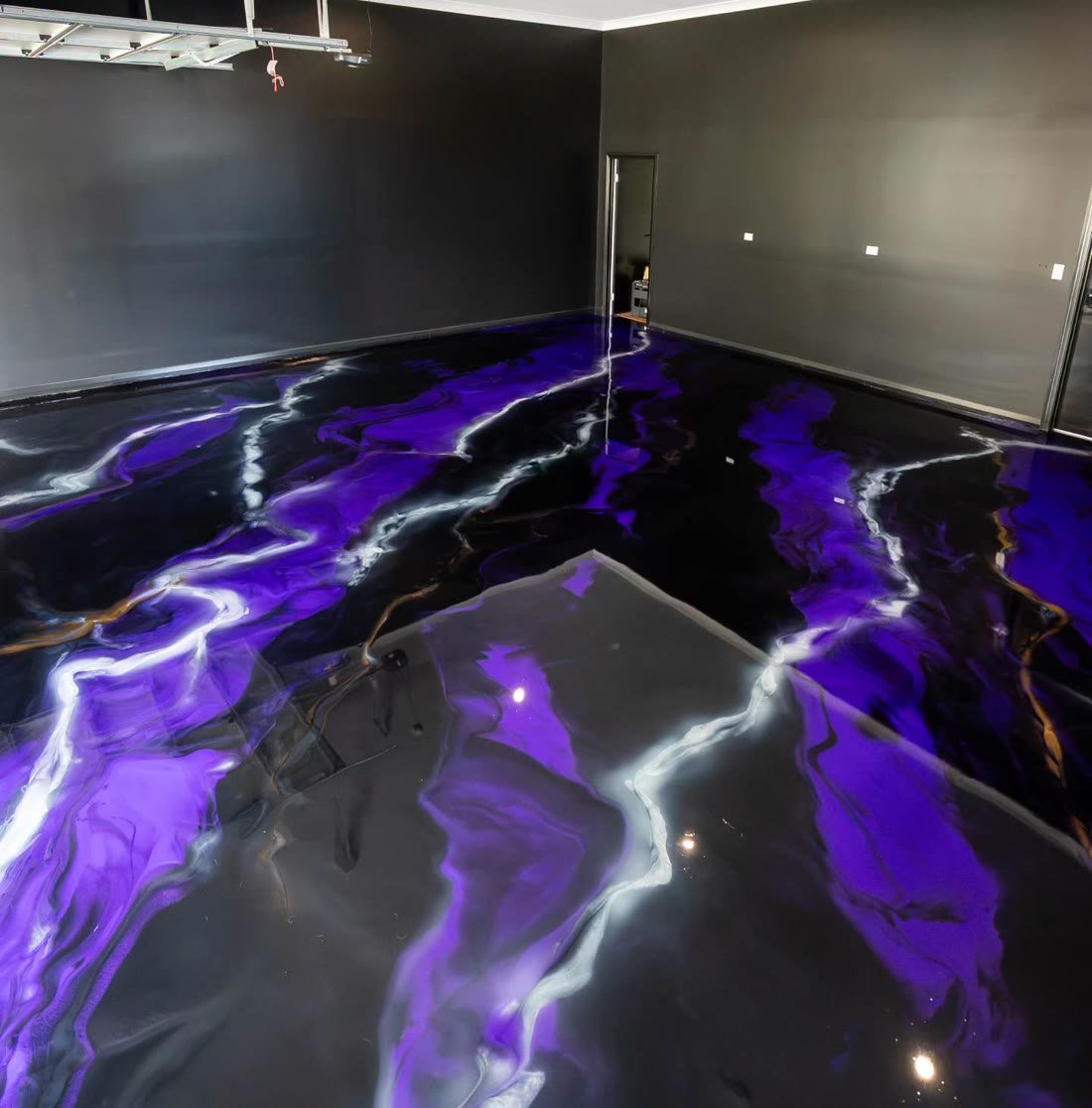
Black and purple metallic. A glossy metallic floor in black and purple, with white veins and a touch of gold. Hear it from the customer.
“Bobby has done an exceptional job for our warehouse here on the Gold Coast. Very clean, and tidy finishing, would not fault!”
Want a floor like these? Send us a photo of the space and we’ll quote it for free.
Get a free quote“Bobby was super friendly and extremely knowledgable. Amazing with his craft, the end result was fantastic. 100% recommend to anyone.”
“Got our outdoor patio sorted before the weekend. The boys were super punctual, easy to deal with, and handled the whole job here in Yarrabilba with zero hassle. Our flake floor looks so amazing. Cheers and Thank you Resin Masters.”
“Had the Resin Masters team out to do my garage floor in Ormeau last week. The old concrete was constantly dusty and had a couple of nasty cracks in it. The boys ground it all back, patched up the cracks, and laid down the full flake epoxy. Honestly looks insane, like a proper showroom. No more dust tracking into the house. Highly recommend these guys if you want a quality finish.”
Rating and reviews from our Google Business Profile.
There isn’t one floor for a whole school. Carpet tiles and vinyl suit classrooms and libraries because they’re quieter. Seamless epoxy suits canteens, toilets, labs, art rooms, workshops and covered walkways, where hygiene, spills and wet shoes matter most.
Pros: very hard-wearing, easy to clean, and no seams for dirt to collect. Cons: it’s harder and noisier underfoot than carpet or vinyl, so it isn’t usually our recommendation for general classrooms unless the room is used for messy activities.
Most school jobs are planned for when students aren’t on site. Larger areas are split into zones so each part of the building can be handed back as it’s finished.
About 24 hours for foot traffic on a standard system, or 4–6 hours with a fast-cure polyaspartic system. Allow 7 days for full chemical cure before heavy cleaning.
Yes. Once fully cured, epoxy is inert. During installation and curing the rooms are kept closed. We use low-VOC to near-zero-VOC products and can supply safety data sheets.
Often, if the tiles are well bonded. We grind them, fill the grout lines and coat over the top, adding roughly 5–8 mm. Loose or hollow-sounding tiles need to be removed first.
A written 7-year workmanship warranty on the floors we install.
Tell us which areas you’re looking at and when the building is free. We’ll inspect the site, test the slab and send an itemised quote by room.
Other floors we lay for the same kind of space.
Snap the space as it is now, tell us roughly how big it is, and we’ll come back with a free quote.
Turn plain concrete into a luxury floor.