Servicing : Gold CoastBrisbaneSunshine CoastToowoomba

Menu
Epoxy Floor Tiles vs Poured Epoxy Flooring
October 9, 2026
Team
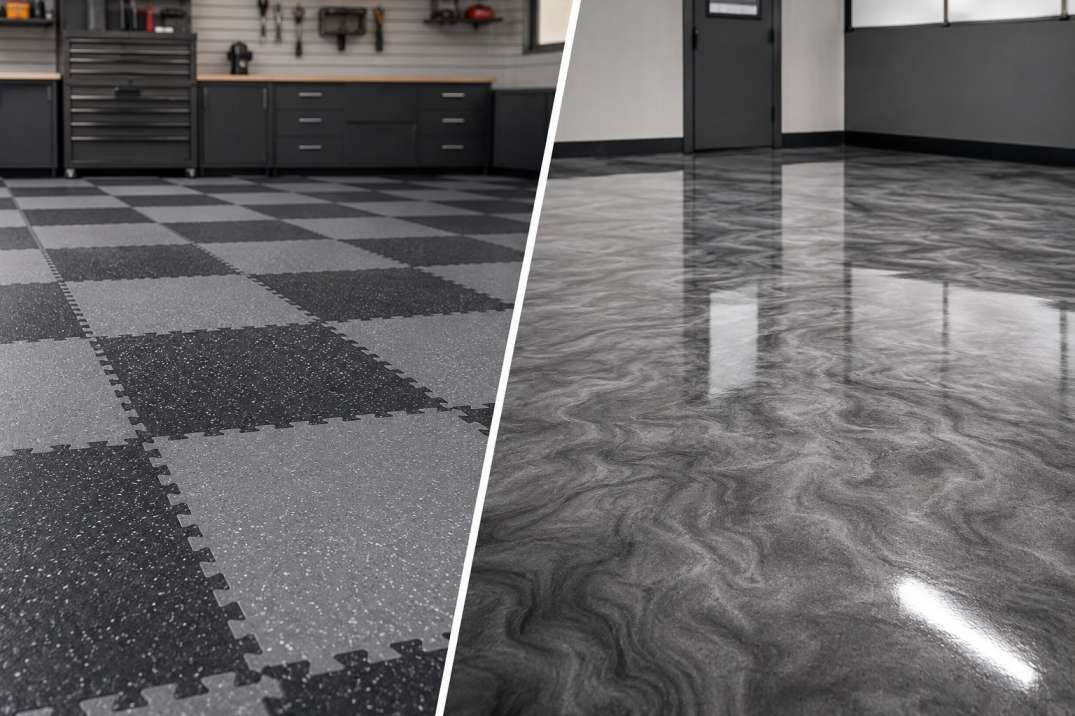
Epoxy floor tiles is a loose term. Most people mean interlocking garage tiles, which are plastic and contain no epoxy, or ceramic tiles they’d like to coat. Poured epoxy is different: a liquid resin that cures into one bonded layer on concrete. Tiles are quick and portable. Poured epoxy is permanent and joint-free.
We read five Australian guides on this and none described a mainstream product actually sold as an epoxy floor tile. That’s worth knowing before you compare prices, because you may be comparing two unlike things.
What do people mean by epoxy floor tiles?
The phrase usually points at one of two things. The first is modular interlocking tiles that snap together over concrete. The second is an existing tiled floor that someone wants to coat. Neither is an epoxy tile in the strict sense. Poured epoxy is the resin system laid wet onto ground concrete.
Sleek Space describes its interlocking garage tiles as modular polypropylene units, 400 by 400 mm, that click together without adhesive. Flexspec’s range uses polypropylene or flexible PVC. That’s plastic, not resin.
Coating over existing tiles is a separate question, and it turns on tile condition and adhesion. Resin Masters checks adhesion before agreeing to coat, and hollow or loose tiles must come out first.
How do poured epoxy and interlocking tiles differ?
Poured epoxy is a multi-layer coating bonded to ground concrete with no joints. Interlocking tiles sit loose on top of the slab and rely on their edges to lock together. Tiles install in hours and can be lifted and moved. Poured epoxy takes days and can’t be moved.
Factor | Poured epoxy | Interlocking tiles |
|---|---|---|
Material | Two-part epoxy resin with a polyaspartic topcoat | Polypropylene or PVC modules |
Fixing | Bonded to diamond-ground concrete | Click together; loose-laid |
Joints | None | Every tile edge; seams can trap dirt and water |
Install | 2 to 4 days at Resin Masters | Hours, usually DIY |
Slab prep | Grind, repair cracks, moisture test, primer | Minimal; tiles can hide slab damage |
Portability | Fixed for life | Lift and take with you |
Warranty | Written 7-year workmanship warranty at Resin Masters | Product warranty from the maker |
What does each cost for a double garage?
Poured epoxy and interlocking tiles overlap on price. Resin Masters publishes solid colour at $50 to $90 per m2 and flake at $60 to $110 per m2, GST included. One Australian guide puts interlocking tiles at $45 to $90 per m2. Prices only mean something on the same area and the same scope.
Option | Per m2 | 36 m2 garage | Source |
|---|---|---|---|
Poured solid colour | $50 to $90 | $1,800 to $3,240 | Resin Masters |
Poured decorative flake | $60 to $110 | $2,160 to $3,960 | Resin Masters |
Poured metallic or custom quartz | $100 to $160+ | $3,600 to $5,760+ | Resin Masters |
Interlocking tiles (supply) | $45 to $90 | $1,620 to $3,240 | Door Supply guide |
The tile figure comes from a Door Supply garage flooring guide, which doesn’t say whether it includes installation. Sleek Space quotes about $1,800 for tiles on a 6 by 6 m garage. Extras on the poured side: crack repair $5 to $20 per m2 on heavily damaged slabs and a moisture barrier at $3 to $8 per m2. See epoxy flooring cost.
How long does each take to install and use?
Interlocking tiles can go down in hours because there’s nothing to cure. Sleek Space puts a double garage at 4 to 6 hours for a DIY job. Poured epoxy at Resin Masters takes 2 to 4 days, is walkable within 24 hours, takes cars at 48 to 72 hours and fully cures at 7 days.
That gap is the honest advantage of tiles. If you need the garage back tonight, tiles win. If you can wait a few days, the cure time buys you a bonded floor.
Which handles heat, oil and hot tyres better?
Poured epoxy under a polyaspartic topcoat is sealed against oil and built for heat, while tiles vary by product. Resin Masters’ own garage comparison says polypropylene tiles can deform under hot tyres in summer. A tile supplier lists a tolerance of 120 degrees Celsius. Read the data sheet, not the sales page.
Both claims come from sellers, so neither settles it. Ask the tile maker for the temperature rating and whether it covers a hot tyre parked on one spot. For the full three-way garage comparison, see garage floor epoxy vs tiles vs rubber matting.
What about cracked, uneven or damp slabs?
Tiles hide a damaged slab. Poured epoxy needs it repaired first. That’s a real advantage for tiles on an old, cracked floor. It also hides problems, and a moisture issue doesn’t vanish because tiles sit on top. Test the slab either way before you choose.
A solid colour epoxy gloss shows every slab flaw, which is why prep matters. Flake systems hide more. Read how to prepare concrete for epoxy and when a moisture barrier is needed before you commit.
When do tiles win?
Tiles win when the floor has to be quick, cheap to start, movable or temporary. Renters, short-term owners and anyone who wants to replace a single damaged square will prefer them. They also suit spaces where you can’t tolerate cure time or the smell of a wet job.
- You rent and can’t fix a coating to the slab.
- The slab is cracked and you don’t want to repair it.
- You want to lift the floor and take it to your next place.
- The garage is needed the same day.
When does poured epoxy win?
Poured epoxy wins when you want a joint-free floor that lasts and you plan to stay. It bonds to the slab, wipes clean and comes with a written warranty. The build is 2 to 3 mm on residential systems, and joints don’t collect dirt or water. You pay for preparation once.
Our solid colour epoxy page sets out the system layers, and epoxy floor thickness explains what 2 to 3 mm means in practice. A free on-site quote will tell you what your slab needs.
Who is this comparison not for?
This isn’t for anyone wanting ceramic tile advice, or a guide to coating over existing tiles. It also isn’t for renters with a landlord who won’t allow bonded coatings. If you can’t test the slab or repair cracks, tiles are the easier route.
- Owners choosing between ceramic tile and epoxy for a home.
- People who want to keep their existing tiles and coat them.
- Workplaces that need a specialist floor, such as anti-static.
Resin Masters’ site describes poured systems only. It doesn’t list tile products.
Frequently asked questions
What are epoxy floor tiles?
There’s no single product by that name in the Australian guides we read. People use the phrase for interlocking plastic tiles, which contain no epoxy, or for coating existing tiles. Poured epoxy is the resin system applied wet to concrete. Check exactly what a supplier is selling before you buy.
Are interlocking garage tiles cheaper than epoxy?
Sometimes, but not always. One Australian guide puts interlocking tiles at $45 to $90 per m2. Resin Masters publishes poured solid colour at $50 to $90 per m2 and flake at $60 to $110 per m2, GST included. Compare the same area and scope.
Can I lay epoxy tiles over a cracked concrete slab?
Interlocking tiles can hide cracks because they sit above the slab. Poured epoxy needs cracks repaired first, which Resin Masters prices at $5 to $20 per m2 on heavily damaged slabs. Either way, check for moisture, since loose-laid tiles don’t cure a damp slab.
Do garage floor tiles handle hot car tyres?
It depends on the product. Resin Masters’ garage comparison says polypropylene tiles can deform under summer tyre heat, while one supplier lists tolerance to 120 degrees Celsius. Ask the maker for the data sheet and check whether the rating covers a parked hot tyre.
Can I move an epoxy floor if I sell the house?
No. Poured epoxy bonds to the slab and stays with the property, so you can’t take it with you. Interlocking tiles can be lifted and moved, which suits renters and people who move often. Weigh that before choosing.
Also Read:- Epoxy vs Vinyl Flooring for Shops, Gyms and Offices