Servicing : Gold CoastBrisbaneSunshine CoastToowoomba

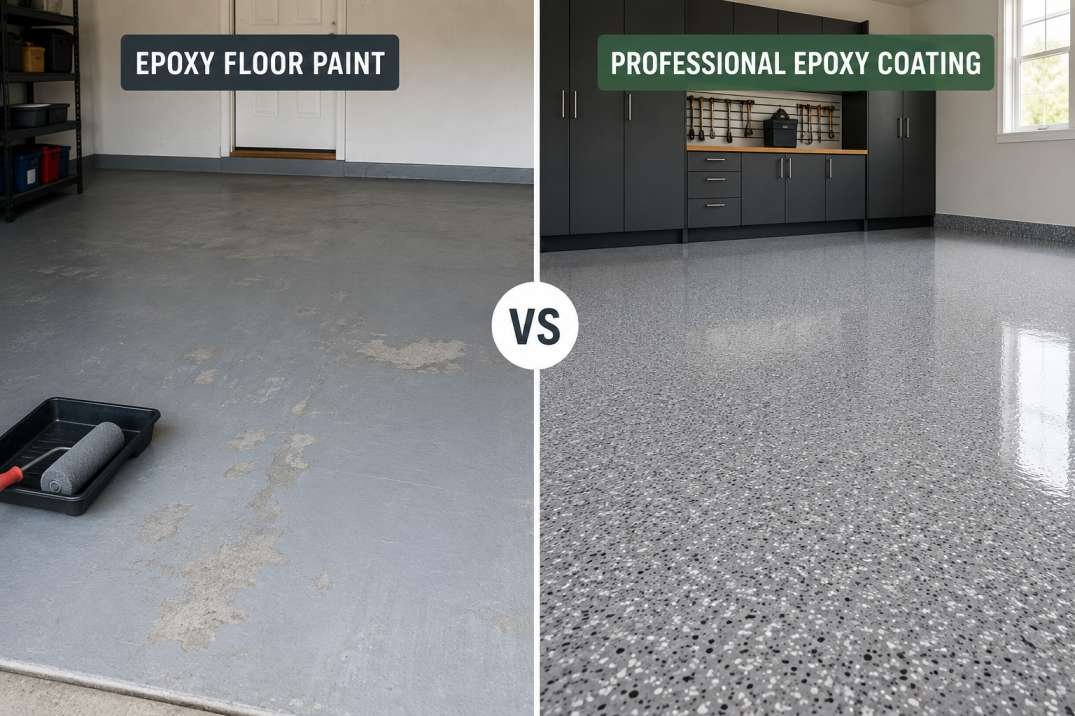
Epoxy Floor Paint vs Professional Epoxy Coating: What Is the Difference?
Epoxy floor paint is a thin, roll-on film that sits on top of concrete, usually sold as a one- or two-part product for DIY use. A professional epoxy coating is a thicker two-part resin system applied over a ground slab. Paint costs less and suits light use. A coating costs more and lasts longer under cars, chemicals and wear.
Choose paint if the floor sees foot traffic only, the slab is dry and you’re happy to recoat it. Choose a professional coating if a car will park on it, you want a warranty, or you don’t want to redo it in a few years.
What is the difference between epoxy floor paint and epoxy coating?
The main differences are film thickness, preparation and bond. Epoxy floor paint is a thin film applied after cleaning and acid etching. A professional epoxy coating is built in layers over a diamond-ground slab and bonds into the concrete surface. The coating is thicker, tougher and priced accordingly.
| Feature | Epoxy floor paint | Professional epoxy coating |
|---|---|---|
| What it is | Thin film, often one-part or lightly modified epoxy | Two-part resin system built in layers |
| Surface preparation | Clean, degrease and acid etch | Diamond grinding, crack repair, moisture test |
| Thickness | Thin film (check the tin for coverage per litre) | 2 to 3 mm total build (100% solids epoxy) |
| Hot tyre resistance | Often poor; can lift | Designed for vehicle traffic |
| UV stability | Depends on the product | UV-stable topcoat available |
| Warranty | Product only, if any | Resin Masters: written 7-year workmanship warranty |
| Upfront cost | Lower; the cost of the product and your time | Resin Masters solid colour: $50 to $90 per m2 installed |
| Best for | Storage rooms, sheds without vehicles, short-term fixes | Garages, homes, workshops, commercial floors |
Why does epoxy floor paint fail on garage floors?
Epoxy floor paint fails in garages mainly because the film is thin and the surface preparation is shallow. Hot tyres soften and pull the film off the slab, and moisture rising through the concrete lifts it from below. Acid etching can also leave a weaker bond than grinding, so the coating peels in patches.
- Hot tyre pickup. After a drive, tyres are hot and soft. The tyre grips the film, then cools and pulls a piece off when the car moves.
- Moisture from the slab. Concrete breathes. Vapour pushing up under a thin film shows as bubbles, then flakes.
- Shallow preparation. Etching cleans but doesn’t open the slab the way grinding does, so the bond depends on a thin surface layer.
- Heat and sun. In a Queensland summer a garage with the door open gets hot and bright. Products not made for it can go soft, chalk or yellow.
Is “epoxy paint” actually epoxy?
Sometimes, but not always in the way you’d expect. Labels such as “epoxy paint” or “epoxy-modified” can describe a water-based, one-part product with only a little epoxy in it. A true epoxy coating comes as two parts, a resin and a hardener, that you mix. Check the technical data sheet before you buy.
Three things to look for on any tin: whether it’s two-part or one-part, whether it says suitable for vehicle traffic, and what the recommended surface preparation is. If it says “not for vehicles” or “acid etch only”, you know what you’re buying.
When is epoxy floor paint the right choice?
Paint is the right choice for a dry, low-traffic floor where you accept that you’ll recoat it. Think laundry storage, a tool shed with no vehicles, or a floor you plan to replace soon. It’s also a reasonable trial run if you want to test a colour before committing to a full system.
We’d rather tell you that than sell you a coating you don’t need. A professional system solves problems that a storeroom doesn’t have.
When should you choose a professional epoxy coating?
Choose a professional coating when the floor carries vehicles, when the slab has cracks or old coatings, or when you want a warranty. It also makes sense if you plan to stay in the property for years, since one properly prepared coat usually costs less over time than repeated recoating.
- Cars or utes park on the floor daily.
- The slab has cracks, oil stains, an old coating or a history of damp.
- You want a written warranty from a licensed installer.
- The floor is part of the home’s look, for example an open-plan or garage-as-showroom space.
For what the job involves, see our garage floor epoxy guide. For prices, start with epoxy flooring cost. Resin Masters’ published range for solid colour epoxy is $50 to $90 per m2 installed.
How do you tell which one you need?
Ask four questions: will a vehicle drive on it, is the slab dry, how long do you want it to last, and do you need a warranty? If the answer to the first is yes, or you want more than a few years, go professional. If not, paint can be enough.
If you decide to do it yourself anyway, preparation is where most DIY jobs are won or lost. Read how to prepare concrete for epoxy first.
Who is this comparison not for?
This post isn’t a DIY how-to, and it isn’t for people whose slab is wet. A damp slab defeats both products, and neither paint nor a coating will fix it. If you have visible moisture, get the slab assessed before you buy anything.
It also won’t help if you’re choosing between epoxy and a completely different floor, such as tiles or timber.
Frequently asked questions
Is epoxy floor paint the same as epoxy floor coating?
No. Paint is a thin film, often one-part, and sits on the surface. A professional coating is a two-part resin system, usually built in layers over a ground slab. The coating is thicker, bonds more strongly and is designed for wear.
Can I put epoxy paint over an old epoxy floor?
Sometimes, but the old surface must be sound, clean and lightly abraded. If the old coating is peeling, it has to come off first. Coating over a failing layer only hides the problem for a short time.
How long does epoxy floor paint last in a garage?
Not long under cars. Hot tyres, moisture and shallow preparation shorten its life, and results vary widely by product and slab. Resin Masters’ professional systems carry a written 7-year workmanship warranty. Ask any supplier for written terms.
Which is cheaper, epoxy paint or a professional coating?
Paint is cheaper upfront. A professional coating costs more per square metre but includes preparation, materials and labour, and usually lasts longer. Compare the total cost over the years you plan to own the floor, not only the first bill.
Do I need to grind the concrete for epoxy?
For a professional system, yes. Grinding removes the weak surface skin and gives the coating a rough profile to grip. Acid etching is common in DIY kits, but it is less reliable, particularly under vehicle traffic.