Servicing : Gold CoastBrisbaneSunshine CoastToowoomba

Menu
Concrete Sealing vs Epoxy Coating in Queensland
October 5, 2026
Team
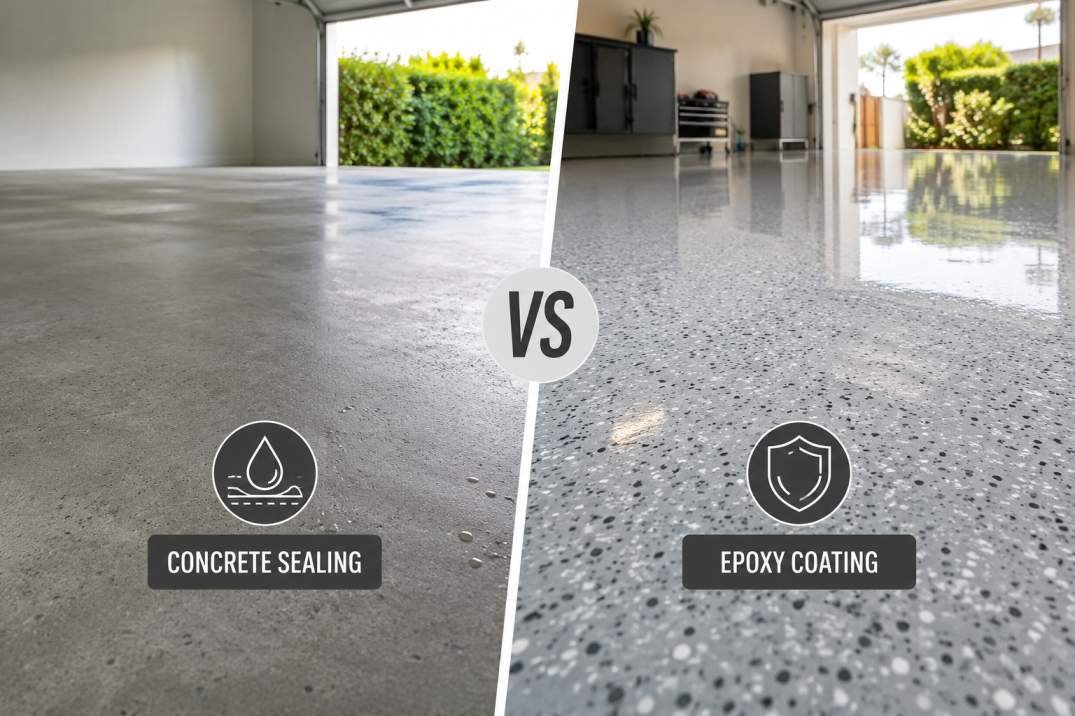
Concrete sealing costs less upfront and suits low-traffic slabs, but it only protects the concrete and needs redoing. Epoxy coating costs more, lasts longer and copes with oil, hot tyres and regular cleaning. Sources quote sealers at roughly $20 to $35 per m2 and Resin Masters’ epoxy at $50 to $110 per m2.
Pick wrong and you pay twice. A sealed garage that starts marking under the car still has to be ground back before epoxy goes on. A coated shed that never needed it just cost more than it had to.
What does concrete sealing actually do?
A sealer reduces how much liquid the concrete soaks up. Penetrating sealers soak in and react below the surface. Topical sealers form a film on top. Neither adds colour or thickness the way epoxy does, so the slab still looks and wears like concrete, just better protected.
Coatpro’s Brisbane sealer guide says penetrating sealers reach about 3 to 5 mm into the concrete and keep its natural texture. Topical films sit on top and depend on that film staying intact. That difference drives most of the cost and lifespan gaps below.
How much does sealing cost compared with epoxy?
Sealing runs about $20 to $35 per m2 across the sources below, while grinding and sealing costs more. Resin Masters’ published epoxy rates are $50 to $90 per m2 for solid colour and $60 to $110 per m2 for decorative flake. Your slab’s condition decides where in those ranges you land.
Option | Typical cost per m2 | Typical life | Where it fits |
|---|---|---|---|
Penetrating sealer | $25 to $30 (Coatpro) | 5 to 10 years (Coatpro) | Low-traffic slabs where the natural look matters |
Topical acrylic sealer | $25 to $30 (Coatpro) | 2 to 5 years (Coatpro) | Cheap, short-term protection |
Sealer, per Resin Masters guide | $20 to $35 | 3 to 5 years | Storage areas, tight budgets |
Professional sealing, or grind and seal | $50 to $75, or $80 to $110 (Haynes, Victoria, incl. GST) | Not stated | Interior slabs that are already sound |
Epoxy: solid colour or flake | $50 to $90 or $60 to $110 (Resin Masters, incl. GST) | 10 to 20 years with good preparation, plus a 7-year workmanship warranty | Garages, workshops, wet or busy floors |
Prices vary by site. The epoxy flooring cost page shows what shifts a quote, and the Victorian figure is included only as a guide to how much grinding adds.
How long does each option last in Queensland?
Sealers last roughly 2 to 10 years depending on type and traffic, and a well-prepared epoxy floor lasts 10 to 20 years by Resin Masters’ guides. Sources disagree, and no independent Queensland test data turned up, so treat every number as a range and ask for warranty terms in writing.
- Penetrating sealer: Coatpro says 5 to 10 years before reapplication.
- Topical sealer: Coatpro says 2 to 5 years. Resin Masters‘ Northern NSW guide says 3 to 5 years for sealers generally.
- Epoxy: Resin Masters’ regional guides quote 10 to 20 years for a properly prepared floor, backed by a written 7-year workmanship warranty.
Heat, sun and heavy use shorten all of them. The NSW guide argues coastal humidity means frequent resealing, and it sets out the cycle costs in epoxy vs concrete sealer for Northern NSW homes.
Which handles Queensland moisture better?
Neither wins outright. Coatpro says penetrating sealers stay breathable. Epoxy forms a barrier, so moisture rising through the slab can lift it. Resin Masters tests moisture first and adds a moisture barrier where needed, at $3 to $8 per m2.
Coatpro says topical films block water from the concrete, while penetrating types stay breathable. Haynes also says sealing needs proper moisture testing. Our guide to testing concrete moisture before epoxy covers the checks that matter for either choice.
Which is safer underfoot when wet?
Both can be slippery if chosen for looks alone. Coatpro warns that smooth topical films can become slippery when wet, and glossy epoxy has the same weakness. Epoxy can take anti-slip aggregate, and Resin Masters specifies AS 4586-rated aggregate for wet areas, so ask what rating your floor will have.
Penetrating sealers keep the slab’s natural texture, which helps outdoors. For a garage or wet room, read our guide on whether epoxy floors are slippery before you decide.
Can you epoxy over a sealed slab later?
Yes, but the sealer has to come off first. Resin Masters says previously sealed concrete needs diamond grinding to remove the sealer and profile the surface for bonding. That means the money spent on sealing gives no credit against the epoxy, and preparation is the same as for bare concrete.
Sealing first is fine if you might epoxy in a few years. Just don’t expect it to shorten the job. The steps are in our guide to preparing concrete for epoxy.
When is sealing the smarter choice?
Sealing is smarter when the slab gets light use, the budget is tight or you plan to sell soon. Resin Masters’ own Northern NSW guide lists the same cases. A sealed floor still looks like concrete, and for a storage shed or a natural-look interior that may be exactly what you want.
- A low-traffic storage area with little exposure to oil or chemicals.
- A hard budget limit where any upfront saving matters.
- A short ownership horizon of a few years.
- A slab where you want to keep the exposed concrete look.
When is epoxy worth the extra money?
Epoxy is worth it when vehicles park on the slab, when spills and stains are routine, or when appearance and easy cleaning matter. You pay more once and reseal less. For a garage that’s used daily, the extra cost usually buys back time, marks and repairs.
Our post on whether garage epoxy is worth it works through that decision for a home garage. Extras vary by slab. Resin Masters lists crack and defect repair at $5 to $20 per m2 for heavily damaged slabs. Old coating removal is assessed at quote.
Who is this comparison not for?
This comparison won’t suit anyone who needs a sealing contractor, a pool-surround specification or a compliance ruling for a commercial floor. The figures are ranges from published pages, not quotes. A damp or cracking slab needs sorting before any option.
- Owners of active damp slabs, who need the moisture source found first.
- Buyers wanting a sealer-only quote, who should ask a sealing contractor.
- Commercial sites with slip or hygiene requirements, who should ask for rating documents.
If epoxy sounds right, a free, no-obligation on-site quote will show what your slab needs. Contact Us Now!
Frequently asked questions
How often does concrete need resealing in Queensland?
It depends on the sealer and traffic. Coatpro says topical sealers need reapplying every 2 to 5 years and penetrating sealers every 5 to 10. Resin Masters’ Northern NSW guide says 3 to 5 years. Check the product data sheet for the sealer you’re offered.
Is a sealer cheaper than epoxy over 15 years?
Not always. Resin Masters’ Northern NSW guide argues that three or four resealing cycles can approach the upfront cost of epoxy. That’s the site’s own estimate, so ask for quotes for both options on your slab and add up the cycles yourself.
Does sealing stop moisture coming through concrete?
It depends on the type. Coatpro says topical films block water while penetrating sealers stay breathable, so a sealer won’t fix a wet slab. If you see damp, find the source and test moisture before choosing any coating.
Can I seal concrete myself?
Yes, DIY sealing is common, and Haynes even prices a DIY job in Victoria. Preparation still matters, and Haynes says moisture should be tested first. Read the product data sheet for coverage, weather limits and cure times, then follow it exactly.
Is epoxy really better than sealer for a garage?
For a garage with daily parking, usually yes. Epoxy resists oil, cleaning and hot tyres better and lasts longer, though it costs more and needs moisture testing. A sealer suits light use or a short ownership window. Compare written quotes before deciding.
Also Read:- How Thick Should an Epoxy Floor Coating Be?