Servicing : Gold CoastBrisbaneSunshine CoastToowoomba

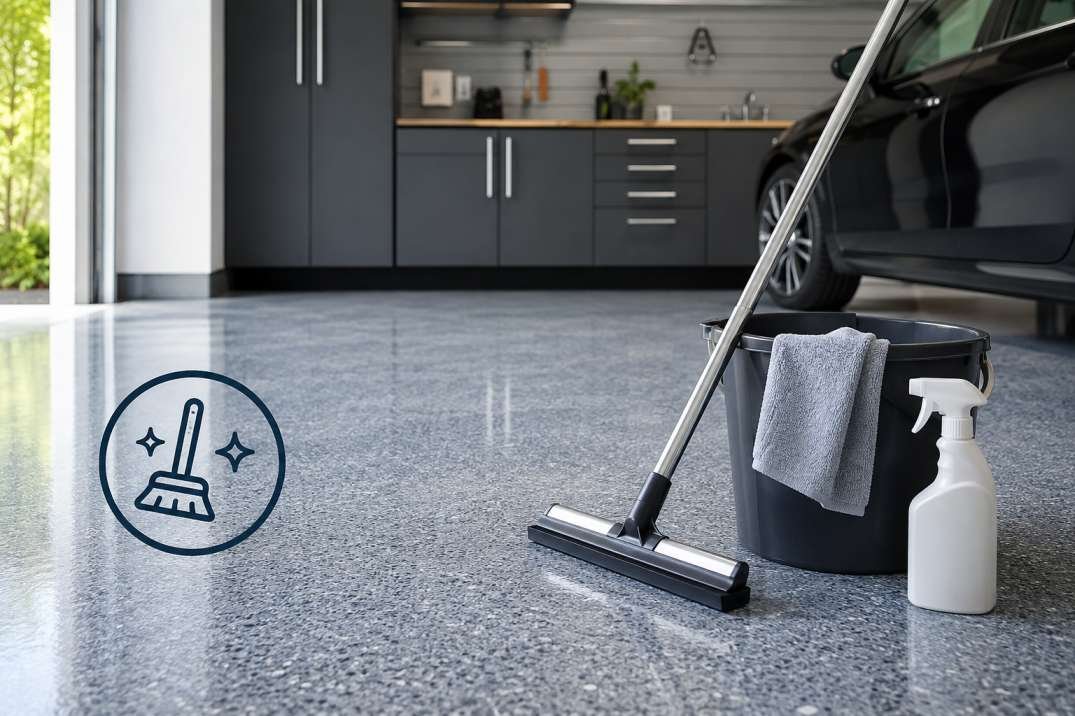
How to Clean and Maintain Your Garage Epoxy Floor — The Complete Guide
One of the most common questions Resin Masters receives from clients across Brisbane, Gold Coast, Logan, Sunshine Coast, Toowoomba, Ipswich, and Northern NSW is: how do I look after my new epoxy garage floor? The honest answer is that a correctly specified and installed Resin Masters epoxy floor needs less maintenance than almost any other garage flooring option — no re-sealing, no grout scrubbing, no periodic professional treatment. But the maintenance it does need matters. Using the wrong cleaner, ignoring grit accumulation, or leaving oil spills to sit can progressively degrade a floor that would otherwise perform flawlessly for 15–20 years.
This guide covers every aspect of garage epoxy floor maintenance in practical terms: the right cleaning products and tools, how often to clean, how to handle oil spills and tough stains, whether you can pressure wash, how to restore a dull floor, and when to call Resin Masters for professional maintenance. We also explain what not to do — because the most common maintenance mistakes are the things that homeowners assume are safe but progressively damage the polyaspartic topcoat that protects the floor.
Why Epoxy Garage Floor Maintenance Is Simpler Than You Think
A bare concrete garage floor requires no maintenance because there’s nothing to maintain — but it stains permanently, creates dust, and absorbs every spill. A grouted tile garage floor requires periodic re-grouting, grout sealing, and professional deep cleaning to address the bacterial growth and oil accumulation that every grout joint develops over years of vehicle use.
A correctly installed Resin Masters epoxy garage floor — 100% solids epoxy base with UV-stable polyaspartic topcoat — is genuinely easy to maintain because of its fundamental material properties. The seamless, non-porous surface means no grout joints to harbour contamination. The non-porous film means oil and chemical spills sit on the surface rather than penetrating — they’re easy to wipe away before absorption occurs. The UV-stable polyaspartic topcoat doesn’t require periodic re-application to maintain UV stability — it remains stable under Australian conditions for the full warranty period and beyond. The result is a floor that needs a sweep and a mop to stay clean — not a maintenance programme.
The maintenance practices in this guide are what Resin Masters provides in written form at every installation handover. They’re specific to our polyaspartic topcoat chemistry and to the conditions Australian garage floors face across our 7 service locations. Following this guide maintains your floor across the full 7-year warranty period — and well beyond.
The Maintenance Schedule — Frequency by Garage Use Pattern
|
Frequency |
Task |
Method & Notes |
|
Weekly |
Dry sweep or blow out |
Push broom or leaf blower — remove grit, debris, and loose material from vehicle contact zones near roller door. Most important single maintenance task — grit driven under tyres creates micro-abrasion on topcoat. |
|
Fortnightly |
Damp mop — standard use |
Microfibre flat mop + pH-neutral floor cleaner diluted in water (1:20–1:50). Rinse with clean water second pass. Allow to dry before vehicle access. 15–20 mins for double garage. |
|
Weekly |
Damp mop — active workshop |
For garages with regular mechanical work and oil exposure, weekly mopping maintains the surface before contamination builds up between the topcoat and any surface deposits. |
|
Immediately |
Oil and chemical spill response |
Absorb excess with kitty litter or absorbent cloth. Clean residual with diluted degreaser appropriate for epoxy. Rinse thoroughly. Do not leave spills overnight. |
|
Annually |
Topcoat condition inspection |
Inspect high-traffic parking zones in raking light for micro-abrasion, gloss reduction, or any chips or scratches. Address spot damage promptly before it expands. |
|
At 7+ years |
Professional condition assessment |
Contact Resin Masters for topcoat assessment — determines whether maintenance topcoat extends floor life before full resurfacing is considered. |
What to Use — Safe Cleaning Products and Tools
The Right Cleaners
The correct cleaner for any Resin Masters polyaspartic-topcoated garage floor is pH-neutral — neither acidic nor alkaline. Most general-purpose floor cleaners labelled ‘pH neutral’ or ‘suitable for sealed floors’ are appropriate. Dilute to the manufacturer’s recommendation and mop with a microfibre flat mop. Rinse with clean water after mopping to prevent cleaner residue building up on the topcoat surface — dried cleaner film is the most common cause of dullness on regularly maintained epoxy floors.
|
Product Category |
Safe for Epoxy? |
Notes |
|
pH-neutral floor cleaner (diluted) |
YES — correct choice |
Bunnings, Mitre 10, trade cleaning suppliers. Dilute per label. Always rinse after. |
|
Warm water only |
YES — for light maintenance |
Effective for non-greasy surface cleaning between full mop cycles. |
|
Diluted dish soap (neutral pH) |
YES — occasional use |
A few drops in warm water is an acceptable occasional alternative. Rinse well. |
|
White vinegar |
NO — avoid |
Mild acid (pH ~2.5) attacks polyaspartic topcoat over time. Common mistake. |
|
Citrus-based cleaners |
NO — avoid |
Typically acidic and solvent-containing — both damaging to polyaspartic. |
|
Bleach (concentrated) |
NO — avoid |
Strongly oxidising. Diluted bleach for spot sanitising is generally acceptable. |
|
Caustic soda / oven cleaner |
NO — avoid |
Strongly alkaline — attacks topcoat polymer chemistry progressively. |
|
Abrasive scrub powders |
NO — avoid |
Physical abrasive particles scratch the topcoat surface. |
|
Brake cleaner / acetone |
CAUTION — spot only |
Strong solvents attack polyaspartic. For small spot use only — not floor cleaning. |
THE WHITE VINEGAR WARNING: White vinegar is widely recommended as a natural, eco-friendly general cleaner — and it works well on many surfaces. However, for polyaspartic topcoated epoxy floors, it is specifically not recommended. The mild acid (pH approximately 2.4–3.4) attacks the aliphatic polymer chains in the topcoat over repeated use, progressively dulling the gloss and reducing the surface’s chemical resistance. Use pH-neutral cleaner instead — it is equally eco-friendly and formulated for the surface chemistry.
The Right Tools
- Microfibre flat mop: preferred for all wet cleaning. Lower abrasive force on the topcoat than string mops or sponge mops. Available at Bunnings, Mitre 10, and cleaning supply stores.
- Soft-bristle push broom: for regular dry sweeping between mop cycles. Avoid stiff wire or nylon bristle brooms that can scratch the topcoat.
- Leaf blower: highly effective for clearing grit and debris from large garage areas — faster than sweeping and reaches corners that brooms miss.
- Soft-bristle deck brush: for scrubbing stubborn marks or concentrated cleaning in workshop zones. Soft bristle, not wire.
- Pump spray bottle: for applying diluted cleaner to targeted zones rather than carrying a full mop bucket for small spill cleanup.
Handling Oil, Grease, and Workshop Spills
The non-porous surface of a Resin Masters epoxy floor is the key advantage in any spill scenario — oil and chemicals sit on the surface rather than absorbing into the floor. Prompt response is the critical variable: a spill cleaned within minutes is far easier to address completely than one that has sat overnight and begun to congeal or concentrate.
Fresh Oil Spill Response
Step 1: Absorb excess oil — apply kitty litter, an oil-absorbent product, or dry cloth generously over the spill and allow to absorb for 5–10 minutes. Step 2: Sweep or vacuum up the saturated absorbent. Step 3: Apply diluted degreaser to the stained zone and work in with a soft-bristle brush. Step 4: Rinse thoroughly with clean water. Step 5: Repeat if any sheen remains. For a Resin Masters installation, this process typically removes fresh oil completely — the non-porous topcoat prevents absorption.
Dried or Built-Up Oil Deposits
For oil that has been allowed to sit and congeal: apply undiluted pH-appropriate degreaser (confirm before using — strongly alkaline formulations damage the topcoat), leave to dwell 10–15 minutes, agitate with a soft-bristle brush, then rinse with hot water. For extensive built-up oil accumulation from years of workshop use, a Resin Masters professional maintenance clean may be the most effective approach — contact us at +61 433 733 956 across any of our 7 service locations.
Pressure Washing — Yes, With These Conditions
Pressure washing a Resin Masters epoxy garage floor is acceptable and effective for periodic deep cleaning — with three specific conditions that protect the topcoat.
- Pressure: keep below 1,500 PSI. Higher pressures can force water under the topcoat film at edges, expansion joints, and any micro-crack in the film, creating conditions for delamination from below.
- Nozzle: use a 25-degree or 40-degree fan nozzle. Never use a zero-degree point jet on an epoxy floor — the concentrated impact abrades the topcoat surface.
- Distance: maintain at least 300mm between the nozzle and the floor surface. Closer distances concentrate the impact force even at moderate pressures.
After pressure washing, allow the floor to dry fully before vehicle access — particularly important in Queensland and Northern NSW’s subtropical humidity where full drying may take 4–6 hours in enclosed garage spaces. Contact Us!
Preventing Scratches, Chips, and Surface Wear
Prevention is significantly cheaper than repair. The maintenance practices that most effectively prevent surface damage on Resin Masters epoxy garage floors are:
- Weekly grit removal: grit driven under vehicle tyres is the primary cause of topcoat micro-abrasion. A weekly sweep eliminates this mechanism before it accumulates into visible surface damage.
- Protective pads on all furniture and equipment feet: chairs, workbenches, shelving, and gym equipment with hard feet create point-load scratches. Stick rubber, felt, or neoprene pads to every foot before placing items on the floor.
- Lift, don’t drag: toolboxes, tyre rims, car parts, and heavy items dragged across the floor create linear scratches. Use furniture sliders, lift with assistance, or use a trolley.
- Prompt solvent cleanup: brake cleaner, thinners, acetone, and other solvents attack the polyaspartic topcoat if allowed to sit. Clean immediately — these products are used in almost every automotive workshop, and prompt response prevents spot damage.
When to Call Resin Masters — Professional Maintenance Services
Resin Masters provides maintenance assessments, professional cleaning, topcoat maintenance application, and spot repair across Brisbane, Gold Coast, Logan, Sunshine Coast, Toowoomba, Ipswich, and Northern NSW. Contact us at +61 433 733 956 when you notice:
- Delamination or lifting patches — covered by the 7-year warranty if arising from our preparation or installation process. Contact us immediately.
- Significant gloss reduction in high-traffic zones that regular cleaning doesn’t address — may indicate topcoat wear requiring professional maintenance application.
- Oil contamination that routine cleaning has not fully removed — professional cleaning with specialist products may restore the surface before the contamination causes adhesion issues in the topcoat zone.
- Chips or scratches exposing the base coat — spot repair now is significantly cheaper than resurfacing the full floor later if the exposed zone is left to expand.
|
Brisbane |
Gold Coast |
Logan |
Sunshine Coast |
|
Toowoomba |
Ipswich |
Northern NSW |
Warranty Repairs — No Charge |
Also Read:- Garage Epoxy Flooring Cost in Australia — 2026 Pricing Guide
 Call Resin Masters: +61 433 733 956
 Email: info@resinmasters.com.au
 resinmasters.com.au | 7-Year Warranty | Low-VOC to Near-Zero-VOC Products
 Brisbane · Gold Coast · Logan · Sunshine Coast · Toowoomba · Ipswich · North NSW
Related reading: → Garage Epoxy Flooring | → UV-Resistant Garage Epoxy | → Hot-Tyre Pickup on Garage Floors | → Garage Epoxy Flooring Cost
Frequently Asked Questions — Garage Epoxy Floor Maintenance
What cleaning products are safe for epoxy garage floors in Australia?
The correct cleaner for Resin Masters epoxy garage floors is a pH-neutral diluted cleaner — available from Australian hardware and cleaning supply stores as ‘pH neutral floor cleaner’ or ‘neutral pH all-purpose cleaner’. Bunnings stocks pH-neutral floor cleaners under several brands. Dilute to the manufacturer’s recommendation (typically 1:20 to 1:50 in water) and apply with a microfibre flat mop. Avoid all of the following: strongly acidic products including undiluted white vinegar, citrus-based cleaners, or muriatic acid-based driveway cleaners; strongly alkaline products including oven cleaner, caustic soda, or high-concentration industrial degreasers; abrasive scrub powders and paste cleaners; bleach at high concentration (diluted bleach for spot sanitising is generally acceptable). The pH-neutral requirement exists because strongly acidic or alkaline products attack the polyaspartic topcoat’s polymer chemistry over time, progressively dulling the gloss and reducing the topcoat’s chemical resistance in the zones of repeated contact.
How often should I clean an epoxy garage floor?
The correct cleaning frequency for a Resin Masters epoxy garage floor depends on how actively the garage is used. Light use (weekly vehicle parking, no workshop activity): sweep monthly, mop every 4–6 weeks. This is the minimum maintenance schedule for any garage floor to prevent grit accumulation. Standard residential use (daily vehicle parking, occasional workshop use): sweep or blow out weekly to remove grit and debris before vehicle tyres drive it into the topcoat surface under compressive load. Mop fortnightly with a pH-neutral diluted cleaner. Active workshop use (daily vehicle access, regular mechanical work, oil and chemical exposure): sweep or blow out after each session, mop weekly, address oil spills immediately. The weekly sweep is the highest-impact single maintenance task for any epoxy garage floor — grit driven under tyre contact is the most common cause of surface scratching and micro-abrasion that progressively dulls the topcoat over time.
Can I pressure wash an epoxy garage floor?
Yes — but with specific conditions that matter for a Resin Masters installation. Pressure washing is acceptable for cleaning heavy grime and debris from an epoxy garage floor when the pressure is kept below 1,500 PSI, a fan-spray nozzle is used rather than a concentrated jet tip, and the spray wand is kept at least 300mm from the surface. Concentrated jet spray at close range can force water under the topcoat film at lap joints and edges, and sustained high-pressure contact can abrade the polyaspartic topcoat surface over time. After pressure washing, allow the floor to dry fully before vehicle access — particularly in Queensland’s summer humidity where drying may take 4–6 hours rather than 1–2 hours. For most residential garage maintenance, a microfibre flat mop with pH-neutral cleaner achieves equivalent cleanliness without the pressure washing risks.
How do I remove oil and grease stains from an epoxy garage floor?
Oil and grease on a Resin Masters epoxy floor should be addressed promptly — the seamless, non-porous surface prevents oil from penetrating the film, but allowing oil to sit for extended periods creates a slip hazard and may allow oil to migrate to the floor-wall junction where it can accumulate. For fresh oil spills: absorb excess oil with kitty litter, paper towel, or an oil-absorbent product, then clean the residual with a diluted degreaser (pH-appropriate, not strongly alkaline) and rinse with clean water. For dried or built-up oil deposits: apply a diluted commercial degreaser appropriate for epoxy surfaces (confirm pH range before using — avoid strongly alkaline formulations), allow to dwell for 5–10 minutes, agitate with a soft-bristle brush, and rinse thoroughly. For heavy oil contamination from workshop use accumulated over time: contact Resin Masters at +61 433 733 956 — we assess whether a professional maintenance clean or topcoat maintenance is appropriate. Oil stains that have penetrated through a compromised topcoat zone may require spot topcoat repair.
What tools and equipment are essential for maintaining an epoxy garage floor?
Resin Masters recommends the following tool kit for residential epoxy garage floor maintenance: a soft-bristle push broom or leaf blower for regular dry debris removal — the most-used tool in any garage floor maintenance routine; a microfibre flat mop head on a standard mop handle — preferred over string mops and sponge mops because it applies less abrasive force to the topcoat surface; a pump spray bottle for applying diluted pH-neutral cleaner to targeted zones rather than direct floor application; a soft-bristle deck brush for addressing stubborn marks or concentrated cleaning in workshop zones; a wet-dry vacuum for extracting rinse water in enclosed areas where mopping spreads water rather than removes it; and an oil-absorbent product (kitty litter, commercial oil absorbent, or absorbent cloths) for prompt oil spill response. Avoid: stiff wire or nylon bristle brushes that scratch the polyaspartic topcoat surface; steel wool or abrasive scrub pads; and floor polishing machines with abrasive pads not specifically rated for polyaspartic surfaces.
How do I deep clean a stained epoxy garage floor — step by step?
For a Resin Masters epoxy garage floor requiring a thorough deep clean: (1) Clear the floor completely — remove vehicles, stored items, and any material from the floor area. (2) Dry sweep or blow out all loose debris, grit, and dust. (3) Pre-treat any oil, grease, or chemical stains using a diluted degreaser appropriate for epoxy surfaces — apply to stained zones, dwell for 5–10 minutes, then agitate with a soft-bristle brush. (4) Mix pH-neutral floor cleaner in a bucket of warm water at the manufacturer’s recommended dilution (typically 1:20 to 1:50). (5) Mop the full floor area with the diluted cleaner using a microfibre flat mop, working from the back of the garage toward the door. (6) Rinse with a second pass using clean water to remove all cleaner residue — diluted pH-neutral cleaner that dries on the floor surface leaves a residue film that dulls the gloss. (7) Allow to dry fully before vehicle access — typically 30–60 minutes at Queensland ambient temperatures. The full deep clean process takes approximately 45–90 minutes for a standard double garage.
How do I restore the shine to a dull epoxy garage floor?
Dullness on a Resin Masters epoxy garage floor has three possible causes, each requiring a different response. (1) Surface residue from cleaner build-up: the most common cause in regularly mopped floors. A thorough rinse with clean water — no cleaner added — often immediately restores gloss by removing the dried cleaner film. (2) Micro-abrasion from grit accumulation: if regular sweeping has been inconsistent and grit has been driven into the topcoat by vehicle tyres, the topcoat surface will show fine scratching visible as dullness in raking light. A professional maintenance polish using a product compatible with polyaspartic surfaces may partially restore gloss in mild cases. For significant micro-abrasion, topcoat maintenance application may be the correct response — contact Resin Masters at +61 433 733 956 for an assessment across Brisbane, Gold Coast, Logan, Sunshine Coast, Toowoomba, Ipswich, or Northern NSW. (3) UV degradation: if the floor was installed with a standard polyurethane topcoat (not the UV-stable polyaspartic Resin Masters uses), UV yellowing produces a haze that no cleaning can address. This requires topcoat removal and re-application with UV-stable chemistry.
Do I need to reseal my epoxy garage floor — and how often?
A Resin Masters epoxy garage floor installed with UV-stable polyaspartic topcoat does not require periodic re-sealing on any fixed schedule — unlike some flooring products where regular re-sealing is a maintenance requirement. The polyaspartic topcoat maintains its protective and aesthetic properties without intervention across the 7-year warranty period and well beyond under normal residential garage conditions. The trigger for topcoat maintenance is condition-based rather than calendar-based: when the topcoat shows visible gloss reduction in high-traffic zones (vehicle parking areas), when cleaning no longer fully restores the surface’s original appearance, or when spot damage (chips, scratches) exposes the base coat. Resin Masters provides topcoat maintenance assessments across all 7 service locations — contact us at +61 433 733 956 if you notice any of these indicators. Prompt spot repair of chips or scratches is significantly less costly than full resurfacing if addressed early.
How do I prevent scratches and chips on my epoxy garage floor?
Four practices prevent the most common causes of epoxy garage floor surface damage. (1) Regular grit removal: grit driven under vehicle tyres creates micro-abrasion across the topcoat surface with every entry and exit. Weekly sweeping or blowing eliminates this — it is the single most effective scratch prevention practice. (2) Furniture and equipment pads: chairs, work benches, and garage storage units with metal or hard plastic feet concentrate point loads on the topcoat surface. Stick felt, rubber, or neoprene pads to all contact feet before placing them on the floor. (3) Careful heavy item movement: dragging heavy objects (toolboxes, tyre rims, pallet jacks) across the floor surface creates scratches that accumulate into visible surface damage over time. Lift, don’t drag — or use furniture sliders on heavier items. (4) Prompt spill response: solvents and strongly acidic or alkaline fluids that contact the topcoat surface and are not promptly cleaned can chemically attack the polyaspartic film at the spill zone. Clean spills within minutes rather than hours, particularly any solvent-based products (brake cleaner, thinners, aerosol sprays).
Are there eco-friendly, low-VOC cleaning solutions for epoxy garage floors in Australia?
Yes — and pH-neutral floor cleaners (the correct cleaner for Resin Masters epoxy floors) are typically among the most environmentally benign commercial cleaning products. Most pH-neutral floor cleaners are biodegradable, low-VOC, and safe for disposal through standard household wastewater. Plant-derived surfactant-based cleaners available from Australian health food stores and sustainability-focused retailers are suitable for epoxy floors — confirm they are pH neutral before using. Diluted white vinegar, despite its natural credentials, is not suitable for epoxy polyaspartic floors: the mild acid (typically pH 2.4–3.4) attacks the topcoat polymer over time and is not recommended despite its general cleaning effectiveness on other surfaces. For oil spill response, biological enzyme-based oil digesters — available from agricultural and environmental supply stores — are effective, low-VOC, and environmentally appropriate for garage oil cleanup before standard floor cleaning. Resin Masters uses low-VOC to near-zero-VOC products in every installation across Brisbane, Gold Coast, Logan, Sunshine Coast, Toowoomba, Ipswich, and Northern NSW — aligning our installation and maintenance approach with responsible environmental practice.
Can I repair minor damage to my epoxy garage floor myself — and what does professional repair cost?
Minor chips and surface scratches in a Resin Masters epoxy garage floor can be addressed with spot repair — the process of applying a compatible epoxy filler and topcoat to the damaged zone. For DIY spot repair: clean the damaged zone thoroughly, degrease, lightly abrade the surrounding topcoat to create a bonding profile, apply a compatible two-part epoxy filler (available from trade epoxy suppliers), and seal with a small application of compatible polyaspartic topcoat material. The visual match of a DIY spot repair depends on the colour direction and finish — solid colour repairs are more achievable than metallic or flake finish repairs, where matching the original visual effect in a small zone is technically demanding. Professional spot repair from Resin Masters across all 7 service locations is typically $200–$600 for standard residential spot repair, depending on the damage extent and finish type. For floors within the 7-year warranty period where the damage arises from a defect in our preparation or installation, repair is carried out at no charge. For damage from external impact or chemical contact outside normal use, professional spot repair is the most reliable approach.
What is the maintenance schedule Resin Masters recommends for garage epoxy floors?
Resin Masters provides every client with a written aftercare guide at installation handover specific to their finish system and garage use pattern. The general maintenance schedule for a standard residential garage floor is: weekly — sweep or blow out grit and debris, particularly from tyre contact zones near the roller door; fortnightly — damp mop with pH-neutral diluted cleaner; immediately as needed — address oil, fuel, or solvent spills with prompt absorption and cleaning; annually — inspect the topcoat surface in high-traffic zones for early signs of micro-abrasion or gloss reduction; and at 7+ years — contact Resin Masters for a topcoat condition assessment to determine whether maintenance topcoat application extends the floor’s service life before full resurfacing is considered. For active workshop garages with heavy daily use, the fortnightly mop becomes weekly and the annual inspection becomes twice-yearly.
Where can I find Resin Masters garage epoxy maintenance services near me?
Resin Masters provides epoxy garage floor maintenance assessments, topcoat maintenance services, and spot repair across all 7 service locations: Brisbane (including all inner suburbs, middle ring, and outer growth areas), Gold Coast (Coomera, Yatala, Broadbeach, Southport, Robina, Hope Island), Logan (Springwood, Browns Plains, Crestmead, Beenleigh), Sunshine Coast (Maroochydore, Mooloolaba, Noosaville, Kawana, Caloundra), Toowoomba (CBD, Rangeville, Highfields, Wilsonton), Ipswich (Springfield, Ripley, Brassall, Raceview, Leichhardt), and Northern NSW (Byron Bay, Ballina, Lismore, Tweed Heads). Contact us at +61 433 733 956 or info@resinmasters.com.au. For floors within the 7-year warranty period, describe the issue at first contact — warranty repairs are assessed and scheduled without charge.
What should I do if my garage epoxy floor starts to peel or delaminate?
Delamination — where the epoxy coating lifts from the substrate in patches — is not a normal maintenance issue; it indicates either a preparation failure (inadequate adhesion from the original installation) or an ongoing moisture vapour problem below the coating. For Resin Masters installations within the 7-year warranty period: contact us immediately at +61 433 733 956. Delamination arising from our preparation or installation process is covered by the warranty and remediated at no charge. For floors installed by other companies: Resin Masters provides assessment and resurfacing services across all 7 locations. We identify the root cause — oil contamination that was present at installation, inadequate surface profile from acid etching rather than grinding, or elevated moisture vapour emission — and address it before applying the new coating system. Applying a new coating over a delaminating floor without identifying and addressing the root cause produces the same delamination within the same timeframe.
Also Read:- Garage Floor Epoxy vs Tiles vs Rubber Matting — Which Is Best for an Australian Garage?