Servicing : Gold CoastBrisbaneSunshine CoastToowoomba

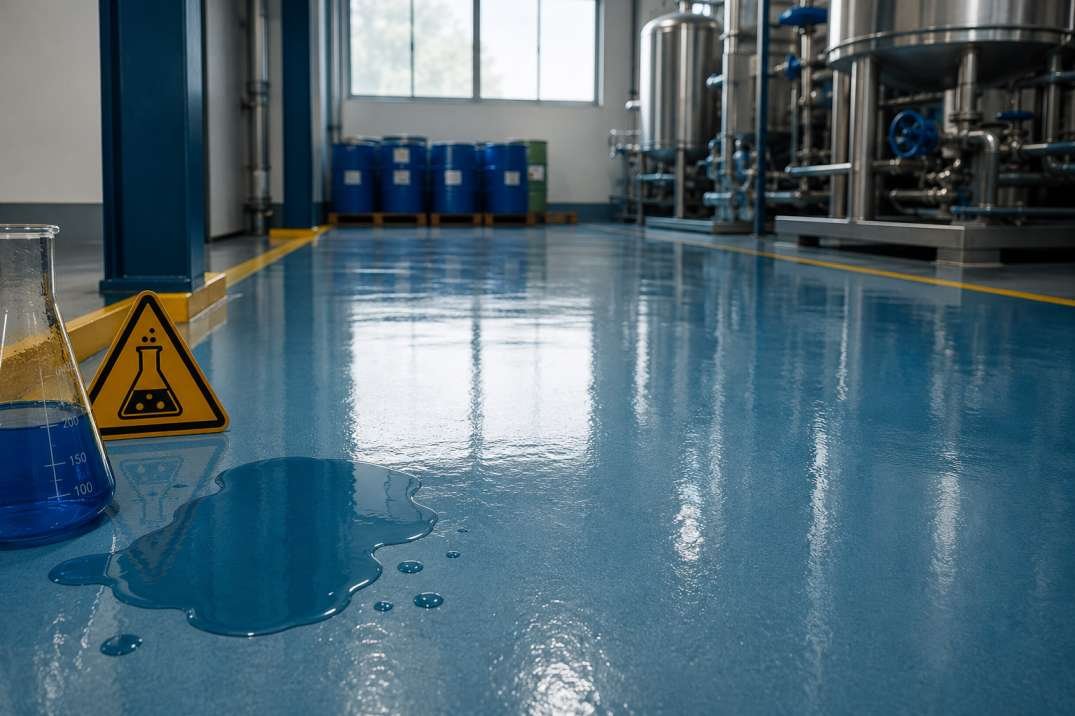
Chemical Resistant Floor Coatings: The Complete Guide for Australian Industrial and Commercial Facilities
Chemical resistant floor coatings are not a luxury specification for Australian industrial facilities — they are a necessity for any floor that contacts acids, caustics, oils, agricultural chemicals, food-processing fluids, or the aggressive cleaning agents used to sanitise commercial environments. A floor installed without the correct chemical resistance specification will fail predictably: the coating blisters, softens, or loses adhesion in the zones of chemical contact, and the deterioration accelerates with every subsequent exposure cycle.
At Resin Masters, we specify and install chemical resistant epoxy floor systems across Brisbane, Gold Coast, Logan, Sunshine Coast, Toowoomba, Ipswich, and Northern NSW — matching every installation to the actual chemical exposure profile of the facility, not to a generic ‘chemical resistant’ product label. This guide explains how chemical resistance works, which chemicals require specialist specification, and how to choose the right system for your Australian facility.
How Chemical Resistance Works in Epoxy Floor Coatings
Chemical resistance in an epoxy floor coating is a function of the resin system’s molecular structure — specifically, how tightly the cured polymer network resists penetration by different chemical types. Not all epoxy systems provide the same resistance, and the differences are significant across chemical families.
100% solids commercial-grade epoxy — the only base chemistry Resin Masters uses on every installation — creates a denser, less permeable polymer network than water-based or solvent-based alternatives. Higher solids content directly correlates with better chemical resistance because there are fewer voids and microscopic channels in the cured film through which chemical molecules can migrate. This is why 100% solids epoxy outperforms retail-grade products under chemical contact even before specific chemical-resistance formulations are considered.
Specific chemical resistance requires formulation beyond standard 100% solids epoxy. Novolac epoxy systems — a specific epoxy chemistry with higher cross-link density than standard bisphenol-A epoxy — provide substantially greater resistance to acids, solvents, and oxidising chemicals. Vinyl ester systems provide the highest broad-spectrum chemical resistance for extreme exposure environments. Polyurethane topcoats add solvent and abrasion resistance at the surface layer. The correct specification combines the right base chemistry with the appropriate topcoat for each facility’s specific chemical profile.
Chemical Families and Epoxy Resistance — What You Need to Know
|
Chemical Family |
Examples in Australian Industry |
Standard Epoxy Resistant? |
Requires Specialist System |
|
Inorganic Acids |
Sulphuric, hydrochloric, phosphoric — battery industry, metal treatment, chemical manufacturing |
Partial — dilute only |
Novolac epoxy for concentration above 20% |
|
Organic Acids |
Citric, lactic, acetic — food processing, dairy, produce handling |
Good resistance at typical food-processing concentrations |
Standard chemical-resistant epoxy adequate for most food applications |
|
Caustic / Alkali |
Sodium hydroxide, caustic cleaning agents — food processing, dairy, cold storage |
Good — standard chemical-resistant systems adequate |
Only extreme concentrations require specialist system |
|
Petroleum / Hydrocarbons |
Diesel, petrol, lubricants, hydraulic fluid — logistics, automotive, transport |
Good — standard chemical-resistant systems adequate |
Standard specification handles typical automotive and logistics exposure |
|
Solvents |
Acetone, MEK, toluene — manufacturing, coatings, chemical distribution |
Poor to moderate — highly solvent-specific |
Novolac or vinyl ester system required for solvent exposure |
|
Agricultural Chemicals |
Herbicides, fungicides, fertilisers — Darling Downs, Northern Rivers, regional distribution |
Variable — highly product-specific |
Facility-specific assessment and formulation matching required |
|
Oxidising Agents |
Hydrogen peroxide, bleach — food processing, pharmaceutical, pool chemicals |
Poor — aggressive attack on standard epoxy |
Specialist formulation or vinyl ester system required |
RESIN MASTERS PROTOCOL: For any facility with chemical exposure beyond general petroleum products and standard cleaning agents, we require a complete list of chemicals, concentrations, and contact temperatures before specifying any chemical-resistant floor coating system. Chemical resistance is a precise specification decision — matching the wrong system to the actual exposure profile produces failure as reliably as applying no chemical resistance specification at all.
Where Chemical Resistant Floor Coatings Are Required in Australia
Food Processing and Food Manufacturing
Food processing facilities across Brisbane’s Rocklea and Acacia Ridge precincts, the Sunshine Coast’s Kunda Park food sector, Logan’s Crestmead food manufacturing corridor, and Northern NSW’s macadamia and dairy hinterland require chemical resistant floor coatings for two distinct exposure categories: the organic acids produced by food processing (citric, lactic, acetic) and the aggressive caustic cleaning agents used in CIP (Clean-in-Place) sanitation cycles. The floor must resist both exposure types simultaneously, across the daily temperature cycling of hot water and steam cleaning. Resin Masters specifies HACCP-aligned, organic-acid and caustic-resistant systems for Queensland Food Act 2006 and NSW Food Act 2003 compliant installations.
Automotive Workshops and Transport
Automotive workshops across all seven Resin Masters service locations — Brisbane’s Rocklea and Archerfield, Ipswich’s busy western corridor, Gold Coast’s Arundel and Southport workshops, and the Sunshine Coast’s Maroochydore trade precinct — handle petroleum products, brake fluid, battery acid, and solvent-based degreasers. Standard chemical-resistant epoxy handles this exposure profile adequately. For battery charging and EV service facilities with higher acid exposure, a novolac specification is recommended.
Agricultural Chemical Storage and Distribution
Toowoomba’s Darling Downs position as the commercial centre of Queensland’s primary agricultural region creates a specific chemical resistance demand. Agricultural supply businesses handling concentrated herbicide and fungicide formulations require specialist chemical-resistant specifications that standard industrial epoxy cannot provide. Northern NSW’s hinterland agricultural sector — macadamia processing, subtropical produce handling, and rural chemical supply — creates similar demand across the Northern Rivers.
Pharmaceutical and Chemical Manufacturing
Pharmaceutical manufacturing and chemical processing facilities in Brisbane’s inner industrial ring require the highest chemical resistance specification — often novolac or vinyl ester systems rated for the specific process chemistry of each facility. Resin Masters assesses pharmaceutical and chemical manufacturing facilities on a case-by-case basis, providing the product chemistry data and resistance documentation that these regulated environments require.
Chemical Resistant Floor Coating Systems Resin Masters Installs
- Standard chemical-resistant epoxy (3–5mm): adequate for most food processing, automotive, and petroleum product exposure. $70–$110/m² installed.
- Novolac epoxy system: for acids above 20% concentration, solvents, and oxidising agents. Higher cross-link density than standard systems. $90–$140/m² installed.
- Polyurethane topcoat: adds solvent and abrasion resistance at the surface layer. Applied over chemical-resistant epoxy base for multi-exposure environments.
- Coved floor-wall skirting: integral to any chemical-resistant system — prevents chemical accumulation at the floor-wall junction, which is the primary failure point in food processing and chemical handling environments.
- Drainage-compatible surface specification: for facilities requiring chemical containment and drainage, we specify topography-matched installations that direct chemical spills to drainage points. Get a free quote!
Resin Masters — Serving All 7 Locations Across SEQ & Northern NSW
Resin Masters installs chemical-resistant, food-safe, anti-slip, and specialist epoxy systems across all seven of our service locations. Every installation uses 100% solids low-VOC to near-zero-VOC commercial-grade epoxy and comes with a 7-year warranty.
|
Brisbane — Industrial estates, warehouses, commercial kitchens, workshops |
Gold Coast — Yatala logistics, prestige garages, hospitality venues |
Logan — Crestmead, Beenleigh industrial, residential and commercial |
Sunshine Coast — Kawana, Kunda Park industrial, food processing, hospitality |
|
Toowoomba — Agricultural, manufacturing, trade, Darling Downs industrial |
Ipswich — Wulkuraka, Swanbank, Springfield new estates, Defence corridor |
Northern NSW — Tweed Heads, Byron Bay, Lismore, Northern Rivers hinterland |
|
 +61 433 733 956
 info@resinmasters.com.au
 resinmasters.com.au
Frequently Asked Questions — Chemical Resistant Floor Coatings
What is the best chemical resistant floor coating for Australian industrial facilities?
The best chemical resistant floor coating for Australian industrial facilities depends on the specific chemicals involved. For food processing and petroleum exposure, a standard chemical-resistant 100% solids epoxy system (3–5mm build) adequately handles most applications. For concentrated acids, solvents, or oxidising agents, a novolac epoxy system with higher cross-link density is required. Resin Masters assesses each facility’s actual chemical exposure profile before specifying any system — and we use only low-VOC to near-zero-VOC 100% solids commercial-grade epoxy on every installation. Every installation comes with a 7-year warranty.
How long does a chemical resistant epoxy floor last?
A correctly specified and installed chemical resistant epoxy floor from Resin Masters lasts 8–15 years in most Australian industrial environments. Food processing facilities with daily caustic cleaning cycles and hot water exposure: 8–12 years. Automotive and petroleum product environments: 12–15 years. Facilities with mild chemical exposure: up to 20 years. Lifespan depends on specification accuracy (matching the system to the actual chemical exposure), surface preparation quality, and maintenance practice. Our 7-year warranty covers installation-related defects across this lifespan.
Does epoxy resist acid?
Standard 100% solids epoxy provides moderate resistance to dilute acids (below approximately 20% concentration) including the organic acids common in food processing (citric, lactic, acetic). For concentrated inorganic acids — sulphuric, hydrochloric, phosphoric above 20% concentration — a novolac epoxy system is required. Resin Masters specifies the correct acid resistance level for each facility’s actual acid type and concentration. Contact us at +61 433 733 956 to discuss your specific acid exposure requirements.
Can epoxy floor coatings resist cleaning chemicals?
Yes — 100% solids epoxy systems from Resin Masters provide good resistance to the caustic cleaning agents (sodium hydroxide, quaternary ammonium compounds, sodium hypochlorite) used in food processing and commercial kitchen sanitation. The key specification factors are concentration and temperature: hot water cleaning cycles at high caustic concentration require chemical-resistant formulation, not standard industrial epoxy. We confirm cleaning chemical compatibility during every on-site facility assessment.
What floor coating do food processing plants use?
Food processing plants use HACCP-aligned 100% solids chemical-resistant epoxy systems with coved floor-wall skirting, AS 4586 anti-slip aggregate in wet processing zones, and organic acid plus caustic cleaning agent resistance specification. Resin Masters installs food processing floor systems compliant with Queensland Food Act 2006 and NSW Food Act 2003, providing AS 4586 documentation and HACCP specification records for food facility licence applications. We serve food processors across Brisbane, Gold Coast, Logan, Sunshine Coast, Toowoomba, Ipswich, and Northern NSW.
How much does chemical resistant epoxy flooring cost in Australia?
Chemical resistant epoxy flooring from Resin Masters costs $70–$140 per square metre installed in 2026, depending on the system and floor area. Standard chemical-resistant systems (food processing, automotive): $70–$110/m². Novolac systems for acids and solvents: $90–$140/m². Large warehouse and processing floor areas produce better per-m² economics — a 500m² Sunshine Coast food facility costs significantly less per m² than a 50m² workshop. All prices include preparation, 100% solids low-VOC epoxy system, topcoat, GST, and 7-year warranty.
What chemical resistance does epoxy flooring offer for agricultural chemicals?
Epoxy flooring’s resistance to agricultural chemicals — herbicides, fungicides, and fertiliser formulations — is highly product-specific and concentration-dependent. Standard industrial epoxy may not provide adequate resistance to concentrated herbicide formulations, particularly those with specific solvent carrier systems. Resin Masters assesses agricultural chemical exposure on a facility-by-facility basis for Toowoomba Darling Downs and Northern NSW hinterland clients, specifying novolac systems where concentrated agricultural chemical contact is identified. Always provide a full chemical list when requesting a quote.
Is there a chemical resistant floor coating near me in Brisbane, Gold Coast or Sunshine Coast?
Yes — Resin Masters installs chemical resistant floor coatings across Brisbane (Rocklea, Acacia Ridge, Eagle Farm), Gold Coast (Yatala, Arundel, Stapylton), Logan (Crestmead, Beenleigh, Loganholme), Sunshine Coast (Kawana, Kunda Park, Nambour), Toowoomba (Wilsonton, Harristown, Wellcamp), Ipswich (Wulkuraka, Swanbank, Redbank Plains), and Northern NSW (Tweed Heads, Lismore, Ballina). Call +61 433 733 956 for a free on-site assessment and facility-specific specification quote.
How do I prepare a floor for chemical resistant epoxy coating?
Chemical resistant epoxy floor preparation requires shot blasting or industrial diamond grinding to achieve a mechanical surface profile — not acid etching, which is inadequate for chemical-resistant system adhesion. Oil contamination zones must be treated before grinding. Cracks and surface defects are repaired with compatible filler systems before primer. Resin Masters handles all preparation stages on every installation. The preparation quality determines the coating’s adhesion and directly affects the 7-year warranty’s deliverability.
Are chemical resistant floor coatings low VOC?
Yes — Resin Masters uses 100% solids commercial-grade epoxy with low-VOC to near-zero-VOC chemistry on every chemical resistant installation. Unlike older solvent-based industrial systems that emit significant volatile organic compounds during application, our 100% solids chemistry contains no solvents and produces minimal to no VOC during curing. This keeps installation safe for operating facilities and aligns with Australian WHS solvent exposure limits. We provide full product data sheets confirming VOC content for facilities requiring environmental compliance documentation.