Servicing : Gold CoastBrisbaneSunshine CoastToowoomba

How to Test Concrete Moisture Before Epoxy
A garage slab can look dry, feel hard and be several years old, yet still hold enough moisture to compromise an epoxy floor. That is why knowing how to test concrete moisture before epoxy is not a minor pre-installation check. It is a key part of making sure the coating bonds properly and stays looking sharp through Queensland heat, humidity, vehicle traffic and daily use.
Moisture-related epoxy failure is rarely subtle. It can appear as bubbling, cloudy patches, peeling edges or sections of coating lifting from the slab. Once that happens, the repair usually involves removing the failed coating, preparing the concrete again and starting over. Testing first is faster, more cost-effective and far more reliable.
Why concrete moisture matters before epoxy
Concrete is porous. Even after it has cured, it can absorb moisture from the ground below, humid air, leaks, wet cleaning or rain blowing into an open garage. Moisture vapour then moves through the slab towards the surface.
Epoxy creates a dense, continuous finish. That is one of its greatest strengths, particularly for garages, workshops, warehouses and commercial areas that need a hygienic, easy-clean floor. But if vapour pressure is pushing upwards from the concrete, the coating may lose adhesion or form blisters beneath the surface.
This is particularly relevant across Brisbane, the Gold Coast and the Sunshine Coast. High humidity, coastal conditions and slabs without an effective vapour barrier can all affect the result. A slab does not need visible standing water to present a moisture risk.
How to test concrete moisture before epoxy
There is no single test that suits every slab or epoxy system. The right method depends on the size of the job, the age and condition of the concrete, the coating manufacturer’s requirements and whether there is any reason to suspect rising moisture. For a premium epoxy installation, the test result should guide the preparation and coating system, not be treated as a box-ticking exercise.
Start with a proper site inspection
Before using any test kit, inspect the slab closely. Look for darkened areas, white powdery deposits known as efflorescence, previous coating failure, cracking, damp walls, leaking pipes and signs that water regularly enters the area. Check external drainage as well. Water pooling against a building can contribute to moisture issues below the slab.
Ask practical questions. Has the floor recently been pressure-cleaned? Is the building newly constructed? Has there been flooding, a plumbing leak or a change to surrounding landscaping? A recent rain event or wash-down can skew a surface reading, while a consistently damp patch may point to a larger issue that needs attention before epoxy is considered.
The slab must also be clean enough to test. Oils, curing compounds, old sealers, adhesives and surface contamination can interfere with both testing and adhesion. Mechanical grinding is often required before a final test and coating application because it exposes sound, open concrete rather than a contaminated surface layer.
Use a moisture meter as an initial screening tool
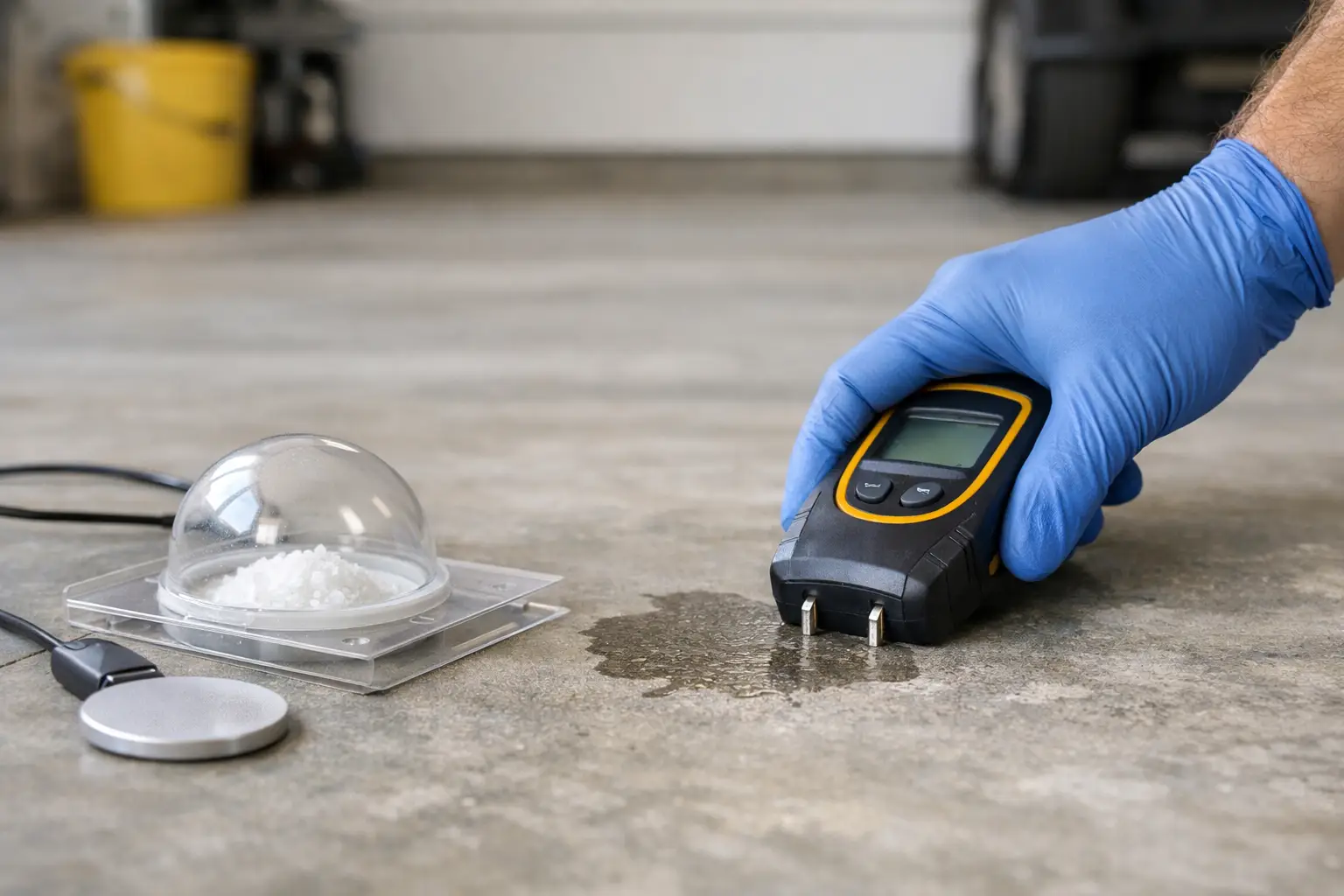
A concrete moisture meter is useful for quickly comparing areas across a floor. It can help identify zones worth investigating, such as a damp-looking corner near a roller door or a section beside a bathroom wall. Readings should be taken across the slab, not just in one convenient spot.
However, a handheld meter is a screening tool, not a final approval on its own. Different meters measure different properties, and their readings can be influenced by concrete density, aggregate, reinforcing steel and surface condition. A low number does not automatically mean the slab meets the requirements of a particular epoxy product.
For a small residential garage with no signs of moisture concern, meter readings may form part of a sensible assessment. For large commercial floors, warehouses, ground-level slabs or any project with questionable conditions, more definitive testing is the professional standard.
Test internal relative humidity for a clearer picture
In-situ relative humidity testing measures the humidity within the concrete rather than relying only on the surface. Small holes are drilled to a specified depth, probes are installed and allowed to equilibrate, then the relative humidity is recorded.
This method provides a more meaningful indication of the slab’s internal moisture condition and its likely behaviour once it is sealed with epoxy. It is commonly used for flooring work because moisture often sits deeper in the concrete and may not be apparent at the surface.
Testing needs to be completed under stable, representative site conditions. If a building has been closed up, freshly air-conditioned or exposed to unusual weather immediately before the test, the result may not reflect normal service conditions. The number and location of test points should reflect the floor area, with extra attention given to known risk zones.
The acceptable relative humidity level is not universal. It must be checked against the technical data for the selected primer, moisture barrier and epoxy system. Some products tolerate higher readings than others, especially where a compatible moisture mitigation primer is specified.
Consider calcium chloride testing where required
Calcium chloride testing measures moisture vapour emission from the concrete surface over a set period. A test dish is placed beneath a sealed cover, then weighed after exposure to calculate the vapour emission rate.
This test can be useful where the epoxy manufacturer calls for it or where project specifications nominate it. It measures surface emission rather than moisture deeper within the slab, so it is not always the only test a contractor will use. A slab can produce a satisfactory result under one set of conditions and still have an internal moisture profile that requires further assessment.
For that reason, the best approach is often based on the coating specification and site conditions rather than a one-size-fits-all method. On a high-value commercial installation, combining inspection, moisture mapping and a specified quantitative test gives far greater confidence than relying on one quick reading.
The plastic sheet test: useful warning, not a final answer
The plastic sheet test involves taping a clear plastic square tightly to the concrete and leaving it in place for roughly 24 hours. Condensation under the sheet or a darkened patch of concrete when it is removed suggests moisture movement.
It is a simple visual warning test and can be helpful for homeowners deciding whether to call in a flooring specialist. It cannot confirm that a slab is suitable for epoxy, nor can it provide a reliable moisture value. Temperature changes, poor tape sealing and short test periods all affect what you see.
Treat a positive plastic sheet test as a reason to investigate further. Treat a negative result cautiously. It does not rule out moisture vapour pressure that could affect an epoxy coating later.
Reading the result and choosing the right response
A moisture test is only valuable if the result changes the installation plan when necessary. If the concrete falls within the specified limits for the selected epoxy system, the work can proceed once the surface has been mechanically prepared, repaired and cleaned.
If readings are above the allowable level, applying standard epoxy and hoping for the best is not a quality solution. Depending on the cause and severity, the options may include allowing more drying time, improving drainage, addressing a leak, installing a compatible moisture-mitigation primer or selecting a system designed for the measured conditions.
A moisture barrier is not interchangeable with any primer. It must be compatible with the epoxy build-up, applied at the required coverage rate and installed over properly prepared concrete. Missing any of those details can undermine the benefit of the product.
It also pays to distinguish between construction moisture and ongoing moisture. A new slab may simply need more time to dry. An older slab with continuous vapour movement may need a moisture-control system that is designed for long-term exposure. The solution depends on the evidence, not the age of the concrete alone.
Common mistakes that put epoxy floors at risk
The most expensive mistake is assuming a 28-day-old slab is automatically ready for epoxy. Concrete curing and concrete drying are different processes. Thick slabs, humid conditions and limited ventilation can significantly extend drying time.
Another common error is testing only one area, particularly near the middle of the room. Moisture conditions can vary across the slab, especially near external walls, doorways, plumbing penetrations and areas with poor drainage.
Homeowners and builders can also be caught out by testing before preparation, then coating days or weeks later after wet grinding, cleaning or rain exposure. The final assessment should reflect the condition of the prepared substrate and the conditions immediately before installation.
Finally, do not overlook ambient conditions. High humidity and incorrect slab temperature can affect epoxy application, cure and appearance even when the concrete moisture result is acceptable. A professional installer assesses the full environment, not just one number on a meter.
When to bring in an epoxy flooring specialist
A DIY test may help you spot an obvious concern, but it is not a substitute for a documented assessment on a substantial floor coating project. Professional testing is especially worthwhile for warehouses, commercial kitchens, showrooms, workshops, newly built homes, ground-floor slabs and garages with previous paint or coating failure.
At Resin Masters, moisture assessment is part of the preparation process because a durable finish starts below the coating. The goal is not simply to apply epoxy quickly. It is to select the right preparation method and system for the concrete in front of us, then deliver a floor built for long-term performance.
If your slab shows damp patches, efflorescence, old coating lift or inconsistent meter readings, pause before choosing a colour or flake blend. Getting the moisture question answered properly gives your epoxy floor the sound foundation it needs to perform for years.