Servicing : Gold CoastBrisbaneSunshine CoastToowoomba

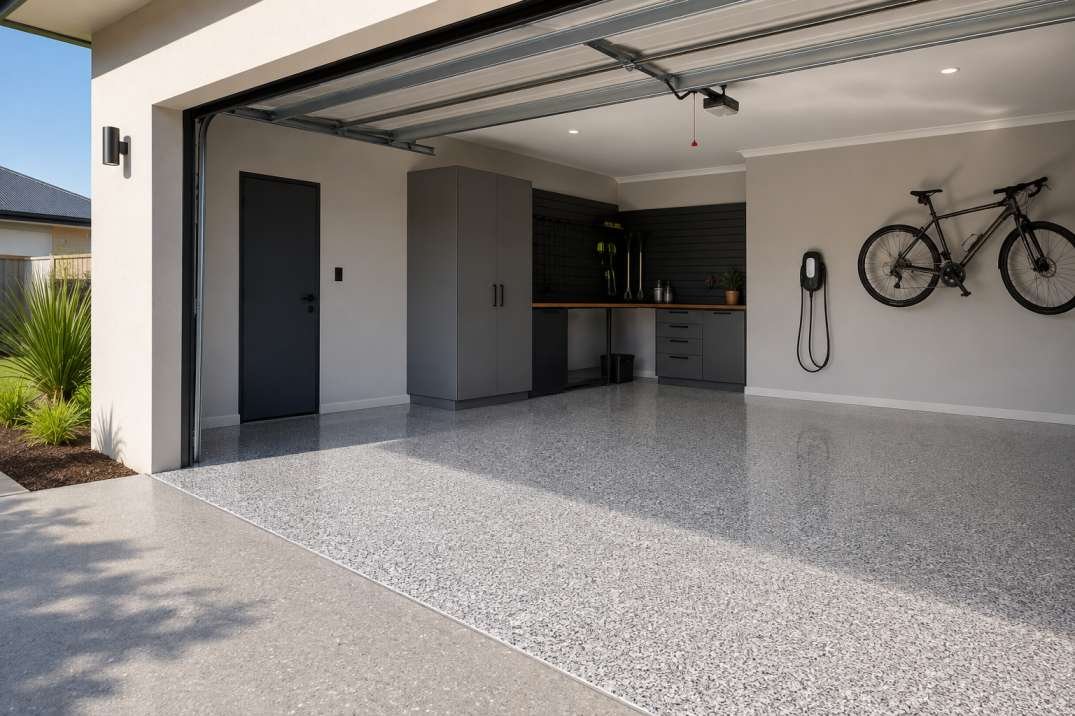
Polyaspartic vs Epoxy — Which Is Better for Your Garage Floor?
Search ‘polyaspartic vs epoxy garage floor’ and you’ll find confident declarations on both sides — articles claiming polyaspartic is the future of garage flooring, and others arguing that epoxy is more than adequate for any residential application. The honest answer is more nuanced than either camp suggests: polyaspartic and epoxy are not competing products. They are complementary coating chemistries that perform different functions in a correctly specified floor system.
At Resin Masters, we install garage floor epoxy systems across Brisbane, Gold Coast, Logan, Sunshine Coast, Toowoomba, Ipswich, and Northern NSW. Every installation we complete uses 100% solids commercial-grade epoxy as the base coat and UV-stable polyaspartic as the topcoat — not because we have a preference for one chemistry over the other, but because the combination uses the strengths of both and the weaknesses of neither. This guide explains exactly what each product does, why the combination is correct for Australian garage conditions, and when a full polyaspartic system — no epoxy — makes sense.
Understanding What Each Product Actually Is
What Is Epoxy?
Epoxy is a thermosetting polymer created by the reaction of two components: an epoxy resin (typically bisphenol-A diglycidyl ether) and an amine hardener. When mixed, these components react to form a densely cross-linked polymer network with exceptional adhesion to prepared concrete, high compressive strength, and good chemical resistance. 100% solids epoxy — the only base coat chemistry Resin Masters uses — contains no water and no solvents: every molecule in the product converts to cured coating, creating a 2–3mm dense, impermeable film.
Epoxy’s weakness is UV reactivity. The aromatic chemistry used in most epoxy resins degrades under sustained UV exposure — chalking, losing gloss, and eventually becoming brittle. This is not a quality failure; it is the chemistry’s inherent property. Epoxy is always sealed with a UV-stable topcoat in any correctly specified floor system, precisely because of this UV limitation.
What Is Polyaspartic?
Polyaspartic coatings are classified as aliphatic polyurea — a chemistry family developed from polyurethane by replacing the aromatic isocyanate structures with aliphatic (non-aromatic) ones. This substitution removes the UV-reactive aromatic groups responsible for yellowing and thermal softening in standard polyurethane, producing a coating with UV stability, thermal resistance, and fast cure times that aromatic chemistry cannot achieve.
Polyaspartic’s strengths — UV stability, hot-tyre resistance, fast cure — make it the correct topcoat for Australian garage conditions. Polyaspartic’s characteristics compared to epoxy — lower build thickness capability, higher material cost, very short pot life during application — make it less well-suited as a base coat than 100% solids epoxy in most garage floor applications.
The Complete Comparison — 8 Performance Factors
|
Factor |
100% Solids Epoxy Base |
Standard Polyurethane Topcoat |
UV-Stable Polyaspartic Topcoat |
Full Polyaspartic System |
|
UV stability |
Poor — must be sealed |
Poor — yellows in 12–18 mths under Qld UV |
Excellent — aliphatic chemistry |
Excellent throughout |
|
Hot-tyre resistance |
N/A — base coat only |
Poor — softens under Qld summer conditions |
Excellent — high thermal resistance |
Excellent throughout |
|
Substrate adhesion |
Excellent — designed for concrete bond |
N/A — applied over epoxy |
Good — applied over epoxy primer |
Good — applied over primer |
|
Build thickness |
2–3mm — correct for vehicle traffic |
0.1–0.3mm topcoat layer |
0.1–0.3mm topcoat layer |
0.5–1.5mm total (thinner than epoxy) |
|
Chemical resistance |
Excellent — resists oils, solvents, acids |
Moderate |
Good |
Moderate — less than epoxy base |
|
Cure to vehicle-ready |
48–72 hrs (base coat stage) |
Adds 24–48 hrs |
Adds 12–24 hrs |
12–24 hrs total system |
|
Yellowing over time |
Not exposed (sealed) |
Yes — within 1–3 Qld summers |
No — colour-stable |
No — colour-stable |
|
Cost per m² (relative) |
$$ |
$ (low cost, wrong spec) |
$$ (Resin Masters standard) |
$$$ (full system, higher cost) |
RESIN MASTERS STANDARD SPECIFICATION: 100% solids low-VOC epoxy base coat + UV-stable polyaspartic topcoat on every garage floor installation across all 7 service locations. This combination uses epoxy’s substrate adhesion, build thickness, and chemical resistance for the base — and polyaspartic’s UV stability and hot-tyre resistance for the surface. Neither product used alone provides the complete performance the combination delivers.
Why the Combination System Is Correct for Most Australian Garages
The combination of 100% solids epoxy base and polyaspartic topcoat is the correct specification for most Australian residential garages because it optimises two distinct performance requirements that no single product chemistry handles equally well.
The Base Coat Requirement: Adhesion, Build, Chemical Resistance
The base coat’s job is to bond to the prepared concrete substrate, build the film thickness that handles vehicle loads, and provide the chemical resistance that garage environments require. 100% solids epoxy excels at all three: the amine-epoxy reaction produces exceptional adhesion to diamond-ground concrete at a molecular level, the 100% solids chemistry builds to 2–3mm film thickness without requiring multiple thin coats, and the cross-linked polymer network resists the petroleum products, vehicle fluids, and cleaning chemicals that Australian garages accumulate.
Polyaspartic base coat — in a full polyaspartic system — achieves good adhesion and moderate chemical resistance, but the material cost is higher, the build thickness per coat is lower, and the pot life (working time) during application is significantly shorter. These characteristics make polyaspartic less well-suited as a garage base coat than 100% solids epoxy for most residential applications.
The Topcoat Requirement: UV Stability and Hot-Tyre Resistance
The topcoat’s job is to seal and protect the base coat from UV degradation, thermal stress from hot-tyre contact, and surface abrasion from daily use. Standard polyurethane topcoat fails at the UV and thermal requirements under Queensland conditions. Polyaspartic topcoat — with aliphatic chemistry — provides the UV stability and hot-tyre resistance that Australian garage conditions demand.
The combination system therefore uses each chemistry for the job it is best suited for: epoxy for the substrate-facing performance requirements, polyaspartic for the surface-facing performance requirements. Across Brisbane, Gold Coast, Logan, Sunshine Coast, Toowoomba, Ipswich, and Northern NSW, this combination produces the floor that looks the same in year seven as it did in year one.
When a Full Polyaspartic System Makes Sense
Despite recommending the epoxy + polyaspartic combination for most residential garage applications, there are genuine situations where a full polyaspartic system — no epoxy base coat — is the correct choice.
- Minimal downtime requirement: full polyaspartic achieves vehicle-ready surfaces in 12–24 hours from start to finish. The epoxy + polyaspartic combination requires 24–48 hours from the final topcoat coat. For commercial garages, strata carparks, and any facility where even a 24-hour closure creates operational problems, full polyaspartic’s faster return-to-service is a meaningful advantage.
- Outdoor and semi-outdoor applications: in carports, alfresco garages, and open structures where the base coat as well as the topcoat receives direct UV exposure, full polyaspartic throughout provides UV stability in both layers. The epoxy base coat in a fully exposed outdoor application will UV-degrade at the base coat level over time even if the topcoat is UV-stable.
- Extreme temperature cycling environments: the flexibility of polyaspartic chemistry under extreme thermal cycling — relevant in Toowoomba’s cold winters and hot summers — can outperform epoxy base coats that become more brittle at low temperatures.
- Very light-traffic or aesthetic applications: where vehicle loads are minimal or occasional, and the priority is fast installation and UV stability, full polyaspartic achieves the visual and performance requirements at lower film build than the epoxy + polyaspartic combination.
Stain Resistance — Epoxy vs Polyaspartic Compared
Stain resistance for garage floors involves two distinct mechanisms: chemical resistance of the coating film to penetration by staining agents, and ease of surface cleaning for spills that contact the topcoat before absorption.
For chemical resistance against penetration — oil, fuel, brake fluid, agricultural chemicals — the epoxy base coat provides the primary resistance through its dense, cross-linked polymer network. The polyaspartic topcoat adds a secondary chemical resistance layer. Full polyaspartic systems provide moderate chemical resistance — good for typical garage spill exposure, but less robust than 100% solids epoxy for sustained chemical contact.
For surface cleaning — wiping up oil drips, food, paint, and workshop residue before penetration occurs — both systems perform equivalently. The seamless, non-porous surface of both epoxy + polyaspartic and full polyaspartic systems allows spills to be wiped away without absorption, regardless of which base chemistry is used. Get a free Quote!
The Verdict — Which System Does Resin Masters Recommend?
For standard residential garages across Brisbane, Gold Coast, Logan, Sunshine Coast, Toowoomba, Ipswich, and Northern NSW: 100% solids low-VOC epoxy base with UV-stable polyaspartic topcoat. This combination delivers superior substrate adhesion, film build, and chemical resistance from the epoxy base, combined with the UV stability and hot-tyre resistance of polyaspartic at the surface. It’s backed by a 7-year written warranty on every Resin Masters installation.
For commercial applications, outdoor structures, or situations requiring vehicle access within 12 hours of installation completion: full polyaspartic system. Resin Masters installs full polyaspartic systems for clients with these specific requirements — at a higher per-m² cost, with the same preparation standard and 7-year warranty.
The question ‘polyaspartic vs epoxy’ is ultimately a false choice. The correct question is: which chemistry should be the base, and which should be the topcoat? For Australian garage conditions, the answer is unambiguous — 100% solids epoxy as the base, UV-stable polyaspartic as the topcoat.
|
Brisbane |
Gold Coast |
Logan |
Sunshine Coast |
|
Toowoomba |
Ipswich |
Northern NSW |
Free Quote — 48hr Turnaround |
 Call Resin Masters: +61 433 733 956
 Email: info@resinmasters.com.au
 resinmasters.com.au | 7-Year Warranty | Low-VOC to Near-Zero-VOC Products
 Brisbane · Gold Coast · Logan · Sunshine Coast · Toowoomba · Ipswich · North NSW
Also Read:- Garage Epoxy Flooring for New Builds — The Perfect Time to Install
Frequently Asked Questions — Polyaspartic vs Epoxy Garage Floors
Is polyaspartic better than epoxy for garage floors?
The direct answer: polyaspartic and epoxy serve different roles in the same floor system, and the correct comparison is between a standard epoxy floor (epoxy base + polyurethane topcoat) and a Resin Masters installation (100% solids epoxy base + polyaspartic topcoat). In that comparison, the Resin Masters system wins on UV stability, hot-tyre resistance, and cure speed — but both systems use 100% solids epoxy as the base coat, and both deliver 12–20 years of service when correctly specified and installed. A full polyaspartic system (polyaspartic base and topcoat, no epoxy) cures faster and delivers excellent UV stability throughout — but costs more and sacrifices some of epoxy’s superior substrate adhesion and chemical resistance in the base coat. Resin Masters recommends the combination system — 100% solids epoxy base, polyaspartic topcoat — for most Australian residential garages. Pure polyaspartic full systems are the correct choice for applications where return-to-service time is the overriding priority.
What are the key differences between polyaspartic and epoxy coating chemistry?
Epoxy is a two-part thermosetting resin — Part A (bisphenol-A diglycidyl ether resin) reacts with Part B (amine hardener) to create a dense, cross-linked polymer film. This reaction produces excellent substrate adhesion, high compressive strength, and good chemical resistance — properties that make 100% solids epoxy the correct base coat for garage floors. The weakness of epoxy chemistry is UV reactivity: epoxy base coats are not UV stable and degrade rapidly under direct UV exposure, which is why they are always sealed with a topcoat. Polyaspartic is an aliphatic polyurea coating — a different chemistry family that provides UV stability, thermal resistance, and fast cure. Polyaspartic is the correct topcoat for Australian garage conditions because it provides the UV stability and hot-tyre resistance that polyurethane topcoats lack. The combination of 100% solids epoxy base (adhesion, build, chemical resistance) and polyaspartic topcoat (UV stability, thermal resistance) uses the strengths of both chemistries and avoids the weaknesses of either used alone.
How does polyaspartic handle hot tyres compared to epoxy — which is more resistant?
This is the critical performance differentiator for Australian garage conditions. Pure epoxy base coat is not UV stable and would degrade rapidly under direct UV exposure — which is why it always requires a topcoat. The question of hot-tyre resistance is entirely about the topcoat, not the epoxy base. Standard polyurethane topcoat (aromatic chemistry) softens under the combination of Queensland summer ambient heat and elevated tyre temperatures, creating the permanent deformation marks known as tyre tracking. Polyaspartic topcoat (aliphatic polyurea chemistry) maintains film hardness under the same conditions — preventing tyre deformation through its higher thermal resistance and resistance to UV-initiated softening. At Resin Masters, every garage floor installation across Brisbane, Gold Coast, Logan, Sunshine Coast, Toowoomba, Ipswich, and Northern NSW uses polyaspartic topcoat as the standard finish coat. This is the specification decision that prevents tyre tracking under Queensland summer conditions.
Is polyaspartic more UV resistant than epoxy — and does epoxy yellow over time?
Yes — polyaspartic (aliphatic chemistry) is significantly more UV resistant than both standard epoxy base coat and aromatic polyurethane topcoat. Standard epoxy base coat degrades rapidly under direct UV exposure and cannot be used as a UV-exposed finish coat — it must always be sealed with a UV-stable topcoat. Standard polyurethane topcoat (aromatic chemistry) yellows in 12–18 months under Australian UV due to photochemical degradation of its aromatic polymer chains. Polyaspartic topcoat (aliphatic chemistry) lacks the UV-reactive aromatic structures and maintains colour stability under sustained Australian UV exposure. The floor does not yellow. Resin Masters applies polyaspartic topcoat on every garage floor installation — which is why the 7-year warranty we provide is achievable. A floor topcoated with standard polyurethane cannot hold a 7-year warranty through Queensland summers without yellowing and tyre tracking.
What is the lifespan of a polyaspartic garage floor system vs a standard epoxy system?
A correctly specified Resin Masters installation — 100% solids epoxy base with polyaspartic topcoat — lasts 12–20 years under normal Australian residential garage conditions, with a 7-year written warranty covering any installation-related defect. A standard epoxy system with polyurethane topcoat, correctly installed, may also deliver 8–15 years in mild conditions — but in Queensland and Northern NSW, where UV intensity and summer temperatures are high, the polyurethane topcoat degrades significantly faster, with visible yellowing and tyre tracking appearing within 1–3 years. A full polyaspartic system (polyaspartic base and topcoat) provides comparable lifespan to the epoxy + polyaspartic combination — 12–20 years under Australian conditions — with the advantage of faster cure and the disadvantage of higher cost and slightly lower chemical resistance in the base coat.
How quickly does a polyaspartic garage floor cure compared to epoxy — what is the return-to-service time?
Cure time is one of polyaspartic’s most significant practical advantages over standard epoxy topcoat. Standard epoxy base coat: tack-free in 4–6 hours, light foot traffic in 24 hours, vehicle-ready in 48–72 hours. Standard polyurethane topcoat: adds a further 24–48 hours to vehicle-ready time. Polyaspartic topcoat over epoxy base: tack-free in 1–2 hours, light foot traffic in 4–6 hours, vehicle-ready within 12–24 hours. Full polyaspartic system (no epoxy base): foot traffic in as little as 3–4 hours, vehicle-ready in 12–24 hours. For homeowners who need their garage back quickly — or for commercial installations where downtime is costly — polyaspartic’s faster cure is a meaningful operational advantage. Resin Masters’ standard epoxy + polyaspartic system achieves vehicle-ready status within 48 hours of the final coat for most installations.
What are the cost differences between polyaspartic and epoxy garage floor systems?
A standard epoxy system with polyurethane topcoat sits at the lower cost end — but Resin Masters doesn’t offer this combination because standard polyurethane doesn’t perform adequately under Australian conditions. Comparing the systems Resin Masters actually installs: the standard 100% solids epoxy base with polyaspartic topcoat costs $50–$165/m² depending on finish (solid colour, flake, or metallic). A full polyaspartic system (polyaspartic base and topcoat, no epoxy) costs approximately 15–25% more per m² than the equivalent epoxy + polyaspartic system, primarily because polyaspartic material costs are higher per kg of solids than 100% solids epoxy. For most residential garages across Brisbane, Gold Coast, Logan, Sunshine Coast, Toowoomba, Ipswich, and Northern NSW, the epoxy + polyaspartic combination delivers the correct performance specification at better value than a full polyaspartic system. The full polyaspartic system is the right choice when return-to-service time under 24 hours is the overriding requirement.
What preparation is required before applying polyaspartic to a garage floor?
Polyaspartic preparation requirements are identical to epoxy preparation requirements — because the adhesion of any coating system is determined by the substrate profile, not the specific coating chemistry. Industrial diamond grinding to create a mechanical adhesion profile is non-negotiable. Oil contamination treatment for petroleum-impregnated zones before grinding. Moisture vapour emission testing and matched primer before any coating application. Crack repair and surface defect remediation. Resin Masters follows the same 5-stage preparation protocol on every garage floor installation — regardless of whether the final system is epoxy + polyaspartic or full polyaspartic. The preparation quality determines whether the 7-year warranty is achievable, and preparation cannot be shortcut regardless of which coating system sits above it.
Is polyaspartic easier to maintain than epoxy in a residential garage?
Both a correctly specified epoxy + polyaspartic system and a full polyaspartic system from Resin Masters require equivalent, minimal maintenance — because the surface the homeowner interacts with every day is the topcoat, and both systems use polyaspartic as the topcoat. Regular sweeping, pH-neutral mopping, and prompt spill cleanup are the standard maintenance requirements for both. The key maintenance advantage of polyaspartic topcoat over standard polyurethane topcoat is the elimination of the most time-consuming maintenance task standard-topcoated floors create: dealing with yellowing and tyre tracking that require resurfacing within 2–4 years. A polyaspartic-topcoated floor simply doesn’t develop these issues — which is why it’s accurate to say polyaspartic-topcoated floors are ‘lower maintenance’ than standard-topcoated floors, even though the ongoing cleaning routine is essentially the same.
Is polyaspartic suitable for outdoor or semi-outdoor garages in Australia?
Yes — polyaspartic’s superior UV stability makes it the correct specification for outdoor and semi-outdoor garage applications in Australia. Fully open carports, semi-covered parking areas, and garages with large open frontage that receive direct UV exposure require a UV-stable topcoat that standard epoxy cannot provide. Polyaspartic maintains colour stability and film integrity under direct UV exposure for 12–20 years — making it appropriate for applications where standard epoxy (which degrades within months under direct UV) and standard polyurethane (which yellows in 12–18 months) are both inadequate. For outdoor or semi-outdoor applications, Resin Masters specifies full polyaspartic systems rather than epoxy + polyaspartic, because the epoxy base coat also has limited UV stability in applications with sustained direct UV exposure in the base coat zone. Contact us at +61 433 733 956 to discuss your specific open-structure or carport application.
Are there health or VOC concerns with polyaspartic or epoxy garage floor coatings?
Resin Masters uses 100% solids commercial-grade epoxy with low-VOC to near-zero-VOC chemistry on every installation, combined with UV-stable polyaspartic topcoat. 100% solids epoxy contains no solvents and emits minimal to no volatile organic compounds during curing — significantly safer than older solvent-based epoxy systems that produce strong chemical odours requiring prolonged ventilation. The polyaspartic topcoat we use is also a low-VOC product — cure times are shorter than epoxy, and the lower emission during curing means garages are safe for re-entry within hours of topcoat application rather than requiring extended airing. We provide full product data sheets confirming VOC content for any homeowner requiring documentation. The combination of low-VOC epoxy base and low-VOC polyaspartic topcoat makes Resin Masters installations among the most occupant-safe professional garage floor products available in Australia.
Can I apply a DIY polyaspartic coating over my existing garage floor?
Retail polyaspartic DIY products are available in Australia, but they present application challenges more significant than standard epoxy kits. Polyaspartic has a significantly shorter pot life (working time) than standard epoxy — typically 10–20 minutes at Australian ambient temperatures — which requires a confident, experienced applicator working quickly across the full garage floor. Insufficient working pace results in overlapping marks and inconsistent finish quality. Preparation requirements for polyaspartic application are identical to epoxy — diamond grinding is required for adhesion; acid etching is not adequate. And applying polyaspartic over a previously degraded or failing floor without adequate preparation produces the same delamination failures as applying standard epoxy over inadequate preparation. Resin Masters installs polyaspartic garage floor systems across all 7 service locations with the preparation standard and application technique that produces a 7-year warranty result — for a cost that makes professional installation competitive with DIY when the preparation equipment hire and product cost of a correct DIY attempt is factored in.
Which companies install polyaspartic garage floor systems across Australia — and how do I find a reputable one?
Resin Masters installs polyaspartic-topcoated garage floor systems across Brisbane, Gold Coast, Logan, Sunshine Coast, Toowoomba, Ipswich, and Northern NSW. Every Resin Masters installation uses polyaspartic topcoat as standard — not as a premium upgrade. When evaluating any installer offering polyaspartic, ask three questions: Is the polyaspartic specification aliphatic (UV stable) or aromatic? Is it being used as the topcoat over an epoxy base, or as a full polyaspartic system? And what warranty period do they provide in writing? Resin Masters provides a 7-year written warranty on every installation using 100% solids low-VOC epoxy base with UV-stable polyaspartic topcoat. This combination — correct specification, honest comparison, documented warranty — is the standard to hold every garage floor installer to.
Is polyaspartic worth the extra cost over standard epoxy topcoat for Australian garages?
For Australian garage floors that see regular vehicle use — which is almost every residential garage in SEQ and Northern NSW — yes, polyaspartic topcoat specification is worth the marginal additional cost over standard polyurethane topcoat every time. The reason is simple: the additional cost of specifying polyaspartic at installation is a fraction of the cost of resurfacing a standard-topcoated floor that has yellowed and developed tyre tracking after two Queensland summers. Resin Masters doesn’t structure this as a choice — polyaspartic topcoat is our standard specification on every installation — because offering the standard polyurethane alternative would produce floors that fail within the warranty period. The 7-year warranty Resin Masters provides is only achievable because the topcoat specification is correct. For any homeowner asking ‘is polyaspartic worth it’ — the more relevant question is: can you afford to resurface your garage floor every 2–4 years? If not, polyaspartic topcoat is worth every dollar.