Servicing : Gold CoastBrisbaneSunshine CoastToowoomba

Menu
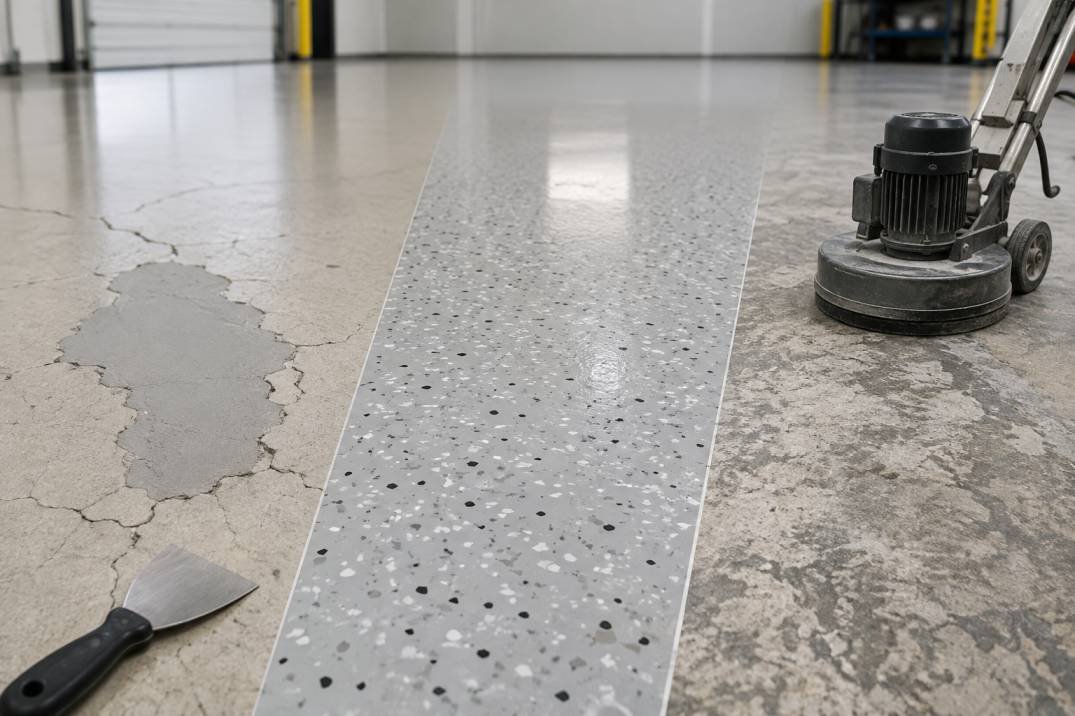
Epoxy Floor Repair and Recoating: Patch, Overlay or Strip
October 28, 2026
Team
You can repair an epoxy floor when the coating is still bonded to the concrete. Chips get patched, worn topcoats get sanded and recoated, and a whole floor can take an overlay. If the coating is peeling, bubbling or lifting from the slab, it has to come off, because new coating over a failed bond fails at the same line.
Most people search for epoxy floor repair after spotting a lifted corner or a dull patch by the roller door. The first decision matters. Cover the wrong problem and you’ll pay for the job twice.
How do you tell which fix your floor needs?
Work out where the failure starts. If the coating is firmly bonded and only the surface is worn, scratched or dull, you can patch or recoat. If it lifts off the slab or bubbles, the bond has failed and removal is usual. Resin Masters’ peeling guide says to check whether the failure is at the concrete or between layers.
|
What you see |
Bond |
Usual fix |
|---|---|---|
|
Chip or gouge, edges still tight |
Sound |
Patch: grind out, fill, recoat the spot |
|
Dull, scuffed or faded topcoat |
Sound |
Sand and recoat the topcoat |
|
Worn through to the base colour in traffic lanes |
Sound but thin |
Overlay: abrade the floor and add a new system |
|
Yellowing or chalking in the sun |
Usually sound |
Recoat with a UV-stable topcoat |
|
Peeling edges or lifting near the door |
Failed |
Strip the failed area, fix the cause, recoat |
|
Bubbles or blisters across the floor |
Failed, often moisture |
Test moisture, strip, add a barrier if needed, recoat |
Bubbling that spreads over time points to the slab, not the surface. Our guides to why epoxy floors bubble and how to stop epoxy floor peeling cover the causes.
When is a patch repair enough?
A patch works for localised damage where the surrounding coating is firmly bonded: a dropped-tool chip, a gouge or a small worn spot. The damaged section is ground back to sound material, filled and recoated. Resin Masters’ peeling guide says every loose or poorly bonded section must come out first.
The same guide warns against brushing away loose flakes and applying fresh epoxy over the area, because the new material anchors to the same compromised coating. It also says edges need feathering so the repair doesn’t leave a ridge that becomes a weak point under traffic.
Expect the patch to show on an older floor. Fresh resin rarely matches a coating that has aged in the sun, so a full-area recoat gives a more even result.
When does a recoat or overlay work?
A recoat works when the existing epoxy is still bonded but worn, scratched or faded. The installer sands the surface, repairs damage and applies a fresh topcoat. Clean & Coat, a Brisbane and Gold Coast recoat business, says recoating costs 30 to 50 per cent less than a full strip and recoat.
Its process is assessment, surface sanding, damage repair and a UV-stable topcoat. That matches what we’d expect: an overlay is only as good as the bond underneath it, so the old floor needs an adhesion check first.
Timing matters too. Resin Masters’ peeling guide notes that a layer left to cure too far before the next goes on may need sanding or grinding to create a mechanical bond. An old, glossy floor is the extreme case of that.
When does the old epoxy have to come off?
Old epoxy has to come off when it’s peeling, bubbling or lifting, when moisture is behind the failure, or when nobody knows what’s under it. Clean & Coat says full removal is needed for coatings that peel, bubble or lift off the concrete. New coat over a bad bond peels again.
- Failure is spread across the floor. Several lifted areas usually mean a slab or moisture problem, not bad luck.
- Moisture is behind it. Resin Masters’ bubble guide says spot repairs tied to moisture usually don’t hold for long.
- Layers of unknown product. A previous DIY kit, paint or sealer under the epoxy is a weak layer. Resin Masters’ flake page says previous paint or sealer is removed during grinding.
- The coating has yellowed or worn beyond recoating. Sanding won’t fix a floor that has lost its bond.
How is epoxy removed, and what does it cost?
Professionals mostly grind or shot blast the coating off, sometimes adding chemical strippers on edges or thin layers. Painters Link Group quotes $25 to $50 per m2 for professional mechanical removal and $40 to $70 for heavy industrial work. Resin Masters lists old coating removal as assessed at quote.
|
Method |
How it works |
Trade-off (Painters Link Group) |
|---|---|---|
|
Grinding or shot blasting |
Diamond or PCD blades, or steel shot, strip the coating and profile the slab |
Fast and consistent; needs dust extraction |
|
Chemical stripping |
Solvent or citrus strippers soften the coating for scraping |
Quieter but messy; less effective on industrial epoxy |
|
Heat |
Heat guns soften thin layers for scraping |
Slow on large areas |
Resin Masters’ published extras help you budget the rebuild. Crack and defect repair is $5 to $20 per m2 for heavily damaged slabs, and a moisture barrier is $3 to $8 per m2. See the epoxy flooring cost guide for base rates. Removal is the cost most owners don’t budget for.
Why do repairs fail?
Repairs fail when they treat the symptom. A patch over a damp slab lifts again, and a recoat over a contaminated surface peels. Resin Masters’ guides trace most failures to preparation, moisture or a system that doesn’t match the site. Find the cause first, then pick the fix.
If moisture is on the list, test before you spend anything. Our guide on how to test concrete moisture before epoxy explains the methods. Its point is that a low reading from a handheld meter doesn’t approve a coating on its own.
Water problems need fixing at the source. Resin Masters’ peeling guide says coating over an ongoing water problem only hides it temporarily, so check downpipes, drainage and garage door seals as well.
What about dust when old epoxy is ground off?
Grinding concrete and coatings makes dust, and Safe Work Australia says grinding can release respirable crystalline silica. It says that dust can cause silicosis, lung cancer and kidney damage, and that controls can prevent exposure. Professionals use extraction and protective gear. Read the regulator’s guidance before any DIY grinding.
Safe Work Australia’s crystalline silica page explains the hazard. If you hire the job out, ask what dust controls the crew will use. Your state regulator sets the rules for your site.
Can you repair epoxy yourself?
Small cosmetic damage on a sound floor is a fair DIY job, and Resin Masters‘ peeling guide agrees. DIY patch kits are less reliable where peeling is widespread, moisture is suspected or the concrete was previously sealed. Painting over a failed floor buys a few months at best.
If you try it, work only on firmly bonded edges. Cut back to sound material, keep the slab clean and dry, and don’t coat over a spot that’s still damp. If the patch lifts within weeks, stop and get the slab assessed. Contact Us!
Who is this repair guide not for?
This isn’t for floors with an active leak, rising water or a moving slab. Those need the source fixed before any coating goes down. It also isn’t for anyone hoping a coat of paint over peeling epoxy will last, because it won’t.
- Owners whose floor is failing because of a leak, drainage fault or rising damp. Fix that first.
- Floors with wide, moving cracks. Resin Masters’ warranty guide says concrete can move and the coating may reflect it.
- Anyone expecting the original installer’s warranty to cover damage from impact, abuse or flooding; read the terms in our warranty guide.
Frequently asked questions
Can you recoat an epoxy floor without removing it?
Yes, if the existing coating is still firmly bonded and the surface is only worn, scratched or faded. The installer sands the floor, repairs damage and applies a new topcoat. If it’s peeling, bubbling or lifting, the old coating has to come off first.
How much does epoxy floor removal cost per square metre?
Painters Link Group quotes $25 to $50 per m2 for professional mechanical removal and $40 to $70 for heavy industrial work. Resin Masters lists old coating removal as assessed at quote, so ask for a site visit. Price varies with thickness and condition.
Can you patch a small chip in an epoxy floor?
Yes, when the coating around it is bonded. The chip is ground back to sound material, filled and recoated, with edges feathered so no ridge remains. On an older, sun-aged floor the patch may still show, so a full recoat gives a more even colour.
How do I know if my epoxy floor has failed or is just worn?
Worn floors look dull or scratched but stay firmly bonded. Failed floors lift at edges, bubble, or peel to bare concrete. A professional can run an adhesion test to be sure. If in doubt, don’t coat over it until the bond has been checked.
Can Resin Masters repair or strip my floor?
Its guides describe approaching peeling floors through preparation, moisture control and system selection, and its flake page says previous paint or sealer is removed during grinding. The site doesn’t list repair of other installers’ floors as a service, so book a free on-site quote and ask.
Also Read:- Quartz Epoxy Flooring: A Slip-Resistant Joint-Free Option