Servicing : Gold CoastBrisbaneSunshine CoastToowoomba

Menu
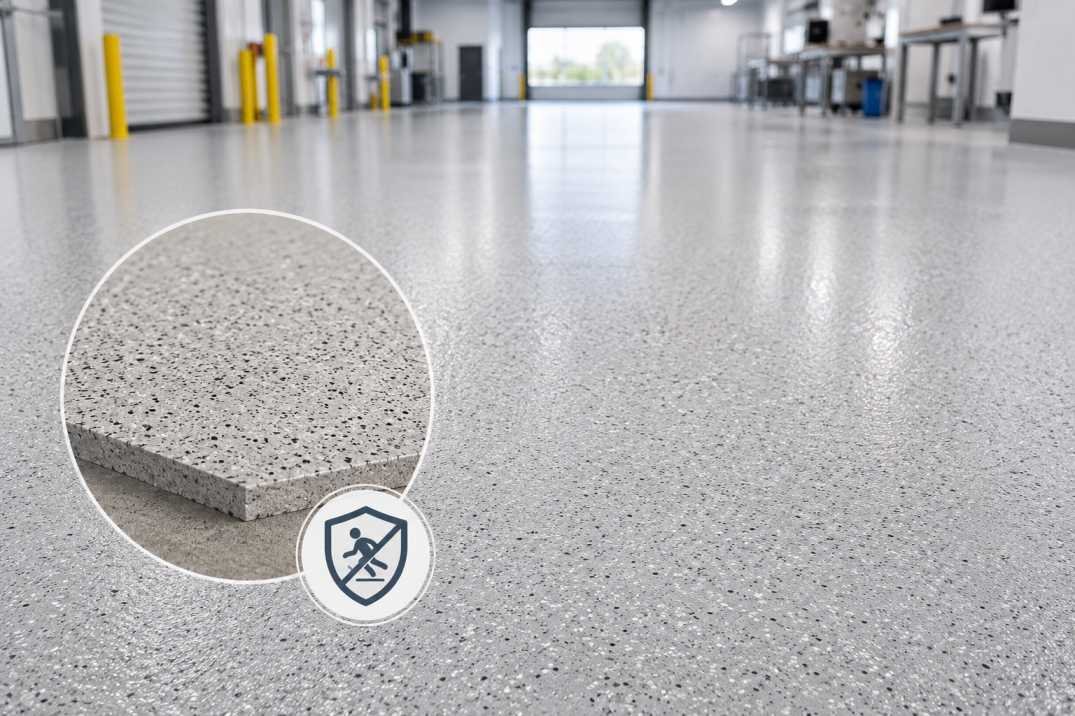
Quartz Epoxy Flooring: A Slip-Resistant Joint-Free Option
October 27, 2026
Team
Quartz flooring, in epoxy terms, is a joint-free resin floor where coloured quartz grains are broadcast into the wet coating and sealed under clear topcoats. The grains give it a gritty surface that grips underfoot, so it suits wet areas, pool surrounds and commercial kitchens. It sits at the grippy end of the epoxy range.
Search “quartz flooring” and you’ll also meet engineered stone tiles and benchtops. This post covers the epoxy version only. If you’re weighing grip against cleaning effort, that trade-off is most of the decision.
What is quartz epoxy flooring?
Quartz epoxy flooring is a resin system where graded, coloured quartz sand is broadcast into a wet epoxy base coat, then locked in with clear topcoats. Sherwin-Williams, a US coatings maker, describes it as multiple coloured quartz grains broadcast into epoxy resin and sealed with a clear coat. The result is a hard, textured, joint-free floor.
Australian suppliers sell it in grip-focused ranges. All Purpose Coatings’ Quartz Shield range lists a variant for outdoor areas, patios and pool surrounds, alongside indoor decorative versions.
Resin Masters’ published price list names “metallic or custom quartz” epoxy as its top rate band. Its site has no dedicated quartz page, so the details of its quartz spec are worth asking for in writing.
How is quartz different from flake and solid colour?
Solid colour is a flat coloured coat. Flake broadcasts vinyl chips into it, and quartz broadcasts mineral grains instead. Quartz carries the most texture, so it grips best but takes the most effort to clean. Resin Masters’ flake floors use multi-colour vinyl chips and can take a fine anti-slip additive.
|
Solid colour |
Vinyl flake |
Quartz |
|
|---|---|---|---|
|
Surface |
Smooth, often glossy |
Lightly textured chip pattern |
Gritty, granular texture |
|
Grip |
Needs an additive for wet areas |
Fine anti-slip additive often added |
Texture is built in |
|
Cleaning |
Easiest to wipe |
Sweeps and mops easily |
Grit holds dirt; more mopping effort |
|
Best for |
Workshops, warehouses, dry rooms |
Garages, showrooms, light commercial |
Wet areas, patios, kitchens, ramps |
|
Resin Masters published rate |
$50 to $90 per m2 |
$60 to $110 per m2 |
$100 to $160+ per m2 (listed as metallic or custom quartz) |
For the flake system in detail, see our flake epoxy guide.
Is quartz epoxy flooring slip resistant?
Usually more than smooth epoxy, because the grains create texture that the topcoat doesn’t fill. No floor is slip proof, though. Grip depends on grain size, how much clear sealer sits on top, and what’s on the surface. Sherwin-Williams notes that extra clear sealer reduces the textured finish.
Resin Masters’ slip guide makes the same trade-off: more texture means more traction when wet, but heavily textured finishes hold dirt and take longer to mop. Oil, soap film and fine dust can cut grip on any surface, quartz included.
What do slip ratings like P4 and P5 mean?
AS 4586 classifies the slip resistance of new surfaces using a wet pendulum test, and it gives a P rating from P0 to P5. Higher numbers mean more friction. Zerofal, a slip-testing firm, lists P4 at 45 to 54 and P5 above 54 on the pendulum scale.
Zerofal also notes that AS 4663 covers testing of existing floors after installation. The rating you need depends on the room and the regulations for your project, so ask your builder or certifier.
Resin Masters’ industrial page says independent slip-resistance testing can be arranged through a qualified testing provider where a project needs it. Ask for a test report on the actual system, meaning the same grain size and topcoat, not a generic brochure rating. Our guide to choosing slip-resistant epoxy covers the wider decision.
Where does quartz epoxy flooring make sense?
Quartz makes sense where a floor gets wet and people walk on it: pool surrounds, commercial kitchens, patios and ramps. Suppliers list these uses. It’s overkill for a dry double garage, where a flake floor with a fine additive already grips well.
- Pool surrounds and patios. All Purpose Coatings lists its grip variant for these. Resin Masters has a page on patio epoxy flooring if the area is covered.
- Commercial kitchens and food prep. Hills Waterproofing, a Sydney company, recommends quartz or polymer aggregates for commercial kitchens, pool decks and medical facilities.
- Loading docks and car parks. All Purpose Coatings lists both among uses for its quartz range.
- Wet-area entries. Anywhere rain gets tracked in and a smooth gloss would be a hazard.
How is a quartz epoxy floor built?
The slab is diamond ground, cracks are repaired and primer goes on. A coloured epoxy body coat follows, and quartz is broadcast into it while wet. After cure, loose grains are swept off and clear topcoats lock the rest in. The number of topcoats sets how gritty the finished floor feels.
- Prepare. Diamond grinding, crack repair and a moisture test, the same standard preparation as any Resin Masters floor.
- Prime and body coat. The coloured resin layer holds the quartz.
- Broadcast. Quartz goes into the wet body coat, then sweeps back once cured.
- Seal. One or more clear coats bind the grains. For outdoor areas, ask for a UV-stable topcoat.
Coat counts vary by product. All Purpose Coatings lists its quartz variants as 5-coat to 7-coat systems, so ask any installer exactly what goes on and in what order.
How thick is a quartz epoxy floor?
Thicker than a plain coat. Sherwin-Williams gives a nominal 1/8 inch, roughly 3 mm, for its standard quartz system. Resin Masters’ published builds are 2 to 3 mm for residential and light commercial systems and 2 to 6 mm for industrial. Get the build for your specific quartz spec in writing.
Our epoxy floor thickness guide explains what those millimetres buy you in wear and impact resistance.
What does quartz epoxy flooring cost?
Resin Masters‘ published rate for metallic or custom quartz epoxy is $100 to $160+ per m2, GST included. Solid colour is $50 to $90 and decorative flake is $60 to $110. On a 20 m2 area, quartz works out at roughly $2,000 to $3,200 or more, before extras.
Extras sit on top. Crack and defect repair is $5 to $20 per m2 on heavily damaged slabs, and a moisture barrier is $3 to $8 per m2. Small spaces may carry a flat minimum project fee. The full breakdown is in our epoxy flooring cost guide.
A free on-site quote gets you an itemised written price within 48 hours of the visit. Ask to see a quartz sample board while they’re there.
How do you clean a quartz epoxy floor?
Sweep or vacuum grit often, then mop with a neutral cleaner. Textured floors trap dirt between the grains, so a soft-bristle brush or a firmer mop head does more than a flat mop. Skip waxes and silicone dressings, because a glossy film cuts traction.
Resin Masters’ slip guide gives the same advice on films. Wipe oil spills quickly, and rinse cleaner off so no soap layer builds up. Contact Us!
Who is quartz epoxy flooring not for?
Skip quartz if you want a smooth, easy-wipe surface in a dry room, or you’ll walk on it barefoot daily and dislike grit underfoot. It also won’t suit a slab with active moisture. Grip does nothing for a bond that’s failing.
- Anyone who wants a glossy, mirror-like metallic look; texture works against it.
- Bedrooms, living areas and other barefoot spaces, unless you’ve stood on a sample first.
- Slabs with untreated moisture problems, which need testing and treatment before any coating.
- Buyers who need a certified slip rating but haven’t asked the installer for a test report.
Frequently asked questions
Is quartz epoxy the same as quartz stone flooring?
No. Quartz stone flooring and benchtops are engineered stone slabs or tiles. Quartz epoxy is a poured resin floor with quartz grains broadcast into it. The name overlaps, but the products, joints and installation are different. Check which one a quote describes.
Is quartz epoxy good for outdoor patios?
It can be, if the system is textured and the topcoat is UV-stable. All Purpose Coatings lists a grip variant for patios and pool surrounds. Resin Masters’ standard topcoat is a UV-stable polyaspartic. Ask any installer to confirm the outdoor spec in writing.
Can you walk on quartz epoxy barefoot?
That depends on grain size and how many topcoats sit over it. Finer grades feel gentler than coarse ones. Ask for a sample board and stand on it before you order. Resin Masters brings colour samples to its free consultation.
How long does a quartz epoxy floor last?
There’s no honest single figure for every floor. Sherwin-Williams says life depends on traffic, climate and abuse, and slab preparation matters most of all. Resin Masters gives a written 7-year workmanship warranty, so ask what that warranty covers for your specific quartz system.
Is quartz epoxy a good garage floor?
It grips well, but most garages don’t need that much texture. Resin Masters’ usual garage system is flake with a fine anti-slip additive and a polyaspartic topcoat, which is easier to sweep. Our garage floor epoxy guide covers the options.
Also Read:- Is Epoxy Flooring Safe? Fumes, VOCs, Kids and Pets
Tags: Quartz Epoxy Flooring