Servicing : Gold CoastBrisbaneSunshine CoastToowoomba

Menu
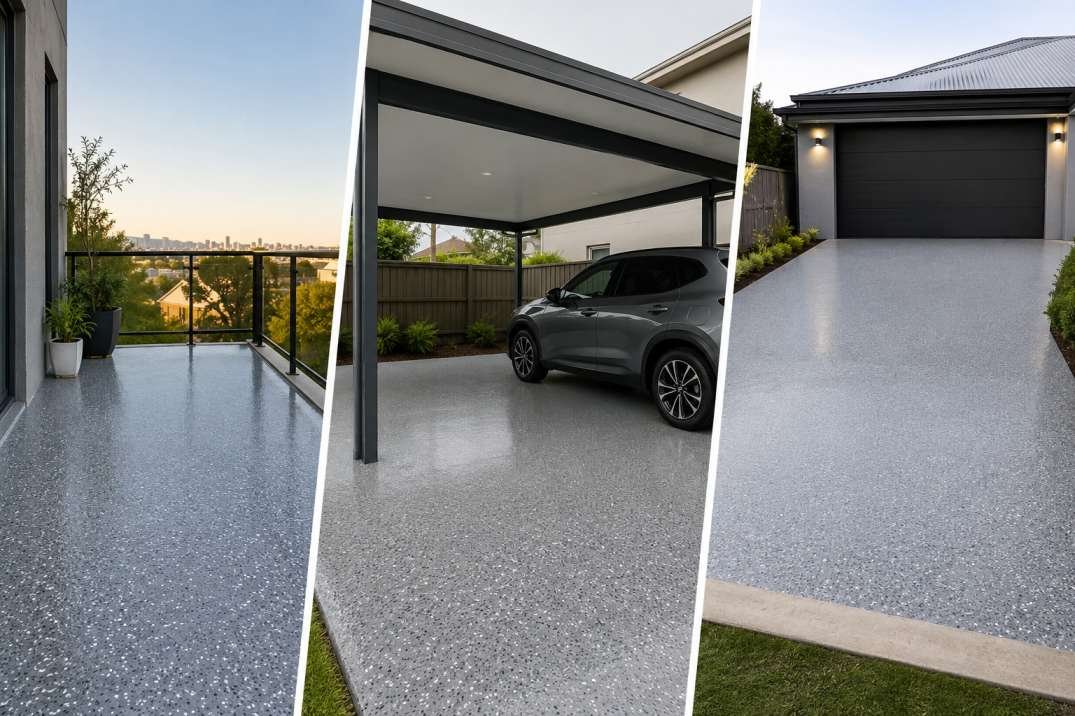
Can You Epoxy a Balcony, Carport or Driveway?
October 30, 2026
Team
A balcony floor coating is the hard one. A balcony over a living space is a waterproofing job first, so ask who owns that risk before any epoxy goes down. Carports and driveways are easier: epoxy over sound concrete works when the topcoat is UV-stable, the surface has anti-slip texture and the slab isn’t damp underneath.
Plenty of installers will say yes to all three and quote the same system. That’s where trouble starts. Sun, water and traffic hit a balcony, a carport and a driveway very differently, and one indoor-style garage system won’t suit them all.
Which outdoor areas suit epoxy, and which need caution?
Epoxy suits open concrete slabs that are sound, drain well and aren’t holding water underneath. Driveways and carports usually fit. Balconies need caution because the floor may be part of the building’s waterproofing. The table shows the main risk for each area and the question to put to any installer.
|
Area |
Sun and weather |
Main risk |
Ask the installer |
|---|---|---|---|
|
Balcony over a room |
Sun and rain, sometimes partly roofed |
Waterproofing and the height at the door |
Who is responsible for the membrane, and how much height does the coating add? |
|
Carport |
Less direct sun, blown-in rain |
Oil, hot tyres, damp slab edges |
How many hours of direct sun does this slab get? |
|
Driveway |
Full sun, full weather |
UV, heat, slope, wet grip |
Is the topcoat polyaspartic, and what anti-slip aggregate is in it? |
|
Patio or alfresco |
Mixed |
UV and wet grip |
See our patio epoxy flooring page |
Can you epoxy a balcony floor?
Sometimes, but only after someone confirms what sits under the floor. If the balcony covers a room, its waterproofing has to stay intact and be detailed correctly at the door. Treat epoxy as a wearing surface, and get any waterproofing claim from the installer in writing.
The Queensland Building and Construction Commission’s technical feature on balcony doorways says AS 4654 was adopted into the Building Code of Australia in May 2013. It says AS 4654.2 gives construction details aimed at stopping leaks at door sills. The same 2017 note says most building contractors were unaware of the basics.
Height is the other trap. Resin Masters’ bathroom epoxy flooring page says epoxy over tiles adds about 5 to 8 mm to the floor. On a balcony, that can eat into the step at the door, which is the spot AS 4654.2 is aimed at keeping dry.
Some online pages go further. One Brisbane installer’s balcony page says epoxy “instantly makes it waterproof”. We couldn’t find that backed by a standard or data sheet, so ask for the product’s data sheet before you accept it.
Balconies aren’t listed on Resin Masters’ published outdoor pages. Treat a balcony as a question for a site visit, not a given.
Can you epoxy a carport floor?
Often, yes. A carport gets less direct sun than a driveway. Resin Masters’ outdoor flooring page for the Gold Coast says covered and semi-covered areas can use epoxy with a UV-stable polyaspartic topcoat. Oil, hot tyres and damp slab edges still need checking first.
Ask how many hours of direct sun the slab gets. That page poses the same question. A carport open on the western side can cop more sun than the roof suggests.
Hot tyres are the other carport issue. Our guide to fixing hot tyre pickup explains the problem, and it’s worth reading before you choose a system.
Can you epoxy a driveway?
It can be done, but a driveway is the toughest outdoor test. It gets full sun, rain, hot tyres and no shelter. Resin Masters’ Gold Coast page lists driveways among the places a UV-stable polyaspartic coating suits, and says standard epoxy isn’t recommended for fully exposed areas.
Slope matters too. Bunnings’ page on coating a driveway with Dulux products says its coating shouldn’t go on gradients steeper than 1:8, or 7 degrees. That’s a paint range, not epoxy. It still shows why a steep driveway needs a different conversation.
Slab joints and cracks move outdoors. Ask how the installer treats them, and what the warranty says about slab movement. Our epoxy floor warranty guide explains why movement in the concrete is a common exclusion.
Why does sunlight decide which system you need?
UV is a topcoat problem, and it decides how long an outdoor floor keeps its colour. Resin Masters’ patio page says indoor-grade polyurethane topcoats can yellow within 12 to 18 months in full Australian sun, while a UV-stable polyaspartic topcoat holds colour far longer. Ask for the topcoat by name.
Our polyaspartic vs epoxy guide covers the chemistry. The point here is simpler. A quote that says “epoxy” and nothing about the topcoat isn’t specific enough for an outdoor slab.
How do you stop an outdoor epoxy floor being slippery?
Build grip into the topcoat and ask for the rating. Resin Masters‘ patio page says it broadcasts AS 4586-appropriate anti-slip aggregate into the topcoat for pool-adjacent and high-traffic areas. Wet feet on a smooth balcony or a sloped driveway are the risk. Ask which aggregate is used and whether it can be tested.
More texture means more grip and a floor that’s harder to sweep. Our guide to slippery epoxy floors walks through that trade-off.
What does an outdoor slab need before any coating goes on?
An outdoor slab needs diamond grinding, a moisture test and crack repair before coating. Resin Masters’ patio page says outdoor slabs face weathering, thermal cycling and often years without protection. It also says slabs near garden beds or with poor drainage commonly carry more moisture, so test rather than guess.
- Grinding, not acid etching. Resin Masters’ patio page calls etching inadequate for outdoor thermal cycling.
- A moisture test. See how to test concrete moisture before epoxy.
- Crack and defect repair. Cracks left open show through and let water in.
- Drainage. A slab that holds water will fail, however good the coating is.
Preparation basics are in our guide to preparing concrete for epoxy.
What does an outdoor epoxy floor cost?
A fair price needs a site visit. Resin Masters’ published rates, which include GST, run from $50 to $90 per m2 for solid colour and $60 to $110 for decorative flake. Outdoor specification, slab repairs and slope move the figure, so treat those rates as an anchor and ask for an itemised quote.
Extras matter outdoors. Crack and defect repair is listed at $5 to $20 per m2 for heavily damaged slabs, and a moisture barrier at $3 to $8 per m2. Old coating removal is assessed at quote. Our epoxy flooring cost page has the full picture.
If a patio or alfresco floor is your project, a free on-site quote lets you compare specifications, not only prices. Contact Us!
Who is an outdoor epoxy coating not for?
Outdoor epoxy isn’t for a balcony with a failing membrane, a slab holding water or a steep driveway. A coating won’t fix leaks or drainage. If water is getting into the room below or pooling on the slab, solve that first with the right trade.
- Balconies over living areas where nobody has confirmed the waterproofing.
- Slabs that stay wet, or show damp patches after rain.
- Anyone planning a retail kit on a fully exposed slab. Resin Masters’ patio page says kits typically use non-UV-stable topcoats.
- Owners who want a warm, soft surface underfoot. Epoxy is hard and cool.
Frequently asked questions
Can you put epoxy on an apartment balcony?
Possibly, but check three things first. Find out whether the balcony floor belongs to your lot or the building. Ask a licensed waterproofer about the membrane. Confirm how much height the coating adds at the door. Get all three answers in writing before booking.
Will epoxy stop a balcony leaking?
Don’t count on it. A leak points to the membrane, flashings or door sill, which sit beneath any coating. AS 4654 covers external above-ground membranes. Have a waterproofer assess the leak, and ask any coating installer for written evidence before you accept a waterproofing claim.
Is epoxy suitable for a carport floor?
Often, yes. Covered areas get less direct sun, and Resin Masters’ Gold Coast outdoor page says covered and semi-covered spaces can use epoxy with a UV-stable polyaspartic topcoat. Check the slab for oil, damp edges and how much afternoon sun reaches it.
How long does an outdoor epoxy floor last?
Resin Masters’ patio page says a correctly specified outdoor system, with a UV-stable polyaspartic topcoat, keeps its colour and gloss for 12 to 20 years. Its written 7-year workmanship warranty covers delamination and adhesion failure from preparation or installation. Actual life depends on sun, slab and use.
Can I use a Bunnings epoxy kit on a driveway?
You can try, but outdoor slabs punish shortcuts. Resin Masters’ patio page says retail kits typically use acid-etch preparation and a topcoat that isn’t UV-stable, which can yellow within one or two summers. Read the pack for outdoor and vehicle ratings first.
Tags: Can You Epoxy a Balcony