Servicing : Gold CoastBrisbaneSunshine CoastToowoomba

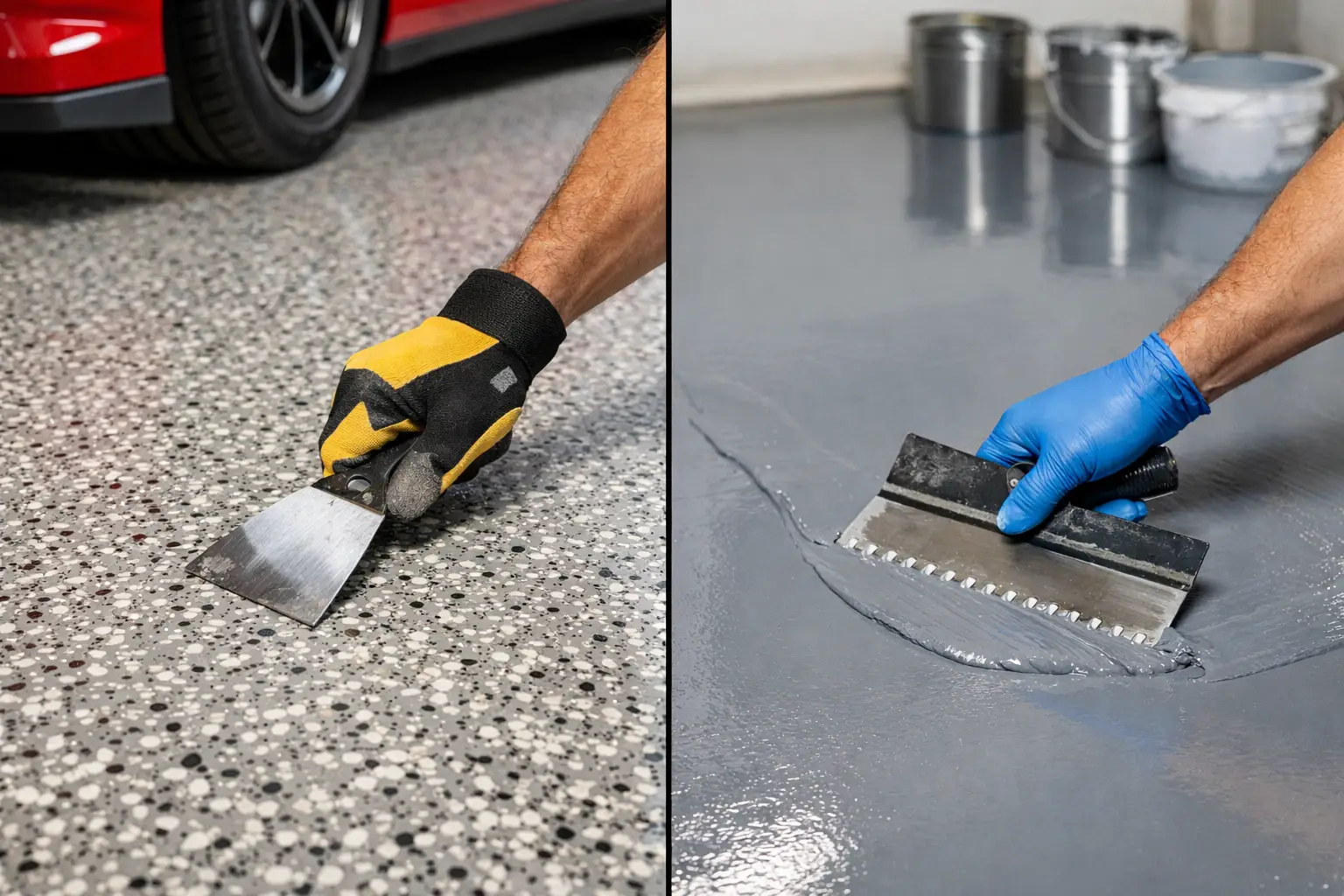
Polyaspartic vs Epoxy Flooring: Which Wins?
A garage floor can look fine on day one and still fail early if the coating system does not suit the slab, the traffic or the local climate. That is why polyaspartic vs epoxy flooring is not just a product comparison. It is a performance decision that affects durability, appearance, downtime and long-term value.
For property owners and facility managers, the right answer depends on how the floor will be used, how quickly it needs to return to service, and how well the installer handles preparation and moisture. In Queensland, that last point matters more than many people realise. Humidity, warm temperatures and concrete moisture can make or break a resin floor before the topcoat even goes down.
Polyaspartic vs epoxy flooring: the core difference
Epoxy and polyaspartic are both resin-based coating systems, but they behave differently during installation and in service. Epoxy is widely used as a base coating because it bonds well to properly prepared concrete, builds film thickness and delivers strong mechanical performance. Polyaspartic is often used as a topcoat or a full system where fast return to service and UV stability are priorities.
The biggest practical difference is cure speed. Epoxy generally takes longer to cure, which can be an advantage for installation control but means more downtime. Polyaspartic cures much faster, which is attractive for busy households, commercial sites and warehouses that cannot afford to have an area out of action for days.
That speed, however, cuts both ways. A fast-curing product leaves less room for error. If the installer is not experienced, or the conditions are not well managed, the finish can suffer. This is why product choice should never be separated from installer capability.
How epoxy performs in real-world spaces
Epoxy remains a strong option for many residential, commercial and industrial floors. When applied over correctly prepared concrete, it creates a hard-wearing, seamless surface that resists stains, tyre marks, abrasion and day-to-day wear. It is also highly versatile in finish, whether you want a plain solid colour, a decorative flake system or a metallic look.
For garages, epoxy performs well under parked vehicles, tool traffic and general storage. In workshops and warehouses, it can provide the thickness and toughness needed for heavier use. For retail and commercial settings, it gives a clean, professional finish that is easier to maintain than bare concrete.
The trade-off is that standard epoxy is not the best performer under prolonged UV exposure. In outdoor or highly sun-exposed areas, some epoxy systems can amber over time. That does not always affect function, but it can affect appearance. Cure time is the other factor. If you need a fast turnaround, epoxy on its own may not be the best fit.
Where polyaspartic stands out
Polyaspartic is known for fast curing, strong chemical resistance and better UV stability than many epoxy coatings. That makes it especially useful where appearance needs to stay sharp in bright light or where downtime has to be kept to a minimum.
In practical terms, a polyaspartic topcoat can help a garage or commercial floor return to service faster than a traditional epoxy-only system. It also tends to hold its colour better in sunlit spaces, which is useful for openings near roller doors, carports or commercial entries with high natural light.
Polyaspartic can also offer excellent abrasion resistance and a very clean finish. The catch is that it is usually more expensive than epoxy, and because it cures quickly, installation precision becomes even more critical. If the slab has moisture issues, contamination or poor preparation, the speed of cure will not save the floor. It will only expose the problem faster.
What matters more than the label on the drum
A lot of online comparisons make this sound like a simple product battle. It is not. The floor system only performs as well as the slab underneath and the preparation before coating.
Grinding, crack repair, surface profiling and moisture assessment are not optional extras. They are the foundation of the job. In humid coastal conditions, moisture vapour in concrete is a serious issue. If it is not managed properly, coatings can blister, delaminate or fail prematurely, whether they are epoxy, polyaspartic or a combination of both.
That is why premium installers often use epoxy as part of a broader system and match topcoats to the environment and use case. The strongest result is often not epoxy versus polyaspartic. It is epoxy and polyaspartic used where each performs best.
Polyaspartic vs epoxy flooring for garages
For a residential garage, both systems can work well, but the best choice depends on your priorities. If you want a decorative flake floor with strong impact resistance, solid value and proven long-term performance, an epoxy-based system is often an excellent option. It is especially suited to garages used for parking, storage, home gyms or weekend workshop use.
If your garage gets strong sun, if you want the floor back in action quickly, or if you are focused on retaining colour stability over time, a polyaspartic topcoat can be a smart upgrade. In Queensland summers, hot tyres, heat cycles and open-front garages create tougher conditions than many homeowners expect. A professionally installed system designed for those conditions will outperform a cheap DIY kit every time.
Slip resistance also needs attention. A glossy finish might look impressive, but garages and external transition areas still need to be safe underfoot. The right texture level should be selected based on how the space is used, especially where water or dust can be present.
For warehouses and commercial sites, downtime changes the answer
In industrial and commercial settings, the question often shifts from aesthetics to logistics. How long can the area be offline? What chemicals are present? How much forklift, pallet jack or foot traffic will the floor carry?
Epoxy can be the right choice where a heavier-build system is needed and the programme allows for cure time. It is widely trusted in warehouses, back-of-house commercial areas and manufacturing environments because it delivers thickness, strength and dependable wear characteristics.
Polyaspartic becomes more attractive when shutdown windows are tight. If a commercial site needs a fast turnaround over a weekend or during a limited maintenance period, cure speed can justify the extra cost. UV stability also matters in showrooms, open industrial units and spaces with large glazed entries.
For compliance-focused sites, slip resistance should never be an afterthought. The coating needs to be specified for the environment and tested against the relevant requirements, particularly in areas where cleaning, spills or weather exposure affect safety.
Cost, lifespan and value
Epoxy is generally more budget-friendly upfront. For many property owners, that makes it the better value option, especially when installed as a high-quality multi-layer system over properly prepared concrete. A cheaper epoxy job, however, is rarely good value if preparation is rushed or moisture is ignored.
Polyaspartic usually costs more, but there are cases where it earns its keep. Reduced downtime, better UV resistance and faster project completion can make it a sound investment for busy homes, retail sites and operational facilities.
Lifespan depends less on marketing claims and more on the full system design, substrate condition and installation quality. A professionally installed epoxy floor can last for many years. A well-built system that includes a polyaspartic topcoat can also deliver excellent long-term performance. Neither product is magic. Both need the right conditions and skilled application.
So which should you choose?
If you want strong all-round performance, decorative flexibility and solid value, epoxy is often the practical starting point. If quick return to service and UV stability are high on the list, polyaspartic deserves serious consideration. For many premium floors, the best outcome is a system that uses both, rather than forcing a one-or-the-other choice.
That is the approach taken by experienced contractors who look at the slab, the environment and the way the floor will actually be used. A garage in Brisbane with afternoon sun, a coastal commercial site on the Sunshine Coast, and a warehouse in Toowoomba do not all need the same answer.
If you are weighing up polyaspartic vs epoxy flooring, focus less on hype and more on fit. The right floor is the one that handles your traffic, suits your timeline, meets safety requirements and still looks sharp after years of hard use. A good coating can improve concrete. A well-specified, professionally installed system can protect the whole space.