
“Bobby was super friendly and extremely knowledgable. Amazing with his craft, the end result was fantastic. 100% recommend to anyone.”
James EdwardsGoogle review
Day spa epoxy flooring has two jobs that pull in different directions. In the wet rooms, showers and change rooms it has to stay grippy under bare, wet feet and be easy to keep hygienic. At reception and in the treatment rooms it has to look calm and expensive. Resin Masters installs seamless epoxy floors that do both, for day spas, wellness studios and beauty clinics across Brisbane, the Gold Coast, Logan and Ipswich.


What’s the best flooring for a day spa? It depends on the room. For wet rooms, showers, change rooms and pedicure areas, a seamless epoxy floor with coved edges and a textured, barefoot-friendly finish is hard to beat: no grout, nothing for water to get under, and easy to clean. For reception and dry treatment rooms, a satin solid colour or subtle metallic epoxy gives a calm, continuous look, though some spas prefer the warmth of timber-look vinyl or carpet in massage rooms.
| Room | Epoxy? | What matters most | What we’d usually install |
|---|---|---|---|
| Wet rooms, showers, Vichy and body-treatment rooms | Yes | Constant water, bare feet, hygiene | Seamless solid colour, coved edges, textured anti-slip topcoat, fall to the drain kept |
| Change rooms and amenities | Yes | Wet floors, daily cleaning | Solid colour or flake, coved edges, anti-slip topcoat |
| Pedicure and foot-ritual areas | Yes | Water from foot baths, bare feet | Coarser anti-slip finish around the bowls |
| Reception and retail | Yes | Looks, foot traffic | Satin or gloss solid colour, or a subtle metallic |
| Treatment and massage rooms (dry) | Optional | Calm look, quiet, warmth | Satin solid colour, or leave to vinyl or carpet if you want a softer feel |
| Laundry and back of house | Yes | Water, detergent, trolleys | Solid colour, coved to the drain |
| Plunge pool and hydrotherapy surrounds | Often | Pool water, chemicals, bare feet | See our swimming pool epoxy flooring page |
| Steam rooms and saunas | Ask us | Sustained heat and moisture | Usually tile or a specialist heat-rated system; we’ll advise on site |
Grout is where spa wet rooms go wrong. It absorbs water and product, darkens, and is hard to keep looking clean between treatments. A seamless epoxy floor is one waterproof surface, and where it meets the wall we form a coved edge so there’s no corner for water and residue to sit in.
For these rooms we:
Commercial bathroom and wet-area systems are published at $90–$140 per m². More detail on our bathroom epoxy flooring page.
Spa guests walk barefoot and wet, often after oil-based treatments. In Australia, slip resistance for this kind of area is tested under AS 4586 using the wet barefoot ramp test, which gives a class of A, B or C (C is the grippiest). Areas where people wear shoes use the wet pendulum test (P0 to P5).
The class each room needs depends on how it’s used, so confirm it with your designer, certifier or WHS adviser. We set the aggregate and texture room by room and can arrange independent testing and documentation where your lease or insurer asks for it. The result depends on the texture chosen, so the class is confirmed by testing for your project and isn’t quoted from a chart. Our guide on whether flake epoxy is slippery when wet explains how texture changes grip.

| Finish | The look | Where it works | Price per m² |
|---|---|---|---|
| Solid colour epoxy (satin or gloss) | Calm, continuous, one tone from room to room | Treatment rooms, corridors, back of house | $55–$80 |
| Flake epoxy | Fine speckle, stone-like, hides water marks | Change rooms, pedicure areas | $65–$90 |
| Metallic epoxy | Soft movement, like polished stone or water | Reception, relaxation lounge | $120–$180 |
| Wet-area system with coving and aggregate | Seamless and practical | Showers, wet rooms, amenities | $90–$140 |
| Epoxy over existing tiles | Same finishes, no tile removal | Any sound tiled room | $60–$170 |
Prices are Resin Masters’ published 2027 ranges, including GST and a written warranty. The polyaspartic topcoat is far more UV-stable than standard epoxy, which helps colours hold under spa lighting and daylight. We bring physical samples to the site visit so you can judge colours in your own rooms.
Spa and salon floors are covered for up to 3 years. The period depends on how the floor is used and is written on your quote. See our warranty terms.
Spa designers often weigh up the same three finishes. An honest comparison:
| Epoxy | Microcement | Tile | |
|---|---|---|---|
| Joins | None; coved at the walls | None on the surface | Grout lines throughout |
| Look | Satin to high gloss; solid, flake or metallic | Matte, hand-trowelled, natural stone feel | Endless choice; grout always visible |
| Water and chemicals | Waterproof once cured; chemical-resistant topcoat | Relies on its sealer, which needs reapplying over time | Tile is waterproof; grout absorbs and stains |
| Grip for bare feet | Aggregate added to the topcoat | Depends on the sealer and texture | Depends on the tile’s rating |
| Over existing tiles | Yes, if tiles are sound | Yes, if tiles are sound | Usually means removal |
| Repairs | Damaged areas can be patched and recoated | Patches can be visible | Individual tiles replaced |
If you want the soft, matte, plastered look, microcement is the natural choice. If you want a floor that’s fully seamless into the wall and tougher against water and cleaning chemicals, epoxy is the stronger option for wet rooms.
Most spas can’t close for a week. A typical floor takes 2–3 days. Light foot traffic is possible about 24 hours after the final topcoat; wet rooms need the full 7-day chemical cure before showers and the normal cleaning routine resume. If you need rooms back sooner, ask us about a fast-cure polyaspartic system. Larger spas can be done room by room so you keep trading. We use 100% solids, low-VOC to near-zero-VOC epoxy to keep odour down, and can supply safety data sheets. After-hours and weekend work is quoted on request.
We’re based in Pimpama and work with spas across South East Queensland:
Running nail services too? See nail salon epoxy flooring, or our salon epoxy flooring page for hair and beauty salons.
Press play to hear customers talk about their new floors, or read what customers are saying about Resin Masters on Google.
White-base flake garage. Our standard flake system over a crisp white base, with a polyaspartic topcoat. The customer does the talking.
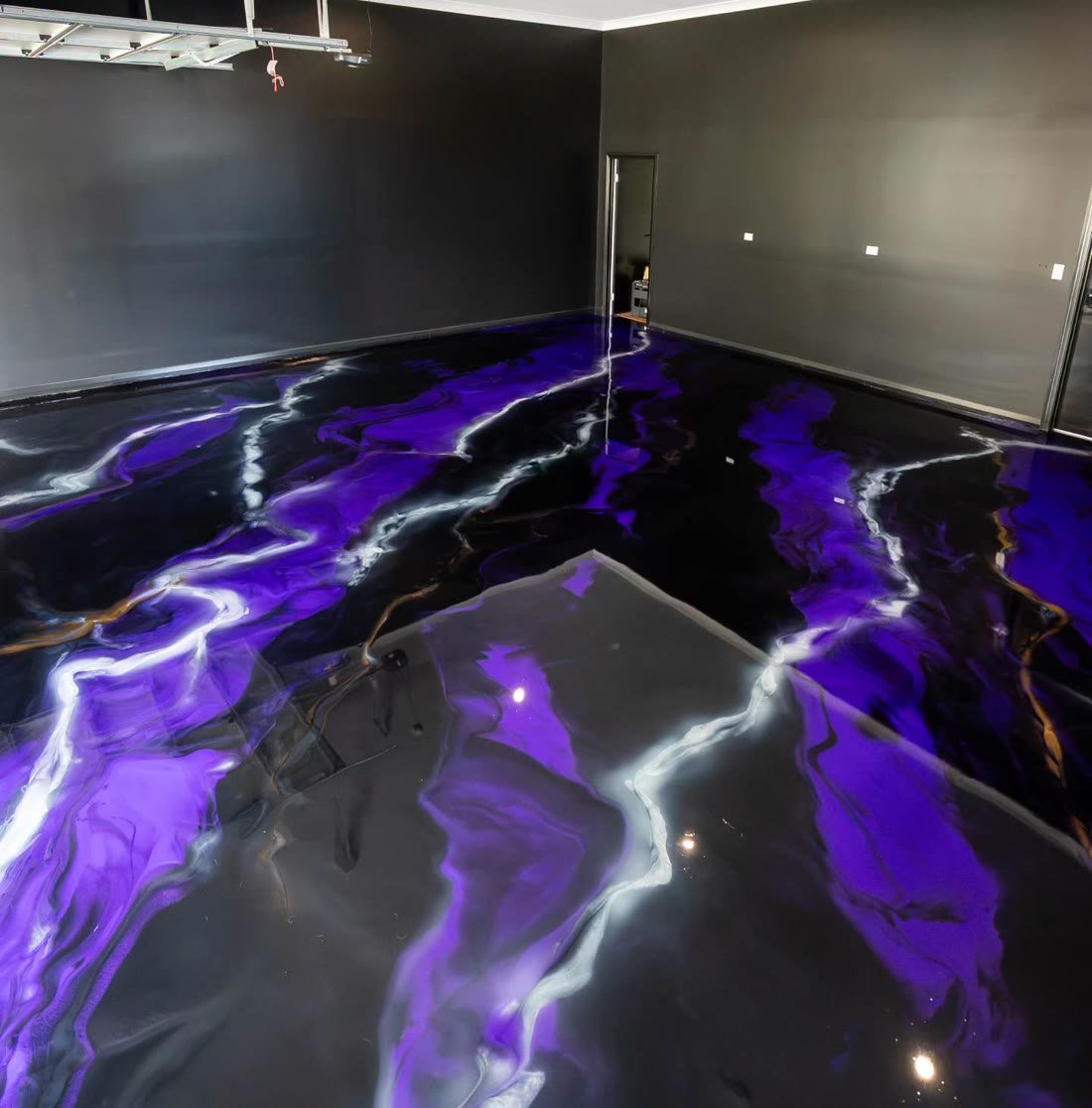
Black and purple metallic. A glossy metallic floor in black and purple, with white veins and a touch of gold. Hear it from the customer.
“Bobby has done an exceptional job for our warehouse here on the Gold Coast. Very clean, and tidy finishing, would not fault!”
Want a floor like these? Send us a photo of the space and we’ll quote it for free.
Get a free quote“Bobby was super friendly and extremely knowledgable. Amazing with his craft, the end result was fantastic. 100% recommend to anyone.”
“Got our outdoor patio sorted before the weekend. The boys were super punctual, easy to deal with, and handled the whole job here in Yarrabilba with zero hassle. Our flake floor looks so amazing. Cheers and Thank you Resin Masters.”
“Had the Resin Masters team out to do my garage floor in Ormeau last week. The old concrete was constantly dusty and had a couple of nasty cracks in it. The boys ground it all back, patched up the cracks, and laid down the full flake epoxy. Honestly looks insane, like a proper showroom. No more dust tracking into the house. Highly recommend these guys if you want a quality finish.”
Rating and reviews from our Google Business Profile.
For wet rooms, showers, change rooms and pedicure areas, a seamless, coved epoxy floor with a textured topcoat. For reception and dry treatment rooms, a satin solid colour or metallic epoxy, or vinyl or carpet if you want a softer feel in massage rooms.
Not with the right finish. We broadcast anti-slip aggregate into the topcoat in wet and barefoot areas and can arrange AS 4586 wet barefoot testing if you need a documented class.
Microcement gives a matte, hand-finished look but depends on a sealer that needs maintaining. Epoxy is fully seamless, can be coved up the wall, and stands up better to constant water and cleaning chemicals.
Usually, if the tiles are well bonded. We grind and prime them and coat over the top, keeping the fall to the drain. Loose tiles are removed first.
Not usually. Sustained high heat and steam need a system rated for it, and tile or a specialist coating is often the better choice. We’ll tell you on site.
Usually 2–3 days for the work. Light foot traffic after about 24 hours; wet rooms back in full use after the 7-day cure. If you need rooms back sooner, ask us about a fast-cure polyaspartic system.
From $55–$80 per m² for solid colour in dry rooms and $90–$140 per m² for wet areas, up to $120–$180 per m² for metallic, including GST and a written warranty.
Tell us which rooms you want done and when you can close them. We’ll visit, check the floors and drains, show you finishes in your own lighting and send an itemised quote by room.
Other floors we lay for the same kind of space.
Snap the space as it is now, tell us roughly how big it is, and we’ll come back with a free quote.
Turn plain concrete into a luxury floor.