Servicing : Gold CoastBrisbaneSunshine CoastToowoomba

Menu
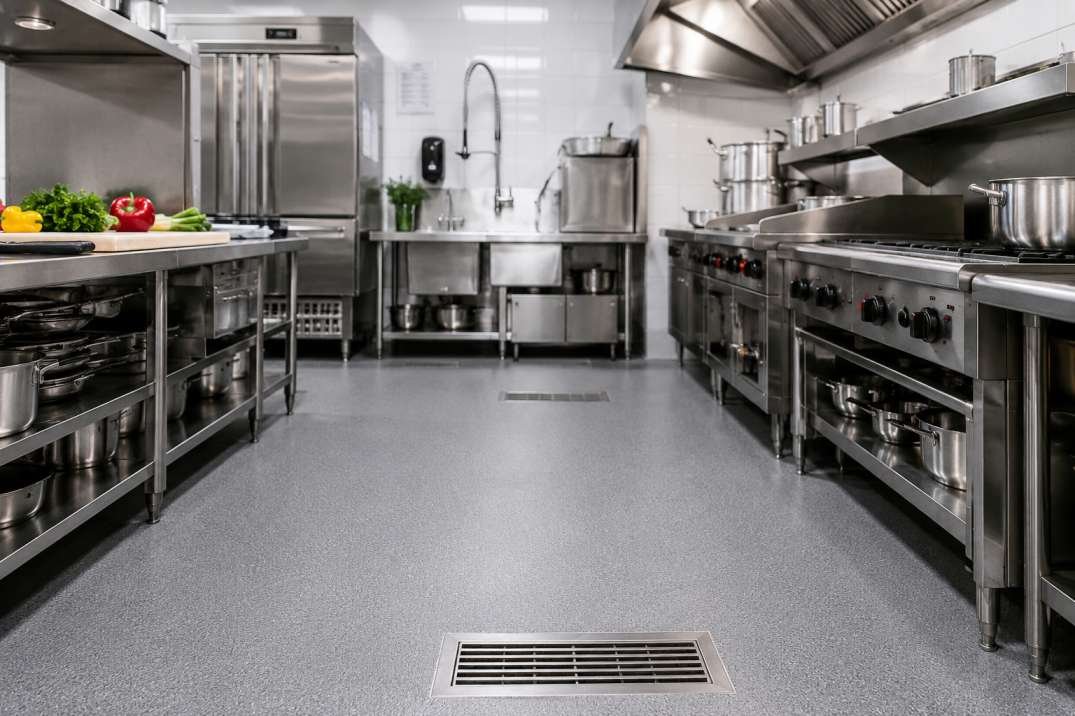
Commercial Kitchen Floor Requirements QLD & Sunshine Coast (2026 Guide)
July 29, 2026
Team
Quick Answer: Commercial kitchen floors in Queensland must be seamless, non-absorbent, easily cleanable, and slip-resistant under Australian Standard AS 4674-2004 and HACCP food safety protocols. A minimum slip rating of R11–R12 (AS 4586) is required in oil-wet kitchen zones. Epoxy and polyurethane resin systems are the industry-standard solution because they meet all these requirements simultaneously — something tiles and other flooring types struggle to achieve.
Opening or renovating a commercial kitchen anywhere in Queensland — from a Brisbane café to a Hastings Street restaurant in Noosa — means navigating a specific set of flooring requirements that go well beyond aesthetics. Health inspectors assess flooring directly, and getting it wrong can mean failed inspections, costly rework, and unplanned closures. Here’s exactly what’s required, and why epoxy has become the industry standard.
The Core Requirements for Commercial Kitchen Flooring in QLD
- Seamless and Non-Absorbent
Queensland food safety regulations require commercial kitchen floors to be free of cracks and crevices, with a smooth, non-absorbent surface. Floors must not absorb grease, food particles, or water, and cannot harbour pests or allow ponding water to accumulate. This is the primary reason tiled floors — despite their durability — are increasingly avoided in new commercial kitchen fitouts: grout lines are inherently porous and create exactly the kind of crevices these regulations are designed to eliminate.
- Compliance with AS 4674-2004
Australian Standard AS 4674-2004 governs the design, construction, and fit-out of food premises, with specific requirements for floor surfaces in food preparation areas. Flooring must be durable under thermal shock, resistant to acids and the cleaning regimes commercial kitchens require, and capable of withstanding constant exposure to hot oil, animal fats, and harsh cleaning chemicals.
- HACCP-Aligned Design
Hazard Analysis and Critical Control Points (HACCP) is the food safety management framework underpinning commercial kitchen compliance across Australia. While HACCP itself doesn’t certify specific flooring products, it places significant emphasis on the physical environment — and a seamless, joint-free, non-porous floor surface directly supports HACCP-aligned facility design by eliminating hiding spots for bacteria, mould, and moisture.
- Slip Resistance — AS 4586
Slip resistance is a critical, non-negotiable safety requirement. Under AS 4586, commercial kitchens require a minimum slip rating of R11 to R12 for oil-wet areas — the rating system that measures how a surface performs under wet, greasy conditions typical of a working kitchen. This rating is achieved by broadcasting aggregate (commonly aluminium oxide or quartz sand) into the epoxy topcoat during installation. Get a free Quote!
Why Epoxy Meets These Requirements Better Than Alternatives
|
Requirement |
Epoxy/Resin Systems |
Tiles |
|
Seamless surface |
Yes — fully monolithic, no joints |
No — grout lines present throughout |
|
Non-porous |
Yes — impervious to grease and liquids |
Grout is porous and absorbs contaminants |
|
Slip resistance (R11-R12) |
Achieved via broadcast aggregate |
Variable, depends on tile texture |
|
Chemical resistance |
Excellent — resists fats, acids, cleaners |
Grout degrades under chemical exposure |
|
Coved skirting integration |
Standard — seamless wall-floor junction |
Difficult — requires separate detailing |
|
Thermal shock resistance |
Good with correct system specification |
Can crack under rapid temperature change |
Coved Skirting: A Critical Detail
A properly specified commercial kitchen epoxy installation includes coved skirting — a smooth, curved transition between the floor and the wall, eliminating the sharp right-angle junction where dirt, moisture, and bacteria would otherwise accumulate. This detail is frequently overlooked in budget quotes but is essential for genuine compliance and easy cleaning.
Sunshine Coast Hospitality-Specific Considerations
The Sunshine Coast’s strong, year-round hospitality and tourism sector — spanning fine dining in Noosa, casual dining across Mooloolaba and Maroochydore, and everything in between — creates specific demands beyond the baseline QLD requirements:
- Higher humidity from the coastal subtropical climate increases bacterial growth risk, making antimicrobial resin additives a worthwhile specification
- Salt air in coastal-adjacent venues can affect standard finishes faster than inland kitchens — a factor worth discussing with your installer
- Tourism-driven trading volumes mean minimal downtime during installation is a genuine business priority — staged installation and fast-curing systems are often worth the investment
- Thermal shock resistance matters significantly given the temperature extremes between walk-in coolers and active cooking stations in a busy kitchen
Choosing the Right Epoxy System for Your Kitchen
Different zones within a commercial kitchen often warrant different specifications. General food prep areas typically use a standard 3-4mm seamless epoxy system. High-moisture zones like dishwashing and walk-in coolers benefit from a quartz-broadcast system offering enhanced slip resistance. Areas near fryers and grills, facing significant thermal shock risk, often perform better with a hybrid epoxy-polyurethane system offering superior heat resistance. Contact Us!
What to Provide Your Inspector
Queensland health inspectors will want documentation confirming your flooring meets the relevant standards. A reputable commercial kitchen flooring installer will provide product specification sheets, slip-resistance test results, and confirmation the installation methodology supports HACCP-aligned design — though final compliance verification always rests with the relevant health authority for your specific premises.
Also Read:- Is Epoxy Flooring Good for Beach or Coastal Homes? (Honest Guide)
Frequently Asked Questions
What slip rating does a commercial kitchen floor need in Queensland?
A minimum of R11 to R12 under AS 4586 is required for oil-wet areas typical of commercial kitchen food preparation zones.
Are tiles acceptable for a commercial kitchen in QLD?
Tiles can technically be used, but the grout lines create compliance challenges around seamlessness and bacterial harbourage that epoxy and resin systems avoid entirely — which is why epoxy has become the dominant industry choice for new commercial kitchen fitouts.
How long does commercial kitchen epoxy flooring take to install?
Typically 2–4 days depending on kitchen size and system specification, though staged installation and fast-curing systems can reduce this for venues needing to minimise trading downtime.
Does Resin Masters provide compliance documentation?
We provide full product specification details and slip-resistance information to support your compliance documentation. Final sign-off always rests with your local health authority based on your specific premises and operations.
Planning a commercial kitchen fitout or renovation on the Sunshine Coast or anywhere in Queensland? Resin Masters specialises in HACCP-aligned, AS 4674-compliant commercial kitchen flooring. Get a FREE quote: +61 433 733 956 or resinmasters.com.au.