Servicing : Gold CoastBrisbaneSunshine CoastToowoomba

Menu
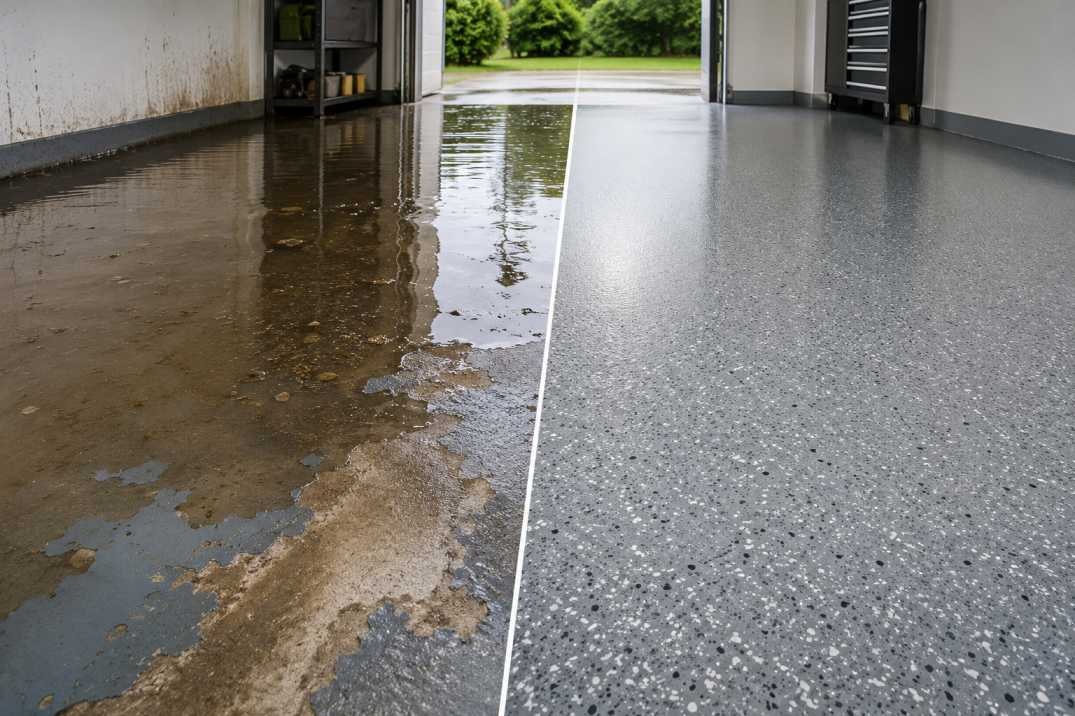
Epoxy Flooring After a Flood: What Survives and What to Redo
October 29, 2026
Team
Epoxy flooring after a flood usually survives surface water, because the cured coating is non-porous. The risk is underneath: contaminated water, moisture pressure from below and a slab that stays wet. Bubbling, lifting or a weakened bond can appear days or weeks later.
Wet-season storms are close. If your garage or shop floods, the first job is safety and insurance, not the floor. The floor decisions come once the slab has dried and you know what you’re dealing with.
Does epoxy flooring survive a flood?
Often the coating does, if it was well applied and the bond was sound before the water arrived. Epoxy doesn’t soak up water like carpet or timber. What fails is the bond, and the slab under it. Tough Floors, an Australian installer, notes that poorly applied epoxy leaves concrete exposed at edges.
Tough Floors’ flood-zone article says professionally applied epoxy is a non-porous barrier that can be cleaned after surface water. It gives no drying times, no replace-or-repair guidance and no Queensland flood data. Treat it as encouraging, not a promise.
What survives a flood and what needs redoing?
Sound, well-bonded coating with clean edges is the most likely to survive. Anything that lets water in behind the coating is the most likely to fail: cracks, edges, joints and thin DIY layers. Check each part of the floor separately before deciding what to redo.
|
Part of the floor |
Often survives if |
Likely needs redoing if |
|---|---|---|
|
Coating in the middle of the floor |
Bond is sound and it dries cleanly |
It bubbles, feels hollow or lifts |
|
Edges, cracks and joints |
They were sealed and are still tight |
Water got behind them; edges lift |
|
Thin DIY or paint-type coating |
Rarely; it depends on the bond |
Peels, softens or blisters |
|
Slab underneath |
It dries out fully and tests within limits |
It stays wet or shows efflorescence |
|
Cracked or moved slab |
Movement stopped and cracks are sealed |
New or wider cracks appear |
Efflorescence is the white powdery deposit that salts leave as water dries out. Resin Masters’ moisture-testing guide lists it as a warning sign worth investigating.
What should you do first after floodwater recedes?
Make the building safe before you touch the floor. Photograph the damage for your insurer, and check with them before you change anything. Don’t switch on power or gas until a professional has checked them. Business Queensland says repairs should start only once the house is clear of mud and completely dry.
- Photograph first. ABC Emergency advises taking photos before you move or clean anything.
- Call the insurer. Business Queensland says to check with your insurer before making changes.
- Check services. ABC Emergency says not to turn on gas, electricity or appliances until they’ve been checked.
- Watch for structure. ABC Emergency says a property isn’t safe to enter with signs of structural damage.
The Business Queensland repair page also flags that some repairs need building approval. Ask your council or certifier.
How do you clean a flooded epoxy floor?
Treat floodwater as contaminated. Queensland Government says it’s often contaminated by sewage from overflowing systems and by agricultural or industrial wastes. NSW Health advises washing hard surfaces with hot soapy water, then disinfecting with a chlorine bleach solution or a commercial disinfectant. Wear boots, gloves and eye protection.
Coating advice can differ. Executive Surfaces, a Canadian installer, recommends pH-neutral cleaners and no bleach on epoxy. Health authorities recommend disinfectant on hard surfaces. Resolve it by checking the coating’s data sheet or asking your installer which disinfectants it tolerates, then follow the health advice.
Read the NSW Health flood guidance for protective gear and what to discard. Queensland’s flood health and safety page covers mould.
How long before you can tell if the coating survived?
Give it time. Surface water may drain in hours, but a saturated slab can take much longer to dry, and blisters can appear well after cleanup. Resin Masters’ bubble guide says a floor can look fine at first and bubble later if vapour keeps building beneath the coating.
Don’t test moisture on a slab that’s just been flooded or washed, because a recent wet event can skew a surface reading. Resin Masters’ testing guide says a recent rain event or wash-down can do that. It also asks about flooding or leaks during site inspection. See how to test concrete moisture before epoxy.
What are the signs the coating has failed?
Look for bubbles, cloudy patches, lifting edges, cracks, efflorescence, mould or a musty smell. Epoxyfloor.net.au, an Australian installer, lists cracking, discolouration, mould, efflorescence and spalling as signs of water damage to an epoxy floor. Any of these means the slab needs a closer look.
- Bubbles or soft blisters. Vapour or trapped water pushing at the underside. See our guide to why epoxy floors bubble.
- Hollow-feeling or lifting edges. Water has got behind the coating at an edge or crack.
- White powder or staining. Salts carried up as the slab dries.
- Mould or odour. The floor or slab is still holding moisture.
Can you spot repair it, or do you redo the floor?
Spot repair suits minor, isolated defects on a floor that is otherwise bonded and dry. Widespread lifting or delamination points to a redo. Executive Surfaces says spot repairs handle minor bubbling but widespread delamination may need full removal and a new system with better moisture protection.
Resin Masters‘ bubble guide agrees on the first half: small isolated defects may be ground out, patched and recoated. If bubbling is tied to moisture, it says spot repairs usually don’t hold for long. The affected coating may need removing so the slab can be treated.
A barrier has limits. Resin Masters’ moisture barrier guide says an applied barrier can’t fix active water leaks or pressure from an unresolved drainage problem. Fix the water path first, then decide the coating.
Does a flood affect your warranty or insurance?
Possibly. Resin Masters’ warranty guide lists flooding among the exclusions that commonly appear in floor warranties, alongside fire, impact and chemical exposure beyond the system’s tolerance. Read your own warranty document, and ask your insurer whether the floor is covered before you commit to any repair.
Our epoxy floor warranty guide explains how workmanship warranties are usually worded. Resin Masters’ own warranty is a written 7-year workmanship warranty, so ask for the exact terms if a flood has hit a floor it installed.
Does epoxy make a garage more flood-resilient?
Somewhat. Tough Floors says a professionally applied epoxy coating can be cleaned after surface water, whereas carpet and timber can need replacing. But epoxy isn’t a waterproof membrane. It won’t stop water entering sideways or from below, and it doesn’t replace drainage or flood mitigation.
Executive Surfaces makes the same point about water pressure from beneath the slab. If your site floods regularly, ask an installer how the system handles moisture, and read our Queensland humidity guide for how damp slabs behave day to day. Contact Us!
Who is this flood guide not for?
This isn’t for a home or shed with structural damage, contaminated sewage that hasn’t been dealt with, or a slab that’s still wet. Those need safety checks, licensed trades and drying time first. It also isn’t advice on insurance, health or building approvals.
- Anyone who hasn’t yet cleared mud and debris or dried the building.
- Owners with electrical or gas systems that haven’t been checked.
- Properties where council or a certifier has flagged structural concerns.
- Anyone looking for a flood-proofing service; check with the installer whether it offers one.
Also Read:- Epoxy Floor Repair and Recoating: Patch, Overlay or Strip
Frequently asked questions
Will an epoxy floor survive a flood?
Often the coating does, because cured epoxy is non-porous and cleans off. The risk is water getting behind it through edges and cracks, or moisture pressure from the slab. A floor that looks fine can bubble later, so watch it for several weeks as the slab dries.
Can you use bleach on an epoxy floor after a flood?
Health authorities advise disinfecting hard surfaces after floodwater. But some installers advise against bleach on epoxy. Check the coating’s data sheet or ask your installer which disinfectants it tolerates, and follow the health authority’s instructions for contaminated floodwater. Don’t guess.
When can I recoat epoxy after a flood?
Only once the building and slab are clean and completely dry, which is Business Queensland’s condition for starting repairs. Test the slab moisture, remove any failed coating and fix the water source first. Recoating over a damp slab risks the same failure again.
Should I take photos before cleaning a flooded floor?
Yes. ABC Emergency advises taking lots of photos of the damage before you move or clean anything, so you have records for insurance claims. Check with your insurer before making changes, then clean using the health guidance for contaminated floodwater.
Does Resin Masters repair flood-damaged floors?
Its site doesn’t list flood recovery as a service. Its published work is installing epoxy over ground, moisture-tested concrete, with a written 7-year workmanship warranty. For a new floor once your slab is dry, book a free on-site quote and ask about moisture testing.