Servicing : Gold CoastBrisbaneSunshine CoastToowoomba

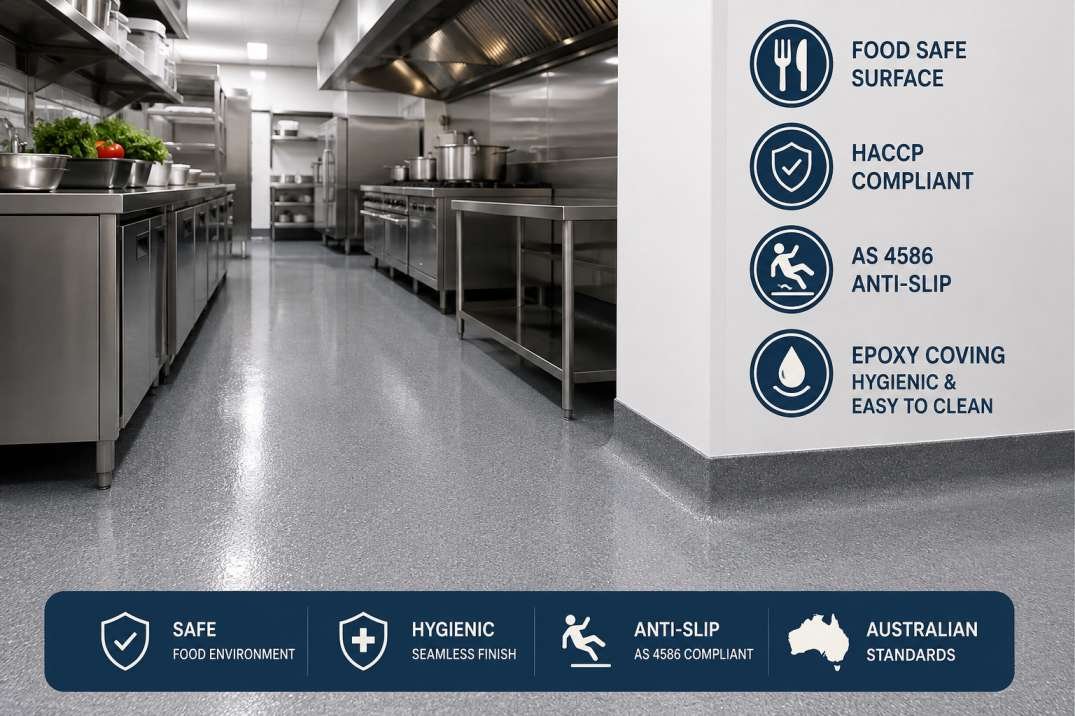
Food-Safe Commercial Kitchen Flooring: Epoxy Coving, HACCP Compliance & AS 4586 Anti-Slip — The Complete Australian Guide
Commercial kitchen flooring is not a decoration decision — it’s a food safety compliance requirement. The Queensland Food Act 2006 and NSW Food Act 2003 mandate that food premises floors be seamless, non-porous, impervious to moisture and food acids, easily cleanable, and slip-resistant for the operating conditions of the space. A commercial kitchen floor that doesn’t meet these requirements exposes a food business to council non-compliance orders, failed health inspections, and the potential for food contamination events with serious consequences.
At Resin Masters, we install food-safe commercial kitchen flooring and commercial kitchen epoxy coving across Brisbane, Gold Coast, Logan, Sunshine Coast, Toowoomba, Ipswich, and Northern NSW — HACCP-aligned systems specified for food regulatory compliance, AS 4586 anti-slip documentation, and the operational demands of Australian commercial kitchens. Every installation uses low-VOC to near-zero-VOC 100% solids commercial-grade epoxy and comes with a 7-year warranty.
What Does ‘Food-Safe’ Mean for Commercial Kitchen Flooring?
Food-safe commercial kitchen flooring must satisfy four technical requirements under Australian food safety law and HACCP principles.
- Seamless and Non-Porous
Commercial kitchen floors must be seamless — no grout lines, no tile joints, no surface cracks — because bacteria, moisture, and food residue accumulate in every joint and crack. Grouted tile floors are the most common compliance failure point in Australian commercial kitchen inspections: regardless of cleaning frequency, grout lines harbour bacteria in an environment where cross-contamination risk is inherent. Epoxy flooring from Resin Masters creates a completely seamless surface from wall to wall, eliminating this failure mode.
- Imperviousness to Moisture and Food Acids
Food processing generates organic acids (citric acid in citrus processing, lactic acid in dairy, acetic acid in pickling and fermented food production) and uses aggressive caustic cleaning agents. The floor coating must resist both without surface degradation that creates absorption zones for contamination. Standard epoxy is adequate for typical food service acid and caustic concentrations. Facilities handling higher acid concentrations or more aggressive cleaning agents require chemical-resistant formulation — we assess each kitchen’s specific chemistry during the on-site inspection.
- AS 4586 Anti-Slip Compliance
Wet commercial kitchen floors must achieve AS 4586 R11 slip resistance as a minimum for general wet areas, and R12 for heavy-wet processing zones. Resin Masters achieves these ratings by broadcasting approved aggregates — aluminium oxide, quartz, or carborundum — into the topcoat during installation, then tests and documents the achieved rating for your food licence application.
- Easily Cleanable — No Harbourage Points
Floor surface profile, coved skirting at floor-wall junctions, and absence of recesses or difficult-to-clean detailing are all HACCP requirements. The floor system must support the cleaning regime in use — hot water, steam, chemical cleaning — without surface degradation. Commercial kitchen epoxy coving is the specific detail that addresses the floor-wall junction compliance requirement.
Commercial Kitchen Epoxy Coving — Why It Matters
Commercial kitchen epoxy coving is the curved or angled transition detail that connects the floor coating to the wall base, eliminating the 90-degree floor-wall junction that is impossible to clean effectively and creates a bacteria-harbourage zone in every food premises inspection protocol.
A flat floor-wall junction in a commercial kitchen accumulates food debris, moisture, and biological contamination in the corner angle regardless of cleaning frequency. HACCP principles explicitly require elimination of harbourage points — and the floor-wall junction is the primary harbourage point in any commercial kitchen that lacks a properly installed cove detail.
Resin Masters installs commercial kitchen epoxy coving as an integral part of the floor system — not applied separately after the floor coating cures. Integral coving bonds within the epoxy system layers, creating a seamless, continuous surface from floor through cove to wall base. This eliminates the adhesion interface at the cove-floor and cove-wall junctions that produces failure in separately applied cove systems. Our cove radius meets HACCP requirements for cleanability and is specified with the same chemical resistance as the floor system it transitions from.
QLD Food Act 2006 and NSW Food Act 2003 — What Each Requires for Kitchen Flooring
|
Requirement |
QLD Food Act 2006 |
NSW Food Act 2003 / Food Reg. 2015 |
Resin Masters System |
|
Seamless surface |
Required — impervious and cleanable |
Required — impervious and cleanable |
100% solids epoxy — seamless from wall to wall |
|
Non-porous |
Required |
Required |
100% solids epoxy — zero porosity after full cure |
|
Slip resistance |
Adequate for operating conditions |
Adequate for operating conditions |
AS 4586 R11 minimum — R12 for wet zones — documented |
|
Coved skirting |
Recommended (HACCP aligned) |
Required under HACCP standard |
Integral cove — same system and chemical resistance as floor |
|
Chemical resistance |
Implied by ‘cleanable’ requirement |
Implied by ‘cleanable’ requirement |
Matched to cleaning chemicals in use — assessed per facility |
|
Documentation |
Not mandated but practically required for licence renewal |
Required for licensing assessment |
AS 4586 test records, product data sheets, specification details |
Commercial Kitchen Epoxy Flooring System — What Resin Masters Installs
Surface Preparation
Industrial diamond grinding to mechanical profile. Previous tile removal and substrate repair where tiles are loose or contaminated beneath. Crack injection and surface defect repair. pH testing and moisture vapour testing — mandatory before any food premises floor installation.
Primer Application
Food-compatible primer matched to the slab’s moisture vapour emission reading. Selected for compatibility with the chemical-resistant epoxy system above it.
Integral Coved Skirting Construction
We build the coved skirting as an integral floor component before applying the main floor system — not as a surface-applied afterthought. The cove profile is formed using a coving former or by hand, bonded to both the substrate and the floor coating layers simultaneously.
Chemical-Resistant Epoxy Base Coat(s)
100% solids low-VOC commercial-grade epoxy in the HACCP-aligned colour direction — typically light grey, off-white, or safety yellow for high-visibility work zones. Applied in one or two coats to the specified build thickness.
Anti-Slip Aggregate Broadcast and Topcoat
Approved anti-slip aggregate broadcast into the wet topcoat to achieve the specified AS 4586 rating. Sealed with a food-safe, chemical-resistant polyaspartic topcoat. The achieved slip resistance rating is tested and documented before handover. Get a free quote!
Commercial Kitchen Epoxy Flooring Cost — Australia 2026
|
Application |
Cost per m² |
Example — 50m² Kitchen |
Includes |
|
Standard Commercial Kitchen Epoxy |
$70–$95 |
$3,500–$4,750 |
Diamond grind, primer, chemical-resistant epoxy, anti-slip topcoat, coved skirting, 7-yr warranty |
|
High-Spec Chemical-Resistant Kitchen |
$90–$120 |
$4,500–$6,000 |
Enhanced chemical resistance, novolac specification where required |
|
Food Processing Wet Zone |
$85–$110 |
$4,250–$5,500 |
R12 anti-slip aggregate, fully coved, HACCP documentation package |
Resin Masters — Serving All 7 Locations Across SEQ & Northern NSW
Resin Masters installs chemical-resistant, food-safe, anti-slip, and specialist epoxy systems across all seven of our service locations. Every installation uses 100% solids low-VOC to near-zero-VOC commercial-grade epoxy and comes with a 7-year warranty.
|
Brisbane — Industrial estates, warehouses, commercial kitchens, workshops |
Gold Coast — Yatala logistics, prestige garages, hospitality venues |
Logan — Crestmead, Beenleigh industrial, residential and commercial |
Sunshine Coast — Kawana, Kunda Park industrial, food processing, hospitality |
|
Toowoomba — Agricultural, manufacturing, trade, Darling Downs industrial |
Ipswich — Wulkuraka, Swanbank, Springfield new estates, Defence corridor |
Northern NSW — Tweed Heads, Byron Bay, Lismore, Northern Rivers hinterland |
|
 +61 433 733 956
 info@resinmasters.com.au
 resinmasters.com.au
Frequently Asked Questions — Food-Safe Commercial Kitchen Flooring & Epoxy Coving
10 mobile-optimised FAQs — structured for Google Featured Snippets, People Also Ask, and AI Overview citation.
What is the best flooring for a commercial kitchen in Australia?
The best flooring for an Australian commercial kitchen is a seamless 100% solids epoxy system with integral epoxy coving and AS 4586 anti-slip aggregate. Epoxy is the specification standard for Australian commercial kitchens because it satisfies the Queensland Food Act 2006 and NSW Food Act 2003 requirements for seamless, non-porous, easily cleanable, and slip-resistant food premises flooring. Resin Masters installs HACCP-aligned commercial kitchen epoxy across Brisbane, Gold Coast, Logan, Sunshine Coast, Toowoomba, Ipswich, and Northern NSW. Every installation comes with a 7-year warranty.
What is commercial kitchen epoxy coving?
Commercial kitchen epoxy coving is the curved or angled transition detail between the floor coating and the wall base in food premises. It eliminates the 90-degree floor-wall junction — the primary bacteria-harbourage point in any commercial kitchen — replacing it with a smooth, seamless, cleanable curve. HACCP principles require elimination of harbourage points, and properly installed integral epoxy coving is the standard solution. Resin Masters builds coved skirting as an integral part of the floor system — bonded within the epoxy layers, not applied as a separate surface treatment.
What AS 4586 slip resistance rating does a commercial kitchen floor need?
Commercial kitchen floors need AS 4586 R11 slip resistance as a minimum for general wet areas — cooking lines, prep benches, general kitchen floor. Heavy-wet processing zones, dishwashing areas, and areas receiving continuous water or food-process fluid require R12. Resin Masters achieves AS 4586 ratings by broadcasting approved aggregates into the topcoat during installation and provides written test documentation for food licence applications and council health inspections.
Does QLD Food Act require seamless kitchen floors?
Yes — Queensland Food Act 2006 and the Australia New Zealand Food Standards Code require food premises floors to be impervious to moisture, easy to clean, and maintained in good repair. Grouted tile floors develop bacteria-harbouring grout line contamination that satisfies neither the impervious nor the easily cleanable standard over time. NSW Food Act 2003 and Food Regulation 2015 carry equivalent requirements. Seamless epoxy flooring is the standard specification for satisfying these requirements in both QLD and NSW.
Can I install epoxy flooring in a commercial kitchen over existing tiles?
Yes — Resin Masters installs commercial kitchen epoxy flooring over existing tiles where the tiles are sound, well-adhered, and the resulting floor height allows for the coved skirting transition. Loose, cracked, or contaminated tiles require removal before epoxy installation. We assess the tile substrate during every free on-site kitchen inspection. For tile-over-tile commercial kitchen installations, we grind the tile surface before applying primer and epoxy to achieve adequate adhesion.
How long does commercial kitchen epoxy flooring last?
Commercial kitchen epoxy flooring from Resin Masters lasts 8–15 years under normal commercial kitchen operating conditions. Factors affecting lifespan include cleaning chemical strength and temperature, daily traffic intensity, and whether the floor was installed with the correct chemical resistance specification for the kitchen’s specific cleaning regime. Our 7-year warranty covers installation-related defects. Floors that regularly exceed the epoxy system’s chemical resistance rating will show reduced lifespan — we confirm chemical compatibility during every kitchen assessment.
How much does commercial kitchen flooring cost in Brisbane?
Commercial kitchen epoxy flooring in Brisbane costs $70–$120 per square metre installed with Resin Masters in 2026. A standard 50m² commercial kitchen costs $3,500–$6,000 including integral coved skirting, AS 4586 anti-slip documentation, and 7-year warranty. Costs vary based on chemical resistance specification, substrate condition, and cove requirements. Resin Masters provides free on-site assessments and itemised written quotes across Brisbane’s hospitality and food-processing sector. Call +61 433 733 956 to book.
Does commercial kitchen flooring need to be slip-resistant?
Yes — Australian WHS legislation and food safety standards both require adequate slip resistance for commercial kitchen floors operating in wet conditions. AS 4586 provides the classification standard: R11 for general wet kitchen floors, R12 for heavy-wet processing zones. Resin Masters specifies the correct AS 4586 rating for each kitchen zone and provides the test documentation required for food licence renewal and council health inspection compliance across all 7 service locations.
What is the best epoxy colour for commercial kitchen floors?
The most common commercial kitchen epoxy colours in Australia are light grey, off-white, and mid-grey — colours that show contamination readily for hygiene monitoring while reflecting adequate light in kitchen environments. Safety yellow is used in marking hazard zones and pedestrian paths within larger food processing facilities. Resin Masters uses food-safe pigments in all commercial kitchen colour specifications. We bring physical colour samples to every free kitchen consultation.
Can I get commercial kitchen flooring installed overnight in Brisbane or Gold Coast?
Yes — Resin Masters regularly installs commercial kitchen flooring overnight or over weekend shutdowns across Brisbane, Gold Coast, Logan, Sunshine Coast, and all other service locations. Our fast-cure polyaspartic topcoat options achieve light foot traffic readiness within 4–6 hours of final coat application, allowing kitchen operations to resume within 24 hours of installation beginning. Contact us at +61 433 733 956 to discuss your kitchen’s operational schedule and our installation planning.