Servicing : Gold CoastBrisbaneSunshine CoastToowoomba

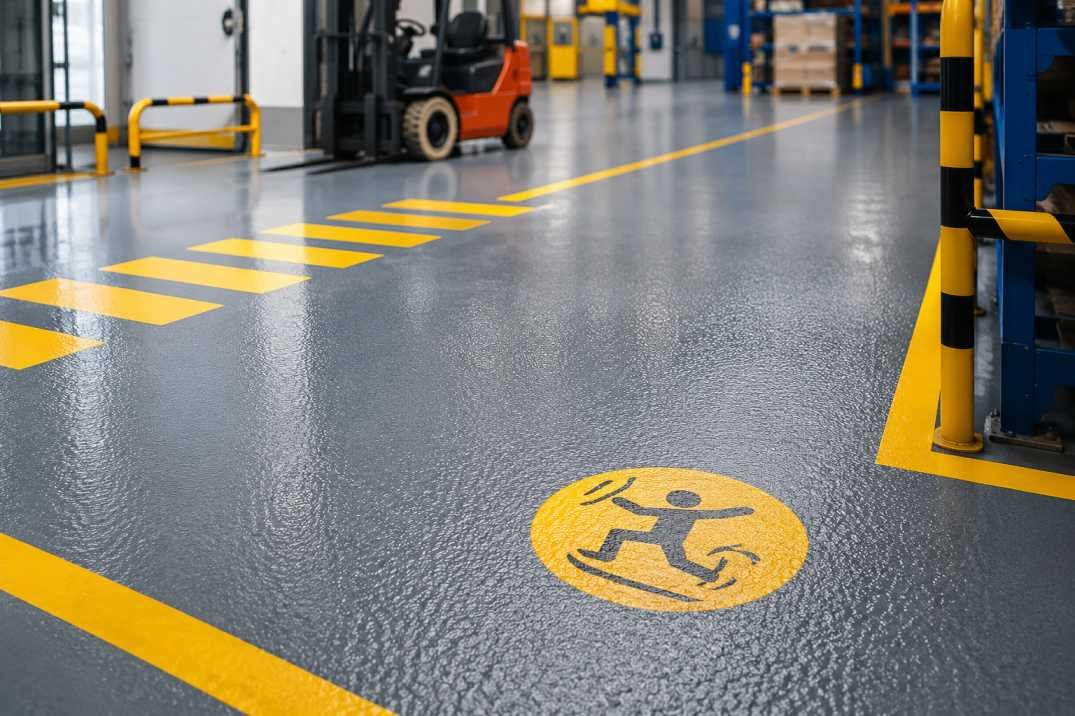
Slip Resistant Industrial Flooring, Safety Line Marking & Slip Resistance Epoxy: The Complete Australian Compliance Guide
Slip and fall incidents are the leading cause of worker injury in Australian industrial environments. The Safe Work Australia data consistently identifies inadequate floor surfaces as a primary contributing factor — and the WHS legislation in both Queensland and New South Wales creates legal obligations for employers to ensure their floor surfaces provide adequate slip resistance for the operating conditions in their facilities.
Resin Masters installs slip resistant industrial flooring, documented AS 4586-rated anti-slip epoxy systems, and integrated safety line marking across Brisbane, Gold Coast, Logan, Sunshine Coast, Toowoomba, Ipswich, and Northern NSW — giving Australian industrial operators the floor systems and compliance documentation their WHS obligations require. Every installation uses low-VOC to near-zero-VOC 100% solids commercial-grade epoxy and comes with a 7-year warranty.
Understanding AS 4586 Slip Resistance — Australia’s Industrial Safety Standard
AS 4586:2013 (Slip Resistance Classification of New Pedestrian Surface Materials) is the Australian Standard used to classify and communicate the slip resistance of floor surface materials. It provides the language that WHS officers, building certifiers, food safety inspectors, and insurance assessors use to evaluate whether a floor surface is adequate for its operating environment.
AS 4586 ratings run from R9 (lowest, dry-only conditions) through R13 (extreme wet industrial environments). The ‘R’ rating refers to the ramp test result — a calibrated assessment of a surface’s frictional coefficient under defined conditions. Higher R ratings indicate greater slip resistance.
|
AS 4586 Rating |
Required Operating Environment |
Typical Australian Industrial Application |
|
R9 |
Low-risk dry pedestrian areas — not suitable for industrial |
Office floors, retail — not applicable to industrial environments |
|
R10 |
Dry industrial — general warehouse, dry storage, loading areas |
Crestmead warehouses, Yatala distribution, general dry industrial |
|
R11 |
Light wet — commercial kitchen general area, light processing |
Kunda Park food businesses, commercial kitchen dry prep zones, cafeteria areas |
|
R12 |
Heavy wet — food processing wet zones, automotive pits, chemical areas |
Lismore macadamia processing, Wulkuraka automotive, Rocklea food manufacturing |
|
R13 |
Extreme wet/chemical — abattoir, chemical manufacturing, agricultural chemical |
Darling Downs chemical storage, high-volume wet food processing |
LEGAL OBLIGATION: Under Queensland Work Health and Safety Act 2011 and NSW Work Health and Safety Act 2011, employers have a duty to provide safe plant and structures — including floor surfaces adequate for the operating environment. Providing a floor surface with inadequate slip resistance for the actual operating conditions is a WHS Act breach. Documented AS 4586 compliance is the standard means of demonstrating that the duty has been discharged.
How Resin Masters Achieves and Documents AS 4586 Ratings
Achieving a specific AS 4586 rating requires broadcasting an approved aggregate into the coating topcoat during installation, then testing the achieved surface. The aggregate creates a controlled surface profile that produces friction under the standardised test conditions, and the quantity, type, and particle size of aggregate determine the achieved rating.
Aggregate Types and Their Effect
Aluminium oxide aggregate: the most common anti-slip aggregate for commercial and industrial applications. Fine grades achieve R11; medium grades achieve R11–R12; coarse grades achieve R12–R13. Aluminium oxide provides a clean, consistent surface finish.
Quartz aggregate: provides good anti-slip performance with a slightly more textured visual result. Used in food processing applications where the aggregate colour is specified for visibility against food contamination.
Carborundum (silicon carbide): the hardest standard aggregate, providing maximum durability of the anti-slip surface profile under heavy traffic. Used in extreme-wear applications and R13 specifications.
Testing and Documentation
Resin Masters tests achieved AS 4586 ratings on every installation requiring documented compliance — using calibrated test equipment on the installed surface before handover. We provide written test records, specification documentation, and product data sheets for your WHS compliance file, food facility licence application, and insurance requirements. This documentation package is the standard evidence base for demonstrating floor compliance in any regulatory or insurance assessment. Explore Industrial Epoxy Flooring
Industrial Floor Safety Line Marking — Built Into the System
Industrial floor safety line marking that’s painted or rolled onto the surface of an epoxy floor wears away under forklift tyre traffic within 12–18 months. Resin Masters integrates safety line marking into the coating system — applied between coating layers so it bonds within the film and achieves the same lifespan as the floor.
What Australian WHS Requires
Queensland and NSW WHS regulations, combined with Safe Work Australia’s Code of Practice for Traffic Management in the Workplace, require defined separation of pedestrian and vehicle traffic in industrial environments — and visible floor marking is the standard means of achieving this separation.
- Yellow pedestrian walkways and corridors — mandatory in any facility with mixed forklift and pedestrian traffic. Width minimum 600mm for pedestrian-only, 900mm for shared emergency egress.
- Forklift lanes and approach corridors — defined boundaries prevent pedestrian entry and support forklift driver attention to path limits.
- Pedestrian exclusion zones around machinery and vehicle loading areas — clearly marked barriers where temporary exclusion is required.
- Emergency equipment locations — fire extinguishers, first aid stations, emergency shower and eyewash, AED locations — all marked on the floor for immediate visibility.
- Racking bay and pallet storage demarcation — prevents aisle encroachment that creates forklift clearance hazards.
- Loading dock vehicle approach zones and stop lines — prevents forklift and vehicle conflict in high-risk dock transition zones.
- Hazardous goods storage zone demarcation — DG storage separation requirements under the Dangerous Goods Act.
Also Read:- Epoxy Flooring Cost Toowoomba QLD (2026 Complete Price Guide)
Slip Resistance Epoxy for Industry — Sector Applications
Food Processing and Commercial Kitchens
The highest slip resistance demand in the Resin Masters service area. Logan’s Crestmead and Meadowbrook food manufacturing sector, the Sunshine Coast’s Kunda Park food businesses, Northern NSW’s Northern Rivers macadamia and dairy processing operations, and Brisbane’s inner-industrial food processing precinct all require R11–R12 anti-slip specification in wet processing areas, with AS 4586 documentation for QLD Food Act 2006 and NSW Food Act 2003 compliance.
Warehousing and Logistics
Dry warehouses across the Yatala and Ormeau Gold Coast logistics corridor, Crestmead and Beenleigh Logan industrial estates, and Brisbane’s Acacia Ridge and Eagle Farm warehousing precincts require R10 for dry floor areas and R11 for cleaning-adjacent or wet dock areas. Integrated safety line marking for forklift lanes and pedestrian walkways is the primary safety investment for most logistics clients.
Automotive and Transport
Automotive workshops across Ipswich’s Wulkuraka precinct, Toowoomba’s vehicle service sector, and Brisbane’s Rocklea and Archerfield trade corridor require R11–R12 in service bays and pit areas where oil, coolant, and water create persistent wet conditions. Safety line marking for traffic management between workshop bays is a WHS requirement for any workshop with more than one vehicle on the floor simultaneously.
Manufacturing and Engineering
Manufacturing facilities across Toowoomba’s Wilsonton and Harristown precincts, Ipswich’s Swanbank and Bundamba manufacturing corridor, and Brisbane’s inner industrial ring require R10–R11 anti-slip specification matched to the facility’s specific wet zone locations, with safety line marking layouts developed from the facility’s traffic management plan. Get a Free Quote!
Slip Resistant Industrial Flooring Cost — 2026
|
Application |
Additional Cost for Anti-Slip Aggregate |
Integrated Line Marking |
Full System Cost/m² |
|
Warehouse floor (R10) |
Included in standard topcoat specification |
$15–$35/m (linear metre) |
$35–$55/m² total |
|
Food processing (R11 wet zone) |
Included — broadcast at correct density |
$15–$35/m (linear metre) |
$70–$95/m² total |
|
Automotive workshop (R12) |
Included at coarser aggregate specification |
$15–$35/m (linear metre) |
$70–$110/m² total |
|
Chemical processing (R12–R13) |
Included — carborundum or coarse aluminium oxide |
$15–$35/m (linear metre) |
$80–$130/m² total |
Resin Masters — Serving All 7 Locations Across SEQ & Northern NSW
Resin Masters installs chemical-resistant, food-safe, anti-slip, and specialist epoxy systems across all seven of our service locations. Every installation uses 100% solids low-VOC to near-zero-VOC commercial-grade epoxy and comes with a 7-year warranty.
|
Brisbane — Industrial estates, warehouses, commercial kitchens, workshops |
Gold Coast — Yatala logistics, prestige garages, hospitality venues |
Logan — Crestmead, Beenleigh industrial, residential and commercial |
Sunshine Coast — Kawana, Kunda Park industrial, food processing, hospitality |
|
Toowoomba — Agricultural, manufacturing, trade, Darling Downs industrial |
Ipswich — Wulkuraka, Swanbank, Springfield new estates, Defence corridor |
Northern NSW — Tweed Heads, Byron Bay, Lismore, Northern Rivers hinterland |
|
 +61 433 733 956
 info@resinmasters.com.au
 resinmasters.com.au
Also Read:- The 3 Types of Epoxy: Choosing the Right Coating for Your Garage Floor
Frequently Asked Questions — Slip Resistant Industrial Flooring & Safety Line Marking
What is slip resistant industrial flooring?
Slip resistant industrial flooring is a floor coating system that achieves a defined AS 4586 slip resistance rating through the broadcast of approved aggregates into the topcoat during installation. The aggregate creates a controlled surface profile that provides friction under foot and equipment contact. Australian WHS legislation requires adequate slip resistance for industrial operating environments — and documented AS 4586 ratings are the standard means of demonstrating compliance. Resin Masters installs AS 4586-rated anti-slip industrial epoxy across Brisbane, Gold Coast, Logan, Sunshine Coast, Toowoomba, Ipswich, and Northern NSW.
What AS 4586 rating does my warehouse floor need?
Dry warehouses with standard pedestrian and forklift traffic require AS 4586 R10. Areas adjacent to cleaning operations or with intermittent wet conditions require R11. Heavy wet industrial areas — food processing wet zones, automotive workshop pits, chemical handling areas — require R12. Extreme wet or chemical processing environments may require R13. Resin Masters assesses your facility’s operating conditions and specifies the correct AS 4586 rating during the free on-site assessment. We test achieved ratings and provide documentation before handover.
Is safety line marking required by law in Australian warehouses?
Yes — Queensland and NSW WHS Acts require employers to manage risks from traffic management hazards, including the separation of pedestrian and vehicle traffic in industrial environments. Safe Work Australia’s Code of Practice for Traffic Management in the Workplace specifies floor line marking as the standard means of defining pedestrian and vehicle lanes. Resin Masters integrates safety line marking into the floor coating system — bonded within the coating layers for the same 7-year warranty lifespan as the floor itself.
How long does anti-slip aggregate last in an industrial floor?
Anti-slip aggregate broadcast into a 100% solids epoxy or polyaspartic topcoat from Resin Masters lasts the full operational life of the topcoat — typically 10–15 years in standard industrial environments before the topcoat shows wear. Anti-slip aggregate painted over an existing floor, or broadcast into a water-based topcoat, wears significantly faster — typically 2–4 years before the aggregate surface is eroded. Our integrated anti-slip specification is covered by the 7-year warranty.
Can I add anti-slip to my existing epoxy floor?
Yes — Resin Masters can apply an anti-slip topcoat over existing epoxy floors where the base system is in sound condition. We assess adhesion and surface condition before recommending a topcoat-over-existing-system approach. The additional topcoat with anti-slip aggregate adds 0.5–1mm to the floor height. Cost is $25–$45/m² for topcoat-only anti-slip application. This is a viable option for facilities that want to upgrade their slip resistance without full floor replacement.
What is the best colour for industrial safety line marking?
Yellow is the Australian standard for pedestrian walkways in industrial environments — matching the Safe Work Australia code of practice specifications. Red is used for fire equipment zones and emergency-only areas. Green marks first aid stations and emergency egress paths in some facilities. White or blue marks general zone demarcation. Resin Masters integrates line marking in the standard safety colours and can customise zone layouts from your facility’s traffic management plan.
How much does industrial floor safety line marking cost in Brisbane?
Integrated industrial floor safety line marking from Resin Masters costs $15–$35 per linear metre across Brisbane and all other service locations, quoted based on the facility layout provided. A standard 500m² Brisbane warehouse with forklift lane and pedestrian walkway marking typically requires 200–400 linear metres of marking, costing $3,000–$14,000 for the marking component. Line marking installed as part of a new epoxy floor installation is significantly more cost-effective than line marking applied to an existing floor. All line marking costs are itemised in your written quote.
Does anti-slip epoxy still feel smooth enough to walk on?
Yes — AS 4586 R10 and R11 anti-slip aggregate provides meaningful grip underfoot without creating a noticeably rough or abrasive surface for regular pedestrian use. R12 and R13 aggregate densities create a more textured surface that is intentionally more grippy for heavy-wet industrial zones. The aggregate particle size and broadcast density determine the texture level. Resin Masters applies the appropriate density for the specified rating — we don’t over-specify texture in zones where pedestrian comfort is also a consideration.
Can epoxy flooring pass a WHS slip resistance inspection?
Yes — a Resin Masters installation with documented AS 4586 testing provides the standard evidence base for demonstrating WHS compliance in any Queensland or NSW WHS inspection. We provide written AS 4586 test records from the installed surface, product specification documentation, and installer records that a WHS officer or insurance assessor would require. Undocumented anti-slip claims — without AS 4586 test records — typically do not satisfy WHS compliance requirements.
Where can I get slip resistant industrial flooring installed near me?
Resin Masters installs slip resistant industrial flooring with AS 4586 documentation across Brisbane (Acacia Ridge, Rocklea, Eagle Farm), Gold Coast (Yatala, Arundel, Stapylton), Logan (Crestmead, Beenleigh, Springwood), Sunshine Coast (Kawana, Kunda Park, Maroochydore), Toowoomba (Wilsonton, Harristown, Wellcamp), Ipswich (Wulkuraka, Swanbank, Redbank Plains), and Northern NSW (Tweed Heads, Lismore, Ballina). Call +61 433 733 956 for a free facility assessment and AS 4586 compliance quote.