Servicing : Gold CoastBrisbaneSunshine CoastToowoomba

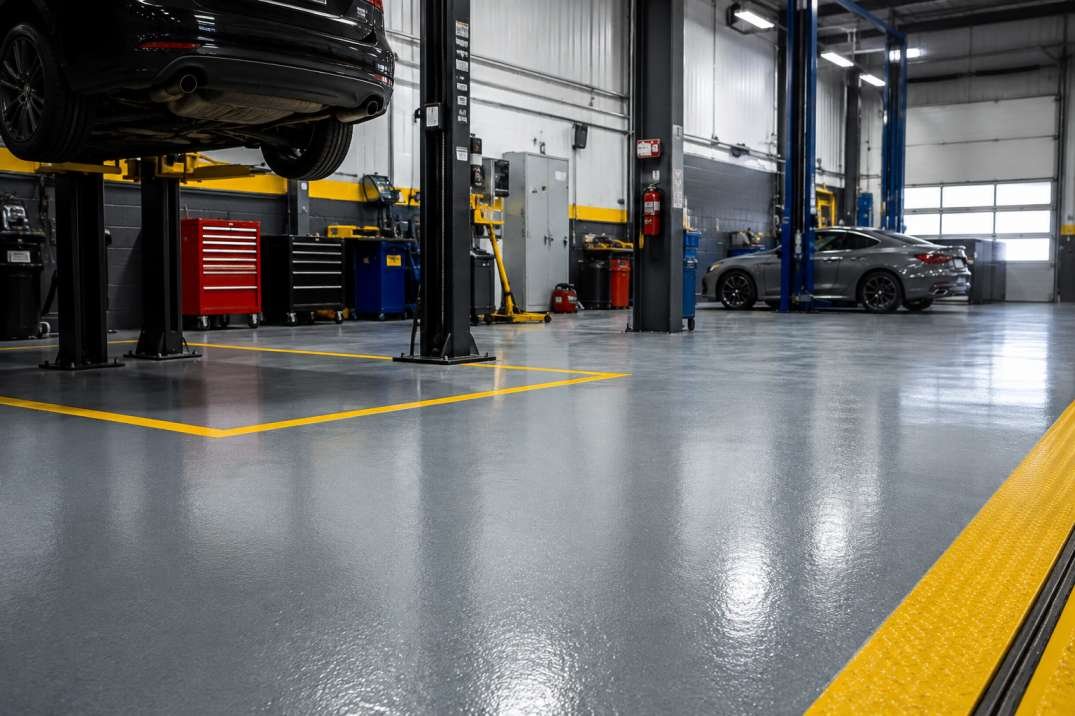
Heavy-Duty Epoxy Screeds & Automotive Workshop Epoxy Flooring: The Specification Guide for Australian Workshops and Factories
Standard epoxy flooring is engineered for vehicle traffic, pedestrian loads, and the chemical exposure of residential garages and light commercial spaces. But Australian workshops, factories, and automotive service operations regularly exceed these parameters — car hoists, counterbalance forklifts, hydraulic press loads, engine cranes, and the daily mechanical intensity of a functioning automotive workshop all create demands that the standard specification isn’t designed to handle.
Heavy-duty epoxy screeds and specialist automotive workshop epoxy flooring address this gap. At Resin Masters, we install heavy-duty epoxy mortar systems and automotive workshop floor coatings across Brisbane, Gold Coast, Logan, Sunshine Coast, Toowoomba, Ipswich, and Northern NSW — specifying the build thickness, aggregate content, chemical resistance, and surface profile that real workshop and factory environments require. Every installation uses low-VOC to near-zero-VOC 100% solids commercial-grade epoxy and comes with a 7-year warranty.
What Is a Heavy-Duty Epoxy Screed?
A heavy-duty epoxy screed — also called an epoxy mortar system — is a trowel-applied floor coating where aggregate (quartz, granite, or aluminium oxide) is blended into 100% solids epoxy resin to create a dense, thick-build material applied at 4–6mm total thickness. This is not a roller-applied coating — it’s a screed that’s trowelled across the floor surface, creating a film thickness multiple times greater than standard epoxy systems.
The aggregate loading in an epoxy screed serves two functions. It provides compressive strength — the ability to resist point loads from machinery, vehicle lifts, and heavy equipment — that exceeds what an unreinforced epoxy film can achieve. And it creates impact resistance, the ability to absorb rather than crack under dropped tools, equipment, and mechanical shock from workshop operations. A 5mm epoxy mortar floor handles impact loads that a 2.5mm standard epoxy floor would crack or chip under.
Heavy-duty epoxy screeds are the correct specification for Australian workshop floors that handle vehicle hoists and car lifts, heavy manufacturing machinery, counterbalance forklifts in confined spaces, drop zones for engine components and heavy parts, and the sustained mechanical cycling of industrial operations running six or seven days a week.
When Do You Need a Heavy-Duty Epoxy Screed Instead of Standard Epoxy?
|
Factor |
Standard Epoxy (2–3mm) |
Heavy-Duty Epoxy Screed (4–6mm) |
|
Vehicle loads |
Cars, light commercial vehicles |
Trucks, heavy vehicles, multiple simultaneous vehicle lifts |
|
Forklift type |
Standard counterbalance up to 3T |
Large counterbalance 3T+, reach trucks, heavy load handling |
|
Impact loads |
Dropped hand tools — tolerable |
Dropped engine components, machinery parts — requires mortar system |
|
Slab condition |
Sound, minimal cracking |
Significant cracking, surface damage, contamination — mortar rebuilds surface |
|
Cost per m² |
$35–$90 depending on spec |
$70–$110 — premium for load capacity |
|
Recommended for |
Standard warehouses, garages, commercial floors |
Automotive workshops, heavy manufacturing, engineering fabrication |
Automotive Workshop Epoxy Flooring — Specific Requirements
Automotive workshop flooring faces a combination of challenges that no other industrial environment creates simultaneously: heavy vehicle loads across the full floor area (not just defined traffic lanes), concentrated point loads at vehicle lift contact points, petroleum and chemical exposure across the entire floor area with no contained zones, hot-tyre contact in service bays receiving continuous vehicle movement, and the mechanical shock of dropped tools and components in an environment where dropping a brake disc or engine part is a normal daily occurrence.
Car Lift and Hoist Point Loads
Vehicle hoists concentrate the full weight of the vehicle — plus service technician weight — at four contact points typically 400mm x 400mm each. A standard passenger vehicle on a two-post hoist creates a point load of 400–600 kg per contact point. A heavy commercial vehicle on a four-post hoist creates significantly higher loading. Standard epoxy films at 2–3mm cannot handle these point loads without surface crushing or substrate fracture over time. Resin Masters specifies heavy-duty epoxy mortar at 4–6mm build for automotive workshop installations with vehicle hoist infrastructure.
Oil and Chemical Resistance for Automotive
Automotive workshops across Brisbane’s Rocklea precinct, Ipswich’s western trade corridor, the Gold Coast’s Arundel and Southport workshops, and Toowoomba’s vehicle maintenance sector handle petroleum products, engine oil, gearbox and transmission fluids, brake fluid (which is highly aggressive to standard epoxy topcoats), battery acid from lead-acid battery maintenance, and solvent-based cleaning agents including brake cleaner — one of the most aggressive automotive chemicals for epoxy topcoats.
Standard chemical-resistant epoxy handles petroleum products, engine oil, and battery acid adequately. Brake cleaner and other aggressive solvent-based automotive cleaning products require a polyaspartic or polyurethane topcoat with specific solvent resistance. Resin Masters specifies chemical-resistant base coats with solvent-resistant topcoats for automotive workshop installations where brake cleaner exposure is regular.
Anti-Slip for Automotive Workshop Environments
Automotive workshop floors are inherently wet and oily — permanent conditions created by water from vehicle underbodies, oil drips, coolant overflow, and cleaning operations. AS 4586 R11 minimum is required for most automotive workshop operating areas. For pit areas and below-vehicle working zones, R12 is the correct specification. Resin Masters specifies and documents slip resistance for automotive workshop installations across all service locations — providing AS 4586 test documentation for WHS compliance records and public liability insurance requirements.
Heavy-Duty Epoxy Screed Installation Process
Step 1 — Shot Blasting and Contamination Treatment
Industrial shot blasting removes existing coatings and creates the surface profile that 4–6mm epoxy mortar bonds to. For automotive workshop slabs with significant oil contamination — standard in established workshops across Ipswich, Toowoomba, and Brisbane’s trade precincts — we carry out scarification and dedicated contamination treatment before shot blasting. This is non-negotiable: epoxy mortar applied over oil-contaminated concrete achieves neither the bond strength the system requires nor the lifespan the 7-year warranty covers.
Step 2 — Structural Crack Repair and Surface Rebuilding
A significant advantage of epoxy mortar systems over standard roll-applied epoxy is their ability to rebuild surface level on damaged slabs. Automotive workshop slabs in established facilities often show crack networks, surface spalling, and relief from years of mechanical loading. The trowelled mortar system fills and bridges these imperfections, creating a level surface profile before the finish coat.
Step 3 — Epoxy Mortar Application (4–6mm)
We mix and trowel-apply the epoxy mortar system at the specified 4–6mm build. This is technically demanding work — trowelling speed, working temperature, and consistency of coverage all affect the finished surface quality. Our installers have experience with heavy mortar systems across automotive and industrial applications across all seven Resin Masters service locations.
Step 4 — Chemical-Resistant Topcoat with Anti-Slip Aggregate
A broadcast anti-slip aggregate topcoat seals the mortar surface, provides the specified AS 4586 slip resistance, and adds the solvent-resistant chemistry required for automotive cleaning agent exposure. UV-stable polyaspartic topcoat maintains the floor’s appearance and protective performance under Australian UV in workshops with significant natural light exposure. Get a free quote!
Automotive Workshop Epoxy Flooring Cost — Australia 2026
|
Application |
Cost per m² |
Example — 100m² Workshop |
Includes |
|
Standard Automotive Workshop Epoxy (2–3mm) |
$65–$90 |
$6,500–$9,000 |
Chemical-resistant spec, anti-slip topcoat, 7-yr warranty |
|
Heavy-Duty Epoxy Mortar (4–6mm) |
$85–$120 |
$8,500–$12,000 |
Mortar system, chemical-resistant topcoat, anti-slip, 7-yr warranty |
|
Automotive + Car Lift Reinforcement |
$100–$140 |
$10,000–$14,000 |
Extra build at hoist points, full mortar system, 7-yr warranty |
Resin Masters — Serving All 7 Locations Across SEQ & Northern NSW
Resin Masters installs chemical-resistant, food-safe, anti-slip, and specialist epoxy systems across all seven of our service locations. Every installation uses 100% solids low-VOC to near-zero-VOC commercial-grade epoxy and comes with a 7-year warranty.
|
Brisbane — Industrial estates, warehouses, commercial kitchens, workshops |
Gold Coast — Yatala logistics, prestige garages, hospitality venues |
Logan — Crestmead, Beenleigh industrial, residential and commercial |
Sunshine Coast — Kawana, Kunda Park industrial, food processing, hospitality |
|
Toowoomba — Agricultural, manufacturing, trade, Darling Downs industrial |
Ipswich — Wulkuraka, Swanbank, Springfield new estates, Defence corridor |
Northern NSW — Tweed Heads, Byron Bay, Lismore, Northern Rivers hinterland |
|
 +61 433 733 956
 info@resinmasters.com.au
 resinmasters.com.au
Also Read:- Epoxy Flooring Cost Toowoomba QLD (2026 Complete Price Guide)
Frequently Asked Questions — Heavy-Duty Epoxy Screeds & Automotive Workshop Flooring
What is a heavy-duty epoxy screed?
A heavy-duty epoxy screed (epoxy mortar system) is a trowel-applied floor coating where aggregate is blended into 100% solids epoxy resin and applied at 4–6mm total thickness. The aggregate provides compressive strength and impact resistance that standard roll-applied epoxy (2–3mm) cannot achieve. Heavy-duty epoxy screeds are specified for automotive workshops with vehicle hoists, manufacturing facilities with heavy machinery, and any environment where point loads exceed what a standard film system can handle. Resin Masters installs epoxy mortar systems across Brisbane, Gold Coast, Logan, Sunshine Coast, Toowoomba, Ipswich, and Northern NSW.
What is the best epoxy floor for an automotive workshop?
The best automotive workshop epoxy is a heavy-duty epoxy mortar system (4–6mm) with chemical-resistant specification and AS 4586 R11–R12 anti-slip aggregate topcoat. The mortar build handles car hoist point loads; the chemical resistance handles petroleum products, brake fluid, and solvent-based cleaning agents; the anti-slip specification satisfies WHS requirements for wet automotive environments. Resin Masters specifies 100% solids low-VOC epoxy mortar for automotive workshop installations and backs every installation with a 7-year warranty.
How thick should epoxy be for a workshop floor?
Workshop floor epoxy should be: 2–3mm for standard residential garages and light commercial workshops with no vehicle hoists or heavy equipment. 4–6mm epoxy mortar for automotive workshops with vehicle hoists, heavy manufacturing, or engineering fabrication with significant impact and point load demands. The point loads from car hoists and vehicle lifts are the key factor that drives the specification from standard (2–3mm) to heavy-duty mortar (4–6mm). Resin Masters assesses your workshop’s specific loads and specifies the correct build during the free on-site assessment.
Can epoxy flooring handle a car lift?
Yes — but only a heavy-duty epoxy mortar system (4–6mm build) provides adequate compressive and impact resistance for car lift contact points. Standard roll-applied epoxy at 2–3mm will develop surface crushing and adhesion failure at vehicle hoist contact zones under sustained vehicle loading. Resin Masters installs heavy-duty epoxy mortar systems for automotive workshops with car lift infrastructure across all 7 service locations. We assess hoist positions and specify reinforced thickness where required.
Is epoxy flooring slippery in automotive workshops?
Standard smooth epoxy can be slippery in automotive workshop conditions — oil, water, and coolant create a consistently wet and contaminated surface. Resin Masters specifies AS 4586 anti-slip aggregate broadcast into the topcoat for all automotive workshop installations — R11 for general areas and R12 for pit and below-vehicle working zones. We test and document the achieved AS 4586 rating before handover. Anti-slip specification is included as standard in our automotive workshop epoxy systems.
How do I stop automotive workshop epoxy floors from looking dirty?
The best automotive workshop epoxy for concealing oil and workshop marks is a flake epoxy system (multi-colour vinyl chip broadcast) rather than a solid colour. The chip pattern absorbs visual contamination that solid colour floors display clearly. For workshops requiring solid colour (e.g. for brand colour compliance), a mid-grey or charcoal base is the most practical choice — dark enough to conceal oil drips but not so dark that light reflection suffers. Resin Masters provides colour samples at every free workshop assessment.
How long does workshop epoxy flooring last?
Heavy-duty epoxy mortar workshop flooring from Resin Masters lasts 12–20 years under normal automotive and industrial workshop conditions. Standard automotive workshops with regular vehicle traffic: 15–20 years. Workshops with heavy-vehicle lifts and sustained mechanical loads: 12–15 years. The critical factor is preparation — oil-contaminated workshop slabs require proper contamination treatment before any epoxy application, and inadequate preparation is the primary cause of premature automotive workshop floor failure. Our 7-year warranty covers installation-related defects.
What epoxy resists brake cleaner?
Brake cleaner (aerosol or spray dichloromethane or acetone-based solvent) attacks standard polyurethane epoxy topcoats aggressively. Resin Masters specifies polyaspartic topcoats with enhanced solvent resistance for automotive workshop installations where brake cleaner is in regular use. We assess the specific cleaning solvents used in each workshop during the on-site assessment and match topcoat chemistry to the actual solvent exposure profile. Do not assume any standard epoxy system handles brake cleaner without confirming the specific topcoat chemistry.
Is epoxy workshop flooring available near me in Brisbane, Ipswich or Gold Coast?
Yes — Resin Masters installs heavy-duty epoxy screeds and automotive workshop epoxy flooring across Brisbane (Rocklea, Archerfield, Eagle Farm), Gold Coast (Arundel, Southport, Yatala), Logan (Springwood, Crestmead, Browns Plains), Sunshine Coast (Maroochydore, Kawana, Noosaville), Toowoomba (Wilsonton, Harristown, Middle Ridge), Ipswich (Wulkuraka, Redbank Plains, Springfield), and Northern NSW (Tweed Heads, Lismore, Ballina). Call +61 433 733 956 for a free workshop assessment and itemised quote.
Do heavy-duty epoxy screeds need special maintenance?
Heavy-duty epoxy mortar floors require similar maintenance to standard epoxy floors — regular sweeping to remove abrasive grit before it accumulates under vehicle and machinery movement, pH-neutral cleaning with a chemical appropriate for the system’s resistance profile, prompt cleanup of brake fluid and aggressive solvent contact, and periodic inspection of the topcoat surface for wear. Mortar systems are more resistant to impact damage and surface wear than standard roll-applied systems, but the topcoat will eventually show wear in highest-use zones. Contact Resin Masters for topcoat maintenance assessment when this occurs.