Servicing : Gold CoastBrisbaneSunshine CoastToowoomba

Menu
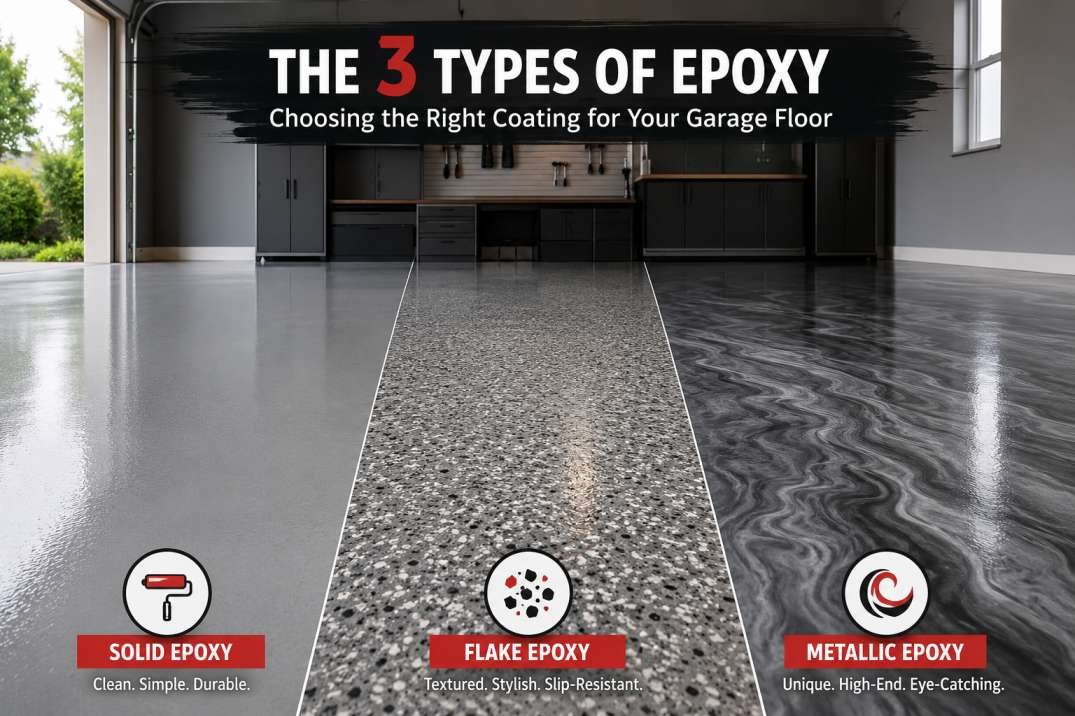
The 3 Types of Epoxy: Choosing the Right Coating for Your Garage Floor
July 31, 2026
Team
Walk into any Australian hardware store and you’ll find products labelled ‘epoxy floor paint,’ ‘epoxy floor coating,’ and ‘garage floor epoxy’ sitting on the same shelf. They carry the same category name but they’re not remotely the same product. The chemistry is different, the application method is different, and — most significantly — the performance under your vehicle on a Queensland summer day is completely different.
Understanding the three types of epoxy isn’t about becoming a chemist. It’s about knowing enough to avoid spending $300 on a product that fails in two summers, and understanding why a professional installation from Resin Masters using the right product lasts 15–20 years. This guide gives you that understanding in plain terms.
The Three Epoxy Types — An Overview
| Type | Solids Content | VOC Level | Best Application | Australian Garage? |
| Water-Based Epoxy | 30–50% | Low | Light-duty interior, walls | Not recommended |
| Solvent-Based Epoxy | 50–70% | High | Industrial — heavy ventilation required | Acceptable (older tech) |
| 100% Solids Epoxy | 100% | Zero | Garage floors, warehouses, all commercial | Yes — the correct choice |
Type 1 — Water-Based Epoxy
Water-based epoxy — sometimes labelled ‘waterborne’ or ‘water-reducible’ epoxy — carries 30–50% solids content. The remaining 50–70% of the product volume is water, which evaporates during cure and leaves no coating behind. This means a water-based epoxy only deposits half or less of its wet volume as actual dried coating on the floor.
What It’s Actually Used For
Water-based epoxy is appropriate for light-duty interior applications — priming concrete walls, sealing light-traffic internal floors, and applications where VOC (volatile organic compound) levels are a genuine constraint. It’s also the chemistry most commonly used in retail garage floor kits because it’s cheaper to manufacture, easier to apply, and less hazardous to transport than solvent-based alternatives.
Why It’s Wrong for Australian Garage Floors
Water-based epoxy fails in Australian garages for three compounding reasons. First, the thin film build — even well-applied, water-based epoxy rarely achieves the film thickness needed to resist vehicle abrasion and point loads. Second, Australian summer heat creates moisture vapour cycling in concrete slabs that permeates the water-based film’s more open molecular structure, causing delamination from below. Third, hot-tyre contact — vehicles arriving home on peak Queensland summer days carry tyre temperatures that exceed the thermal resistance of standard water-based formulations, causing surface deformation and permanent tracking marks.
This is the product category behind most of the ‘my garage epoxy peeled within two years’ stories we hear from clients across Brisbane and Ipswich. The product is genuine epoxy — but it’s specified for light-duty applications, not residential garages in Australia’s subtropical climate.
Type 2 — Solvent-Based Epoxy
Solvent-based epoxy carries 50–70% solids content — a meaningful improvement over water-based — with the remaining volume consisting of chemical solvents that evaporate during cure. The solvent carrier allows the epoxy chemistry to penetrate concrete more aggressively than water-based alternatives, providing better adhesion on less-than-perfect substrates.
Practical Limitations
Solvent-based epoxy is an older technology that’s increasingly displaced by 100% solids formulations. Its limitations are significant. The high VOC content during application and cure requires genuine ventilation — we’re not talking about opening a window, but mechanical ventilation with OSHA-appropriate protocols for confined-space chemical exposure. For a residential garage installation, this creates real occupant hazard risk and usually requires the homeowner and household to vacate the property during application and for an extended cure period.
Environmental regulations around solvent-based coatings have also tightened in most Australian states, making them less accessible and more costly to handle properly. Commercial painting contractors using solvent-based systems carry specific licensing and disposal requirements for the waste solvents.
Where Solvent-Based Still Has a Role
Solvent-based epoxy retains a role in specific industrial and commercial situations where its deep concrete penetration provides a meaningful adhesion advantage — heavily contaminated substrates where solvent-based chemistry can dissolve residual contamination that grinding alone doesn’t fully address, or situations requiring adhesion to marginal substrate conditions. Resin Masters uses solvent-based chemistry where the specific substrate calls for it, but it’s not our default for residential garage installations.
Also Read:- Beyond Standard Epoxy: What Is the Strongest Floor Coating for a Garage?
Type 3 — 100% Solids Epoxy (The One That Belongs on Your Garage Floor)
100% solids epoxy contains no water and no solvents. Every part of the wet product volume converts to cured coating — nothing evaporates, nothing is lost to the atmosphere during cure. This creates a fundamentally denser, thicker, and more structurally complete coating than either water-based or solvent-based alternatives at equivalent application thickness.
Why 100% Solids Performs Better in Australian Conditions
The performance advantages of 100% solids epoxy in Australian garage conditions are direct and measurable. Higher film build — 2–3mm total system thickness versus sub-1mm for retail water-based products — creates genuine mechanical durability that handles vehicle traffic, dropped tools, and industrial loads. Zero water content means no moisture permeation vulnerability through the coating film, eliminating the delamination mechanism that destroys water-based systems in Queensland’s humidity cycling. And the denser film structure provides better thermal resistance under hot-tyre contact — critical in SEQ garages where vehicle tyres regularly arrive home at elevated temperatures from summer asphalt.
The Trade-Off — Why It Needs Professional Application
100% solids epoxy has a shorter working time (pot life) than diluted alternatives. Once the two components are mixed and the chemical reaction starts, the installer has a limited window — typically 20–40 minutes depending on ambient temperature — to apply the product before it begins to cure in the bucket. In a hot Australian summer environment, this window shortens further.
This is a genuine technical constraint that makes 100% solids epoxy significantly harder to apply correctly for a DIY operator. Resin Masters schedules summer applications with morning starts precisely because ambient temperature management directly affects pot life and application quality. For professional installers with the right tools, training, and scheduling protocols, 100% solids epoxy is the straightforward correct choice. For a DIY operator applying from a bucket in a hot Ipswich garage in January, it’s genuinely challenging.
What Type of Epoxy Does Resin Masters Use on Garage Floors?
We use 100% solids commercial-grade epoxy on every residential and commercial garage floor installation across our service area. There is no situation in which we substitute a water-based product for an Australian garage floor application — the performance gap is too significant and the failure modes too predictable.
Our complete garage floor system combines 100% solids epoxy base coat(s) with a UV-stable polyaspartic topcoat. Polyaspartic is technically a polyurea-adjacent coating rather than an epoxy — but it’s the correct topcoat chemistry for Australian conditions because it provides UV stability (standard polyurethane yellows under Queensland UV), hot-tyre resistance (critical in SEQ’s summer heat), and faster cure times than traditional epoxy topcoats.
How the Finish Type Sits on Top of the Chemistry Type
One more distinction worth understanding: the three epoxy types (water-based, solvent-based, 100% solids) describe the base chemistry, not the finish appearance. The finish types — solid colour, flake/chip, and metallic — describe the visual treatment applied using that base chemistry.
A flake epoxy floor and a solid colour floor can both be made with 100% solids chemistry (which is what Resin Masters does) or with water-based chemistry (which is what most retail kits use). The chemistry choice determines the system’s durability. The finish choice determines how it looks. Both decisions matter, and they’re independent.
The Bottom Line for Australian Homeowners
- Water-based epoxy: easy to apply, low cost, low VOC — wrong for Australian garage floors. Choose this for light-duty interior concrete sealing or walls.
- Solvent-based epoxy: better adhesion, moderate film build, high VOC — being displaced by 100% solids in most applications. Has specific niche uses in industrial settings.
- 100% solids epoxy: professional specification, zero VOC, highest film build, best performance in Australian heat and UV — the correct base chemistry for any residential or commercial garage floor installation.
When you ask a garage floor coating company what product they use, the answer you want to hear is ‘100% solids commercial-grade epoxy.’ If the answer is ‘an epoxy floor paint’ or ‘a water-based coating,’ ask more questions before signing anything. The chemistry determines the performance, and the performance determines whether you’re doing this again in two years or not thinking about it for fifteen.
Ready to upgrade your garage floor? Resin Masters provides free on-site quotes across Brisbane, Gold Coast, Logan, Sunshine Coast, Toowoomba, Ipswich, and Northern NSW. Call +61 433 733 956, email info@resinmasters.com.au, or visit resinmasters.com.au.
Also Read:- Metallic vs Flake vs Regular Epoxy: Which Is Best for Your Garage?