Servicing : Gold CoastBrisbaneSunshine CoastToowoomba

Menu
Is Epoxy Flooring Safe? Fumes, VOCs, Kids and Pets
October 26, 2026
Team
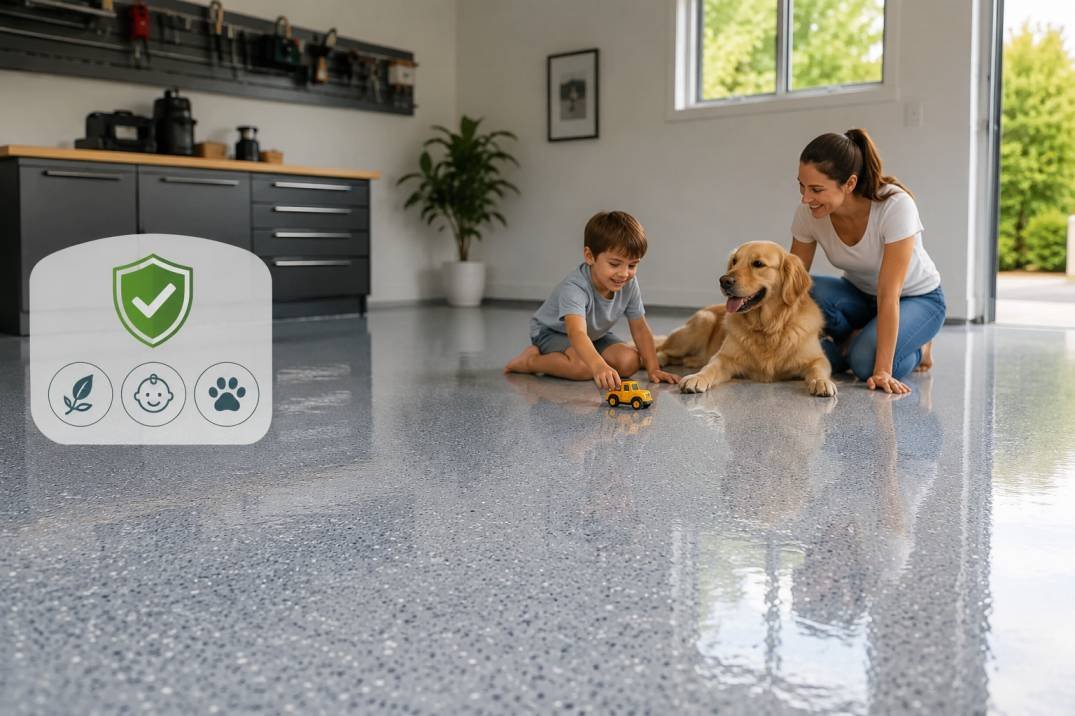
Once fully cured, epoxy flooring is generally regarded as safe for people and pets, and European industry body Epoxy Europe says cured resins are not hazardous. The risk sits in installation, when liquid resin and hardener can irritate skin and eyes and fumes need ventilation. Stay off the floor until your installer confirms the re-entry time.
Most pages that answer this question are installers saying yes. We’ve kept to what regulators, data sheets and industry bodies actually say, and marked where the evidence runs thin. Where it runs out, we say so.
What is hazardous about epoxy before it cures?
The liquid components. Epoxy Europe says uncured liquid epoxy resins are mild to moderate irritants for skin, eyes and mucous membranes. They can also be mild to moderate skin sensitisers, so repeated contact may cause an allergic reaction. Amine hardener vapours irritate too. Installers wear gloves, eye protection and respirators for that reason.
One Australian hardener safety data sheet, the Concept Paints 309 Epoxy Hardener SDS, lists skin irritation (H315), serious eye damage (H318) and a flammable liquid class. It calls for a well-ventilated area, local exhaust ventilation or a respirator. That’s one product, not a rule for every epoxy. Your installer’s product has its own sheet.
Safe Work Australia says that if you supply, use or store hazardous chemicals you must keep copies of the SDS in your workplace. See its safety data sheets page.
Are epoxy fumes and VOCs a problem?
During application, yes, so ventilate. VOCs are volatile organic compounds, gases released by paints, adhesives and coatings. Resin Masters says it uses 100% solids epoxy with low-VOC to near-zero-VOC chemistry and can supply data sheets confirming VOC content. Near-zero isn’t zero, so ask for the sheet.
The Australian Government’s YourHome guide says most off-gassing happens when products are new or freshly installed, then lessens dramatically. It advises ventilating well during and after indoor painting, and looking for Good Environmental Choice Australia certification or an E1 or E0 rating. Read it at YourHome on indoor air quality.
Resin Masters’ warehouse page contrasts its 100% solids product with older solvent-based systems that need evacuation and heavy ventilation. We couldn’t find a published Australian test of VOC levels in a home after an epoxy install. Until you’ve seen the data sheet, “low” and “near-zero” are the supplier’s descriptions.
When can kids and pets walk on a new epoxy floor?
Follow your installer’s written times. Resin Masters says garage floors are usually walkable within 24 hours, vehicle-ready in 48 to 72 hours and fully chemically cured at 7 days. Bunnings’ DIY guide says to wait at least 24 hours before walking on a kit floor and 4 to 7 days before parking a car.
|
Stage |
Resin Masters garage floors |
Bunnings DIY kit guide |
|---|---|---|
|
Walk on it |
Usually within 24 hours |
At least 24 hours |
|
Park a vehicle |
48 to 72 hours |
4 to 7 days |
Keep children and pets out of the work area while it’s being applied. Bunnings’ guide says to store products out of reach of children and pets. For a home with a crawling baby or a pet that licks surfaces, a cautious approach is to wait for the full 7-day cure. Ask for that in writing. See the Bunnings guide to epoxying a garage floor.
Is a cured epoxy floor safe for pets and children?
Cured epoxy is a hard, non-porous surface, and Epoxy Europe describes cured resins as not hazardous. The practical risks are different: slipperiness when wet, and a hard, cool surface for a young child or older pet. Anti-slip texture helps. We found no Australian vet or regulator guidance specific to epoxy floors.
Our guide to whether epoxy floors are slippery covers texture and AS 4586 ratings. If a child or pet has a health condition or a chemical sensitivity, show your doctor or vet the product’s data sheet and ask them.
Is epoxy flooring safe around food?
Standard 3.2.3 says floors in food handling areas must be effectively cleanable and unable to absorb grease, food particles or water. Its guidance lists epoxy resins among suitable floor finishes for food preparation areas. Resin Masters’ restaurant page says its epoxy achieves food-contact safety after the full 7-day cure. Ask for the data sheet that says so.
The standard covers food handling areas, not dining areas. For commercial kitchens, see restaurant and commercial kitchen epoxy flooring. The wording is in Safe Food Queensland’s copy of Standard 3.2.3.
Is it safe to install epoxy yourself?
It can be, with care. Bunnings’ guide says to wear safety glasses, gloves, ear muffs and a mask, and to keep products away from children and pets. The hardener data sheet we read asks for ventilation and a respirator. Open the garage door, and treat mixing as chemical handling, not painting.
Retail kits differ from commercial systems in preparation and build, which our Bunnings kit vs professional install guide covers. Whatever you use, read the data sheet for that specific product first.
What should you ask before you book an installer?
Ask for the product data sheets and safety data sheets, the VOC content, the re-entry times in writing, and how the installer will ventilate and protect occupants. Then ask what the warranty covers. Resin Masters‘ warranty page says the exact written terms remain the reference point for each project.
- Which product, and can I see its data sheet and SDS?
- What’s the VOC content, and does the product carry any low-emission certification?
- When can people and pets be back in each area, in writing?
- How will the space be ventilated during application and cure?
- What does the warranty cover? Resin Masters’ written 7-year workmanship warranty addresses how the floor performs, as its epoxy floor warranty guide explains. The data sheet addresses what’s in it.
For homes, the epoxy flooring for homes in Queensland guide covers where epoxy suits a house. A free on-site quote with an itemised written quote within 48 hours is a good moment to ask every question above. Contact Us!
Who is this guide not for?
This isn’t medical or legal advice, and it isn’t a clearance for a specific person or premises. Anyone with asthma, a skin allergy or another condition that chemicals aggravate should read the product’s safety data sheet. They should also ask their doctor before spending time near an install.
- Workplaces with legal duties: check Safe Work Australia and your state regulator, such as WorkSafe Queensland.
- Anyone wanting a guarantee of zero fumes: no source we read offers one.
- Buyers who want a rating for a specific product: only that product’s data sheet can give it.
Frequently asked questions
Are epoxy floor fumes harmful?
During application, vapours can irritate the eyes, skin and airways, which is why installers wear protective equipment and ventilate. Epoxy Europe says amine hardener vapours are irritating. Low-VOC products reduce the issue but the safety data sheet for your product is the reference. Keep people and pets out until re-entry.
Can I stay in the house while epoxy is applied?
The sources we read say to ventilate well during and after application and to keep children and pets out of the work area. Whether you can stay depends on the product, the room and the airflow. Ask your installer for written advice and the safety data sheet before the job starts.
Is epoxy flooring toxic to dogs and cats?
Epoxy Europe describes cured resins as not hazardous, and the risk is mainly from uncured product. We found no Australian veterinary guidance specific to epoxy floors. Keep pets away until the installer’s re-entry time, and ask your vet if you have a specific concern.
Does epoxy off-gas after it cures?
YourHome says most off-gassing happens when a product is new or freshly installed, then lessens dramatically over time. Products differ, so check the data sheet for your system. Resin Masters describes its epoxy as low-VOC to near-zero-VOC and says data sheets confirming VOC content are available.
What does low-VOC epoxy mean?
Low-VOC is a supplier description, not a safety rating. YourHome suggests looking for certified products, such as Good Environmental Choice Australia or E1 and E0 ratings. Ask the installer for the VOC content on the data sheet and whether the product carries any independent certification.
Also Read:- Epoxy Flooring for Breweries, Wineries and Cellar Doors
Tags: Is Epoxy Flooring Safe