Servicing : Gold CoastBrisbaneSunshine CoastToowoomba

Menu
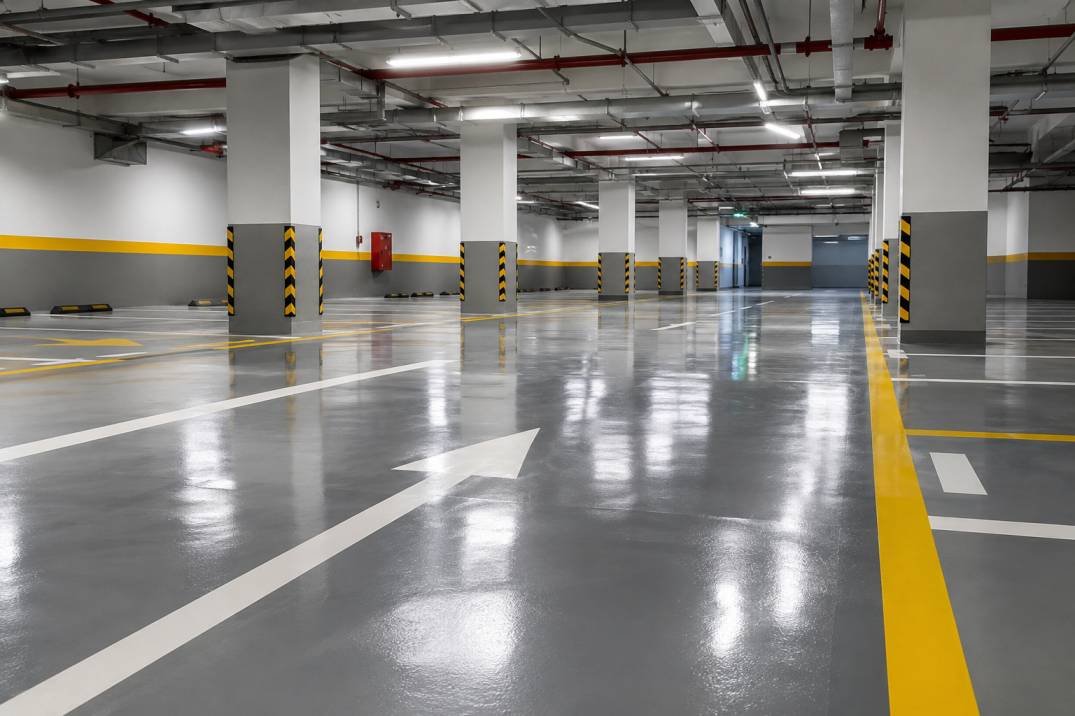
Epoxy Flooring for Car Parks and Basements
October 22, 2026
Team
Epoxy car park flooring is a resin coating applied to a prepared concrete deck to resist oil, tyre wear and dusting, usually with anti-slip aggregate and line marking. It suits sheltered, enclosed slabs best. Open decks and leaking basements raise a different question, because a decorative coating isn’t a waterproofing membrane.
Car park floors take a beating that garage floors never see: turning tyres, dripping oil, wet shoes and ramps. Get the system wrong and you’re recoating in a few years, with the car park closed again.
What does epoxy actually do for a car park floor?
Epoxy seals the surface of the concrete so oil, fuel and water don’t soak in, dust stops shedding, and the floor cleans up faster. It gives a base for anti-slip grit and line marking. It doesn’t add structure, and by itself it doesn’t stop water passing through the slab.
- Surface protection. Oil and automotive fluids sit on top and wipe off.
- Dust control. Bare concrete sheds fines that end up on cars and in ventilation.
- Grip and marking. Aggregate and bays go into the coating, not on top of it.
- Brighter space. A light-coloured, glossy floor reflects more of your lighting than bare concrete.
Which car parks suit epoxy, and which do not?
Epoxy suits enclosed, sheltered car parks on sound slabs. Exposed rooftop decks and car parks with active leaks are harder. One supplier says epoxy isn’t recommended for outdoor car parks, and moisture, UV and structural movement all shorten a coating’s life. Match the system to the slab before you choose.
Car park type | Epoxy fit | Main risk |
|---|---|---|
Enclosed ground-level or sheltered bay | Good | Oil, tyre marks and wet shoes |
Basement slab on ground | Depends on moisture | Moisture vapour from below can blister or lift coatings |
Suspended multi-level deck | Depends on movement | Slab movement and cracks flex the coating |
Open or rooftop deck | Often the wrong tool | UV, rain and water ingress; a membrane system may be needed |
Home garage | Good | See the garage floor epoxy guide |
The Tremco basement car park article describes hydrostatic pressure, moisture vapour transmission and structural movement as the main threats. Liquimix says epoxy suits indoor car parks and not outdoor ones. Treat both as supplier views, and test your own slab.
Is a car park coating the same as a waterproofing membrane?
No. A decorative epoxy or polyaspartic coating protects the top surface. A waterproofing membrane is designed to keep water from reaching what’s below, and it’s assessed to different standards. If your car park sits over occupied space, a leak is a membrane and waterproofing question first.
AS 4654.1 covers materials for external above-ground waterproofing membranes, installed under AS 4654.2. One Brisbane installer, Multiblast, says its trafficable systems comply with AS 4654.1. We couldn’t confirm from the listing whether the standard covers vehicle traffic, so ask for the certificate and the design engineer’s view.
Resin Masters’ published systems are epoxy floor coatings with a polyaspartic topcoat, not waterproofing membranes. If water is coming through the slab, get a waterproofing specialist involved before anyone coats over it.
What goes into a typical car park epoxy system?
A typical system runs: mechanical preparation, crack and joint repair, moisture testing, primer, a body coat, anti-slip aggregate, a UV-stable topcoat and line marking. Resin Masters’ industrial systems are 2 to 6 mm thick, and polyaspartic topcoats are standard. Preparation decides how long it lasts.
- Prepare. Resin Masters’ industrial page lists shot blasting or diamond grinding, oil contamination treatment and crack injection.
- Test. Moisture testing comes before priming; see moisture barrier under epoxy flooring.
- Coat. Primer, then a body coat. Heavier systems suit heavier traffic.
- Grip and finish. Aggregate is broadcast, then a UV-stable topcoat seals it.
- Mark. Bays, arrows and pedestrian zones go in as part of the system, not as surface paint.
Resin Masters’ slip resistance and line marking guide says painted lines wear away under forklift tyres within 12 to 18 months. That’s why it builds marking into the coating. Car traffic is lighter, but ask how long your lines should last.
How much grip does a car park need, and what about ramps?
A car park floor needs grip when it’s wet and when oil is present, so ask for test results on the actual finish. Ramps are the sensitive spot. A coating shouldn’t be used to fix a ramp that’s too steep, and it adds texture and a little thickness at the edges.
AS 4586 gives wet pendulum ratings (P1 to P5) and oil-wet ramp ratings (R9 to R13); thresholds are here. WorkSafe Queensland says a floor that’s slip-resistant when dry may not be when wet. No single rating suits every car park, so your designer or certifier should set it per area.
On gradient, a traffic engineering summary of AS/NZS 2890.1 gives a maximum ramp grade of 1 in 5 for public or commercial car parks. It adds transition zones above 12.5 per cent. That’s a secondary source, so check the standard.
What about hot tyres, oil and heavy braking zones?
Turning and braking zones wear fastest, and hot tyres can lift weak coatings. Oil and fuel drips are constant in car parks. A well-prepared, well-cured system handles them, but ask what happens where tyres twist, at ramp bases and at boom gates.
Our hot tyre pickup guide explains why it happens and how preparation and cure time reduce it. Reapply or repair worn topcoat before it wears through to the body coat.
How long will the car park be closed?
Resin Masters lists 48 to 72 hours before vehicles for most garage floors, with full chemical cure at 7 days. Its industrial page mentions fast-cure polyaspartic systems for vehicle access within 24 hours, and staging larger floors around your operations. Enclosed basements also need ventilation, so confirm the plan.
- Stage by bay, level or zone so residents or tenants keep some parking.
- Ask for written vehicle-ready and full-cure times for your exact system.
- Ask how fumes and odour are managed in an enclosed space; get the safety data sheet.
- Plan cleaning and line-marking dates so the car park isn’t reopened half finished.
What does it cost, and who approves it in a strata building?
Resin Masters publishes $50 to $90 per m2 for solid colour and says industrial work is quoted per site, so a car park needs an on-site quote. Crack repair is $5 to $20 per m2 for heavily damaged slabs and a moisture barrier is $3 to $8 per m2. Rates include GST.
In a Queensland strata scheme, a body corporate usually decides on car park works, and whether it’s maintenance or an improvement changes the approval needed. The Queensland Government guidance sets out the resolution levels. Ask your body corporate manager before you accept a quote. See epoxy flooring cost for the wider picture. Get a free Quote!
Who is epoxy car park flooring not for?
Epoxy isn’t the fix for an open deck exposed to sun and rain, a car park with active leaks, or a slab with structural cracking. Those need a waterproofing specialist or an engineer first. It also isn’t the cheapest way to stop dusting on a low-traffic bay.
- Open rooftop decks that need a full waterproofing system.
- Basements with water coming through the slab or walls.
- Slabs with structural cracks or spalling that need engineering advice.
- Single home garages, which the garage floor epoxy guide covers better.
Frequently asked questions
Is epoxy good for car park floors?
Yes, in enclosed or sheltered car parks on sound, dry slabs. It resists oil, cleans easily and takes anti-slip aggregate and line marking. It’s a poor fit for exposed decks, active leaks and slabs with movement. Test the slab first and ask for written system details.
Can you epoxy an outdoor car park?
It’s difficult. Sun, rain and slab movement all work against a coating, and one Australian supplier says epoxy isn’t recommended outdoors. If the deck is exposed or sits over occupied space, ask a waterproofing specialist about a trafficable membrane system.
How long does epoxy last in a car park?
It varies with traffic, preparation and maintenance. Liquimix says an indoor epoxy car park can last 10 to 15 years with care. Resin Masters gives a written 7-year workmanship warranty and says industrial floors can last 10 to 20 years or more.
How soon can cars drive on a new epoxy car park floor?
Resin Masters lists vehicle-ready in 48 to 72 hours for most garage floors, with full chemical cure at 7 days, and fast-cure polyaspartic systems for 24-hour access. Get exact times in writing for your system, temperature and ventilation.
Will epoxy stop water leaking into a basement?
Not reliably. Moisture vapour and hydrostatic pressure can blister or lift a coating, and epoxy isn’t a waterproofing membrane. Fix the source of the water first, then coat. Ask for moisture test results before any epoxy goes on.
Also Read:- Epoxy Flooring for Childcare Centres and Schools