Servicing : Gold CoastBrisbaneSunshine CoastToowoomba

Menu
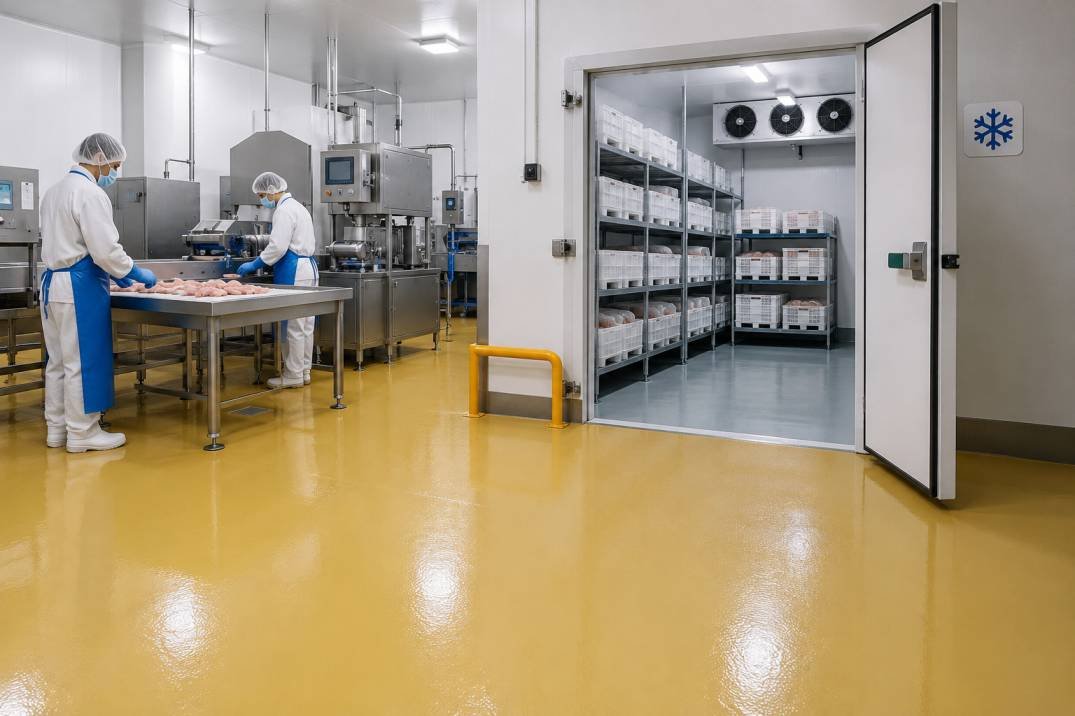
Polyurethane Flooring for Food Processing & Cold Rooms
October 23, 2026
Team
Polyurethane flooring for food processing usually means polyurethane cement, a thick, heat-tolerant screed used where floors face hot washdowns, steam or freezer temperatures. Epoxy suits drier and milder rooms. Resin Masters’ published systems are epoxy with a polyaspartic topcoat, so ask before assuming it installs polyurethane cement.
Get the system wrong and the floor can crack or lift under repeated hot and cold cycles. A food plant can’t easily shut for a redo. This guide sorts out what “polyurethane” means, where it’s justified, and where epoxy does the job.
What does “polyurethane flooring” actually mean?
The term covers three different products. Polyurethane cement, also called PU screed or urethane cement, is a thick, cement-filled floor. Polyurethane coatings are thinner resin films. Polyurethane topcoats are clear finishes over another resin. When a food plant asks for a freezer or hot-wash floor, it usually means the first.
Resin Masters’ own chemical resistant floor coatings guide mentions polyurethane only as a topcoat that adds solvent and abrasion resistance at the surface layer. That’s the third product, not a screed.
Why do food plants and cold rooms use polyurethane cement?
Because it copes with temperature swings that can crack a rigid floor. Australian suppliers say polyurethane cement keeps some elasticity after curing, tolerates steam and hot washdowns, and handles rapid cooling in refrigerated areas. Those are supplier claims, but the reasoning is consistent across every source we read.
- Wolffes Floor Coatings says polyurethane keeps its elasticity after curing, so it can expand and contract with temperature changes. It lists hot washdowns, steam cleaning, rapid cooling in refrigerated areas and freeze-thaw cycles.
- Floortek (Adelaide) quotes thermal shock from -25 to +120 degrees Celsius without delamination, and a 6 to 9 mm system for heavy kitchen traffic.
- Antiskid gives a working range of -20 to +120 degrees Celsius for polyurethane cement.
- Tremco CPG Asia Pacific says polyurethanes tolerate thermal shock better than epoxy, which it calls more brittle under extreme heat or cold.
Each of those is a manufacturer or installer statement, not independent testing. Ask for the data sheet for the exact product and thickness. Sources: Wolffes, Floortek, Antiskid, Tremco.
How does polyurethane cement compare with epoxy?
Polyurethane cement is thicker, rated for bigger temperature swings and pitched at wet, hot-washed rooms. Epoxy is thinner and suits dry to moderately wet areas. Supplier figures for polyurethane cement are shown below beside Resin Masters’ published epoxy specifications. Treat the left column as marketing claims until you have the data sheet.
|
Factor |
Polyurethane cement (supplier claims) |
Epoxy with polyaspartic topcoat (Resin Masters) |
|---|---|---|
|
Build thickness |
6 to 9 mm for heavy kitchen traffic (Floortek); 2 to 9 mm across one product range (Tremco) |
2 to 3 mm residential and light commercial; 2 to 6 mm industrial; epoxy mortar 4 to 6 mm for forklift zones |
|
Heat and thermal shock |
-25 to +120 degrees Celsius without delamination (Floortek) |
Hot water mopping and steam cleaning to about 70 to 80 degrees Celsius, per its restaurant page |
|
Damp slabs |
Floortek says it goes over damp concrete without moisture barriers |
Moisture tested first; barrier where needed, $3 to $8 per m2 |
|
Back in use |
Foot traffic in 24 to 48 hours, full chemical resistance at 7 days (Floortek) |
Most jobs 2 to 4 days; full chemical cure at 7 days |
|
Price |
No Australian rate found in the sources we read |
Solid colour $50 to $90 per m2, flake $60 to $110 per m2; industrial quoted per site |
Suppliers disagree on epoxy. Flowcrete’s guide says epoxy is poorly suited to thermal shock. Resin Masters says its epoxy with a polyaspartic topcoat handles thermal cycling from coolroom adjacency. The gap is probably the room. Next to a coolroom isn’t inside a freezer. See Flowcrete’s food and beverage flooring guide.
What do food premises rules say about the floor?
Standard 3.2.3 (Food Premises and Equipment) says food handling floors must be effectively cleanable and unable to absorb grease, food particles or water. They must also be laid so water doesn’t pond. It sets performance, not a product. Public dining and drinking areas are exempt.
The standard’s guidance lists epoxy resins among finishes suitable for food preparation and wash-up areas, meaning smooth, free from cracks and resistant to hot water, steam or chemicals. It doesn’t name polyurethane cement in that list, and they’re examples, not a rule. Read it in Safe Food Queensland’s copy of Standard 3.2.3.
Your council or state regulator decides what’s acceptable for your premises. Slip rating is separate. Resin Masters’ industrial epoxy flooring page lists AS 4586 R12 for heavy wet food processing zones and says the class should be set for the actual application. Coving, HACCP and kitchen rules are in our food-safe commercial kitchen flooring guide, so we won’t repeat them here.
Can a floor handle freezer and cold room temperatures?
Some polyurethane cement systems are rated for it. One manufacturer’s guide lists a 9 mm system from -45 to 120 degrees Celsius and a 6 mm system from -25 to 100. The range depends on product and thickness, so read the data sheet for your exact product, not the brochure headline.
Independent test data is thin online. Every temperature figure in this post comes from a supplier. Before you commit, put these questions to any installer:
- Does the rated range apply to the thickness you’re quoting?
- Is the slab insulated or heated underneath, and does the floor system allow for it?
- How are the wall junction, drains and door thresholds detailed?
- Can they name a running cold room with a similar temperature profile?
When is epoxy enough for a food business?
Epoxy is usually enough for dry or mildly wet areas such as packing rooms, prep areas, dry stores, amenities and floors beside a coolroom. Antiskid says epoxy suits light to medium duty and dry goods packaging. Save polyurethane cement for constant hot water, steam and freezer floors.
Resin Masters lists food processing among its industrial sectors, with coved floor-wall skirting, optional anti-slip aggregate, and systems chosen for exposure to organic acids and caustic cleaning agents. Its chemical guide adds that standard chemical-resistant epoxy is adequate for most food-processing acid and caustic exposure. Bleach and other oxidising agents attack standard epoxy, so name your cleaners at the quote stage.
For kitchens and serveries, the restaurant and commercial kitchen epoxy page covers that ground.
How long is a plant out of action?
Polyurethane cement installers quote foot traffic in about 24 to 48 hours, with full chemical resistance at 7 days. Resin Masters’ epoxy jobs mostly run 2 to 4 days, with full chemical cure also at 7 days. Whichever system you choose, ask when the first hot washdown is safe.
Downtime can be trimmed. Resin Masters says it sections larger industrial floors and stages the work around your operating calendar. Its restaurant page says fast-cure polyaspartic options reach light foot traffic within 4 to 6 hours of the final coat. Antiskid says polyurethane cure can also be accelerated for short-downtime jobs.
What should you ask before you choose a system?
Ask for the data sheet, the rated temperature range at your thickness, and the AS 4586 slip class in writing. Then ask how the installer handles slab moisture, coving and drains. A clear written answer to each is a better guide than any brand name or warranty headline.
- Which system, at what thickness, with which data sheet?
- How is slab moisture tested, and what happens if the reading is high?
- Which AS 4586 class is proposed for each zone, and who tests it?
- How are coving, drains and door thresholds detailed?
- What does the written warranty cover? Compare it with Resin Masters’ epoxy floor warranty guide.
What does Resin Masters offer for food processing floors?
Resin Masters installs epoxy-based systems for food processing: 100% solids epoxy, coved skirting, optional anti-slip aggregate and a polyaspartic topcoat. Its published pages don’t mention polyurethane cement or freezer-room floors. For those, ask Resin Masters directly what it would specify and get the answer in writing.
For an epoxy-suited area, a free on-site quote is available, with an itemised written quote within 48 hours of the visit and a written 7-year workmanship warranty. Extras such as crack repair ($5 to $20 per m2 on heavily damaged slabs) are itemised. Get a free Quote!
Who is this guide not for?
This guide isn’t a specification. Freezer rooms, steam-cleaned processing floors and dairies need a manufacturer’s data sheet and an engineer’s input, not a blog post. It’s also not for small cafe kitchens, where epoxy is the usual choice and the polyurethane debate rarely arises.
- Anyone specifying a large cold store: get the manufacturer’s rating and an independent reference.
- Sites using bleach or other oxidising cleaners: check chemical compatibility for any system.
- Anyone expecting a price: we found no Australian polyurethane cement rate in the sources we read.
Also Read:- Epoxy Flooring for Car Parks and Basements
Frequently asked questions
Is polyurethane flooring better than epoxy for food processing?
It depends on the room. Polyurethane cement is usually chosen for wet, hot-washed and freezer areas because suppliers say it tolerates thermal shock. Epoxy suits dry and milder areas and is what Resin Masters publishes. Choose by washdown temperature and cold-room rating, not brand preference.
What is polyurethane cement flooring?
Polyurethane cement is a thick, cement-filled polyurethane screed, also called PU screed or urethane cement. Suppliers describe it as tolerant of steam, hot washdowns and freezer temperatures. It is thicker than a standard epoxy coat, with one Adelaide installer quoting a 6 to 9 mm system for heavy kitchen traffic.
Does a cold room floor need special flooring?
Often, yes. Rapid swings between cold and warm, plus wet cleaning, put stress on rigid coatings. Check the data sheet’s temperature range for your exact system and thickness, and ask whether the slab is insulated underneath. Supplier ranges we found reach as low as -25 to -45 degrees Celsius.
How thick is a polyurethane cement floor?
Thickness depends on the product. Floortek quotes a 6 to 9 mm system for heavy kitchen traffic, while Tremco’s Flowfresh range runs from 2 to 9 mm. Thicker systems tend to carry wider quoted temperature ranges, so confirm the data sheet matches the thickness you’re being priced for.
Does Resin Masters install polyurethane cement?
Its published pages describe epoxy systems with a polyaspartic topcoat, and mention polyurethane only as a topcoat that adds solvent and abrasion resistance. They don’t mention polyurethane cement or freezer floors. Ask Resin Masters directly and get a written specification before you assume either.