Servicing : Gold CoastBrisbaneSunshine CoastToowoomba

Menu
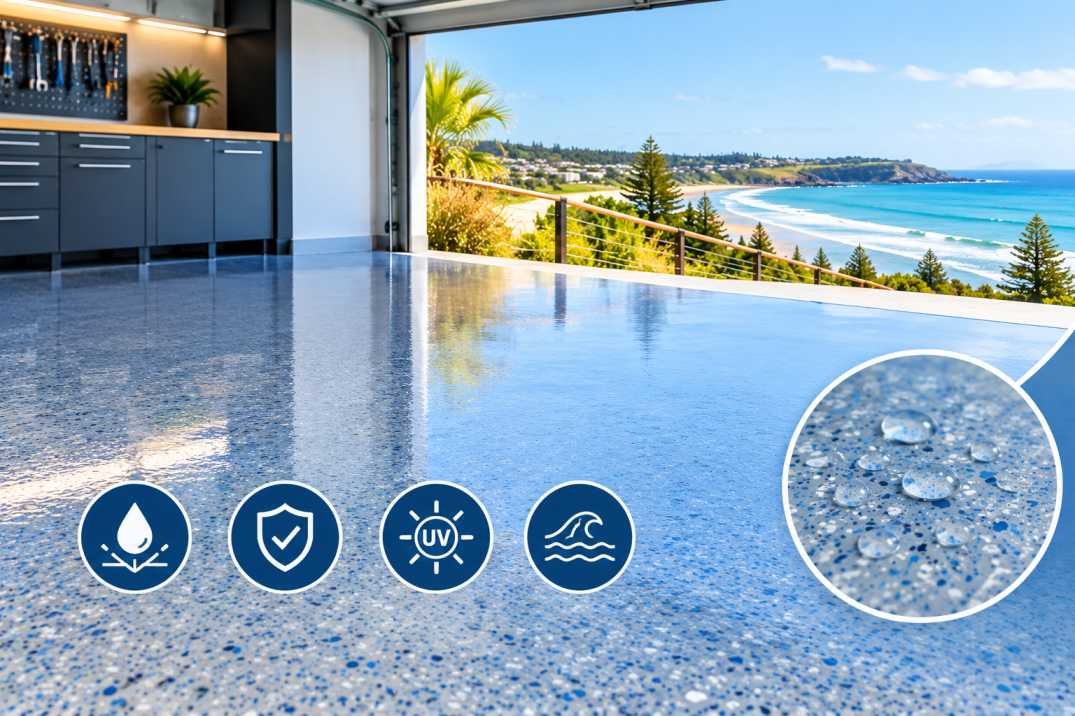
Is Epoxy Flooring Suitable for Humid Coastal Northern NSW?
September 11, 2026
Team
Quick Answer: Yes — epoxy flooring works very well in humid coastal Northern NSW when installed with proper moisture testing, a vapour barrier where the slab requires it, and a UV-stable topcoat. The key is correct installation practice, not avoiding epoxy altogether. This guide explains exactly how quality installers handle Northern Rivers humidity.
A genuinely common concern among Northern NSW homeowners considering epoxy flooring is whether the region’s coastal humidity — from Tweed Heads through Byron Bay to Ballina — will cause problems. The honest answer is that humidity absolutely needs to be accounted for, but it doesn’t rule out epoxy flooring. It simply requires the right installation approach.
Why Humidity Matters for Epoxy Installation
Concrete slabs naturally contain moisture, and in humid coastal environments like Northern NSW, moisture vapour emission from the slab can be elevated. If epoxy is applied over a slab with excessive moisture vapour without addressing it, the coating can fail — typically showing as bubbling, peeling, or delamination within the first 6–18 months.
This is genuinely the most common cause of epoxy flooring failure in humid coastal regions — and it’s also entirely preventable with proper testing and preparation.
How Quality Installers Handle Northern NSW Humidity
- Moisture Vapour Testing
Before any installation, a proper moisture test measures the slab’s moisture vapour emission rate. This single step identifies whether the slab is dry enough for direct epoxy application, or whether additional preparation is needed.
- Moisture-Tolerant Primers and Vapour Barriers
Where testing indicates elevated moisture, a moisture-tolerant primer or full vapour barrier system is applied before the epoxy coats. This creates a protective layer that prevents moisture vapour from interfering with the epoxy bond.
- Appropriate Cure Time Allowances
Humidity can affect epoxy cure times. Quality installers adjust scheduling and product selection to account for Northern NSW’s typical humidity levels, ensuring each coat properly cures before the next is applied.
Salt Air: A Related but Distinct Consideration
For coastal-adjacent Northern NSW properties — particularly in Kingscliff, Pottsville, and similar beachside suburbs — salt air exposure is a related but separate factor, primarily affecting genuinely outdoor, exposed surfaces rather than indoor humidity. Indoor epoxy floors are largely unaffected by salt air; it’s outdoor patios and entertaining areas facing direct sea exposure that need the polyaspartic specification discussed in our coastal homes guide. Get a free Quote!
Indoor vs Outdoor Humidity Considerations
|
Area Type |
Humidity Factor |
Recommended Approach |
|
Indoor garage/living area |
Slab moisture vapour |
Moisture testing + barrier if needed + standard epoxy |
|
Covered patio/alfresco |
Ambient humidity + some exposure |
Moisture testing + UV-stable topcoat |
|
Exposed outdoor area |
Full humidity + salt air + UV |
Full polyaspartic specification |
|
Commercial/hospitality kitchen |
High humidity + cleaning chemicals |
HACCP-aligned epoxy with antimicrobial additives |
Signs of Humidity-Related Installation Problems
If an epoxy floor in Northern NSW wasn’t installed with proper moisture consideration, watch for these warning signs: bubbling or blistering appearing within the first year, a milky or hazy appearance to the coating, peeling starting at edges or joints, or a persistent musty smell from beneath the coating. These typically indicate inadequate moisture management during installation — a problem with the process, not with epoxy as a material. Explore Seamless Flake Epoxy Flooring
Why This Shouldn’t Discourage Northern NSW Homeowners
Quality epoxy installers across the Northern Rivers region, including Resin Masters, install epoxy flooring successfully in genuinely humid coastal conditions every week. The technology and process to handle humidity correctly is well-established and reliable — the key factor is choosing an installer who actually follows proper moisture testing and barrier protocols rather than skipping this step to save time or cost.
Also Read:- Best Epoxy Flooring Contractors Tweed Heads and Northern Rivers
Frequently Asked Questions
Does Northern NSW’s humidity make epoxy flooring a bad choice?
No — it makes proper installation practice (moisture testing, vapour barriers where needed) essential. With correct installation, epoxy performs excellently in Northern NSW’s coastal humid climate.
How can I tell if my installer is properly testing for moisture?
Ask directly whether they test moisture vapour emission before installing, and what their process is if elevated moisture is detected. A confident, specific answer is a strong positive sign.
Does salt air affect indoor epoxy floors in Northern NSW?
Indoor floors are largely unaffected by salt air — this primarily impacts genuinely exposed outdoor surfaces, which require a different (polyaspartic) specification.
Concerned about humidity affecting your Northern NSW epoxy flooring project? Resin Masters performs proper moisture testing on every job — no shortcuts. Get a FREE quote: +61 433 733 956 or resinmasters.com.au.