Servicing : Gold CoastBrisbaneSunshine CoastToowoomba

Menu
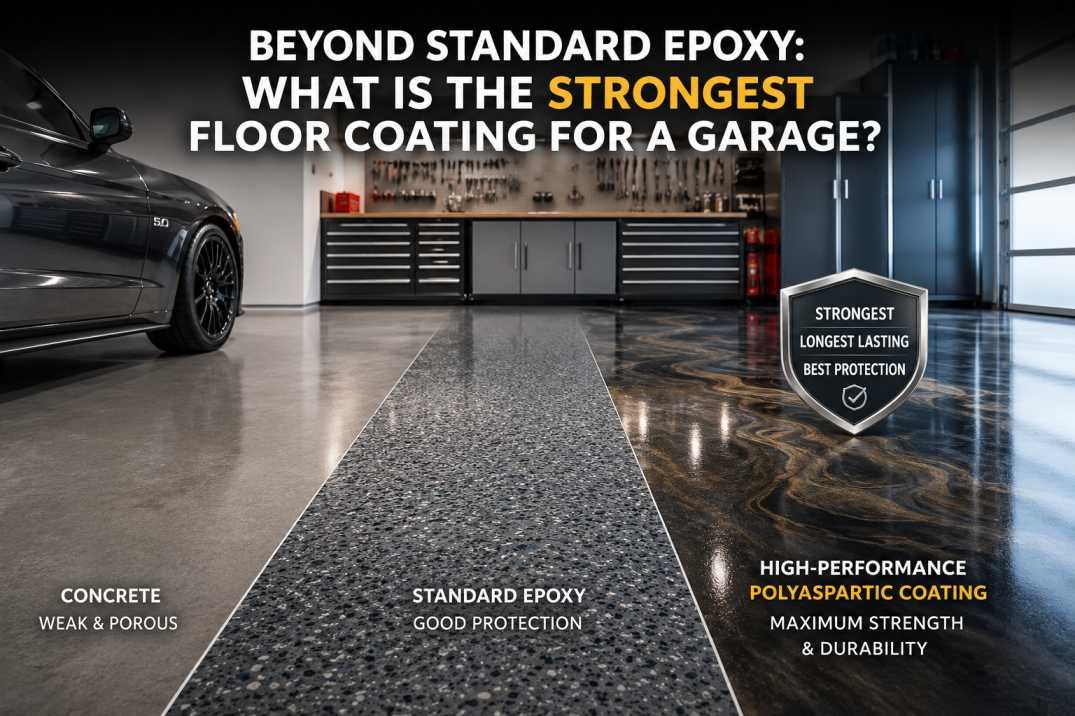
Beyond Standard Epoxy: What Is the Strongest Floor Coating for a Garage?
July 30, 2026
Team
You’ve had a standard epoxy garage floor before — and it didn’t last. Or you’re planning a garage that sees heavier than average use: a home workshop with a car lift, a shed that doubles as agricultural machinery storage, a coastal workshop exposed to salt air and UV from dawn to dusk. You’re not asking whether epoxy works. You’re asking what’s stronger.
It’s a good question, and it has a real answer. Resin Masters installs the full spectrum of garage floor coating systems across Queensland and Northern NSW — from standard residential epoxy through to heavy-duty industrial mortar systems and full polyaspartic floors. This guide explains what’s actually available beyond standard epoxy, what the chemical differences mean in practice, and when each makes sense.
First — What Standard Garage Epoxy Actually Is (and Its Real Limitations)
Standard residential garage epoxy is a 100% solids two-part epoxy system applying to a 2–3mm total thickness over a diamond-ground concrete slab. In the right specification, this system handles residential vehicle traffic, oil spills, common household chemicals, and Australia’s UV and heat conditions — and lasts 12–20 years. Resin Masters’ standard residential system fits this description.
Standard epoxy’s limitations emerge under conditions that exceed residential intensity: sustained mechanical impact from dropped heavy tools or equipment, point loads from vehicle lifts and jack stands, heavy forklift traffic, extended exposure to aggressive chemicals like agricultural herbicides or aviation hydraulic fluids, or outdoor UV and weather exposure without a building structure to moderate conditions.
These aren’t failure modes of a poor-quality standard epoxy — they’re the genuine limits of what the chemistry is designed for. Above this threshold, you need either a thicker and harder epoxy system or a different coating chemistry entirely.
Option 1 — Heavy-Duty Epoxy Mortar: Thicker and Harder Epoxy
The first step beyond standard epoxy is epoxy mortar — a system where aggregate (typically quartz or aluminium oxide) is combined with the 100% solids epoxy resin to create a trowel-applied material that builds to 4–6mm total thickness rather than the standard 2–3mm. This is the same epoxy chemistry, significantly reinforced.
Where Epoxy Mortar Makes Sense for Garages
Epoxy mortar suits garages that function as genuine workshops: spaces with car hoists, engine stands, welding equipment, and the mechanical loads of vehicles being fully serviced on the floor. Vehicle lift contact points and jack stand positions concentrate enormous point loads on a small surface area — and a 4–6mm mortar system handles these contact loads significantly better than a 2–3mm standard system.
Epoxy mortar also suits situations where the concrete substrate has damage — cracks, surface pitting, or areas of delaminated concrete — because the mortar system’s trowel-applied thickness can rebuild the surface profile before the finish coat is applied. Standard epoxy follows the substrate; epoxy mortar can correct it.
Trade-offs
Epoxy mortar costs more — typically $70–$110 per square metre versus $50–$90 for standard residential epoxy — and takes longer to install due to the trowel application technique. It also typically requires more experienced installation to achieve a consistent finish, since trowel work is more skill-dependent than roller application. Resin Masters uses epoxy mortar where the substrate condition or mechanical load requirements genuinely call for it.
Option 2 — Polyaspartic Coating: Faster, More Flexible, UV Superior
Polyaspartic coatings are technically part of the polyurea coating family — a chemically distinct group from epoxy. While epoxy chemistry creates rigid, high-compressive-strength films, polyaspartic chemistry creates more flexible films that remain elastic under thermal cycling and mechanical stress rather than becoming brittle.
What Polyaspartic Does Better Than Epoxy
Polyaspartic outperforms standard epoxy on three dimensions that matter particularly for Australian garage conditions. UV stability — polyaspartic coatings don’t yellow or chalk under direct UV exposure, making them genuinely suitable for outdoor or open-structure garage applications where standard epoxy topcoats would degrade visibly within months. Hot-tyre resistance — the polyaspartic film’s higher thermal resistance means it doesn’t soften and deform under hot-tyre contact pressure the way standard polyurethane topcoats do, eliminating the permanent tyre tracking marks that affect cheaper garage floor systems in Queensland’s summers. Cure speed — full polyaspartic systems achieve vehicle-ready surfaces in 12–24 hours versus 48–72 hours for standard epoxy, which matters for high-use garages and commercial carparks.
Polyaspartic as Topcoat vs Full System
Resin Masters applies polyaspartic in two configurations. As a topcoat over 100% solids epoxy base coats — this is our standard on all residential garage floor installations, combining epoxy’s excellent substrate adhesion and compressive strength with polyaspartic’s UV and thermal resistance at the surface. And as a full standalone system — epoxy primer, polyaspartic intermediate and topcoat — where the fastest return-to-service is the priority or where the outdoor exposure makes a full polyaspartic system the most appropriate chemistry from substrate to surface.
A full polyaspartic system costs more than a standard epoxy system — typically $75–$110 per square metre — but the 12–24 hour vehicle turnaround and superior UV performance often justify the cost for commercial carparks, coastal workshops, and any garage where the downtime of a standard epoxy cure creates operational problems.
Option 3 — Polyurea Coating: Maximum Chemical and Impact Resistance
Polyurea is the chemistry that polyaspartic is derived from, and the most technically advanced option in the garage floor spectrum. Full polyurea systems use moisture-reactive chemistry that cures extremely rapidly — sometimes in seconds — and creates a film with tensile strength and flexibility significantly beyond both epoxy and polyaspartic.
Where Polyurea Excels
Polyurea’s primary advantage is impact resistance. The film’s flexibility under impact loads means it absorbs rather than fractures under dropped tools, dragged equipment, and the mechanical shock of objects falling from vehicle lift heights. For garages used as genuine automotive workshops where heavy engine components, transmissions, and suspension parts get lowered to the floor regularly, polyurea’s impact tolerance is a meaningful practical advantage.
Polyurea also provides the highest chemical resistance in the garage floor category — relevant for garages storing or handling agricultural chemicals, marine antifouling products, industrial solvents, or any chemistry more aggressive than standard petroleum products and household cleaners.
The Application Constraint
Full polyurea systems typically require plural-component spray application equipment — specialist machinery that most general painting contractors don’t operate. The extremely fast reaction time (sometimes seconds between mixing and cure) makes brush or roller application impractical for full polyurea systems. Resin Masters uses polyurea chemistry where the specific application calls for it, but the equipment requirement means it’s a specialist solution rather than a standard offering.
Comparative Summary — Which Is Actually Strongest?
|
System |
Compressive Strength |
Impact Resistance |
UV Resistance |
Hot-Tyre Resistance |
Cost Range |
|
Water-Based Epoxy |
Low |
Low |
Poor |
Poor |
$15–$30/m² |
|
100% Solids Epoxy (Standard) |
High |
Moderate |
Moderate (with topcoat) |
Good (polyaspartic topcoat) |
$50–$90/m² |
|
Epoxy Mortar (4–6mm) |
Very High |
Good |
Moderate (with topcoat) |
Good (polyaspartic topcoat) |
$70–$110/m² |
|
Full Polyaspartic System |
High |
Good |
Excellent |
Excellent |
$75–$110/m² |
|
Full Polyurea System |
Very High |
Excellent |
Excellent |
Excellent |
$100–$150+/m² |
What Does Your Garage Actually Need?
The honest answer to ‘what is stronger than epoxy for a garage floor’ is that for most Australian residential garages, correctly installed 100% solids epoxy with a polyaspartic topcoat is already stronger than the conditions require. The failures people experience with garage floor coatings are almost always the result of wrong product chemistry (water-based retail products), inadequate preparation (acid etching instead of diamond grinding), or an inappropriate topcoat (standard polyurethane instead of polyaspartic) — not the genuine limits of the system.
The upgrade path to polyaspartic full systems, epoxy mortar, or polyurea makes sense for specific high-demand scenarios:
- Home workshop with vehicle lift — epoxy mortar (4–6mm) for the point load resistance
- Coastal or open-structure garage with direct UV — full polyaspartic system for genuine UV stability
- Agricultural shed handling herbicides or concentrated chemicals — polyurea or chemical-resistant epoxy specification
- Commercial carpark or body corporate garage needing 12-hour turnaround — full polyaspartic system
- High-value automotive collection garage — polyaspartic system with zero hot-tyre concern
For standard residential garages across Brisbane, Gold Coast, Logan, Sunshine Coast, Toowoomba, Ipswich, and Northern NSW seeing normal family vehicle use, our 100% solids epoxy base with UV-stable polyaspartic topcoat is the correct and sufficient specification. We don’t upsell homeowners into more expensive systems when the standard system is appropriate for their conditions — and we’re transparent about which category your garage falls into during the free on-site assessment.
How Resin Masters Assesses Your Specific Requirement
During every free Resin Masters garage floor assessment, we evaluate the operational conditions that determine the correct specification: mechanical load type and intensity, chemical exposure profile, UV and weather exposure level, and downtime constraints. These four factors together determine whether standard 100% solids epoxy, epoxy mortar, full polyaspartic, or a polyurea specification is the right call — and we explain our reasoning in the written quote so you can evaluate it.
The 5-year workmanship guarantee we provide covers the specified system performing as specified. We don’t apply a system we know is under-specified for the conditions — because the guarantee would be unsustainable, and more importantly, the floor wouldn’t perform as promised.
Ready to upgrade your garage floor? Resin Masters provides free on-site quotes across Brisbane, Gold Coast, Logan, Sunshine Coast, Toowoomba, Ipswich, and Northern NSW. Call +61 433 733 956, email info@resinmasters.com.au, or visit resinmasters.com.au.
Also Read:- Commercial Kitchen Floor Requirements QLD & Sunshine Coast (2026 Guide)