Servicing : Gold CoastBrisbaneSunshine CoastToowoomba

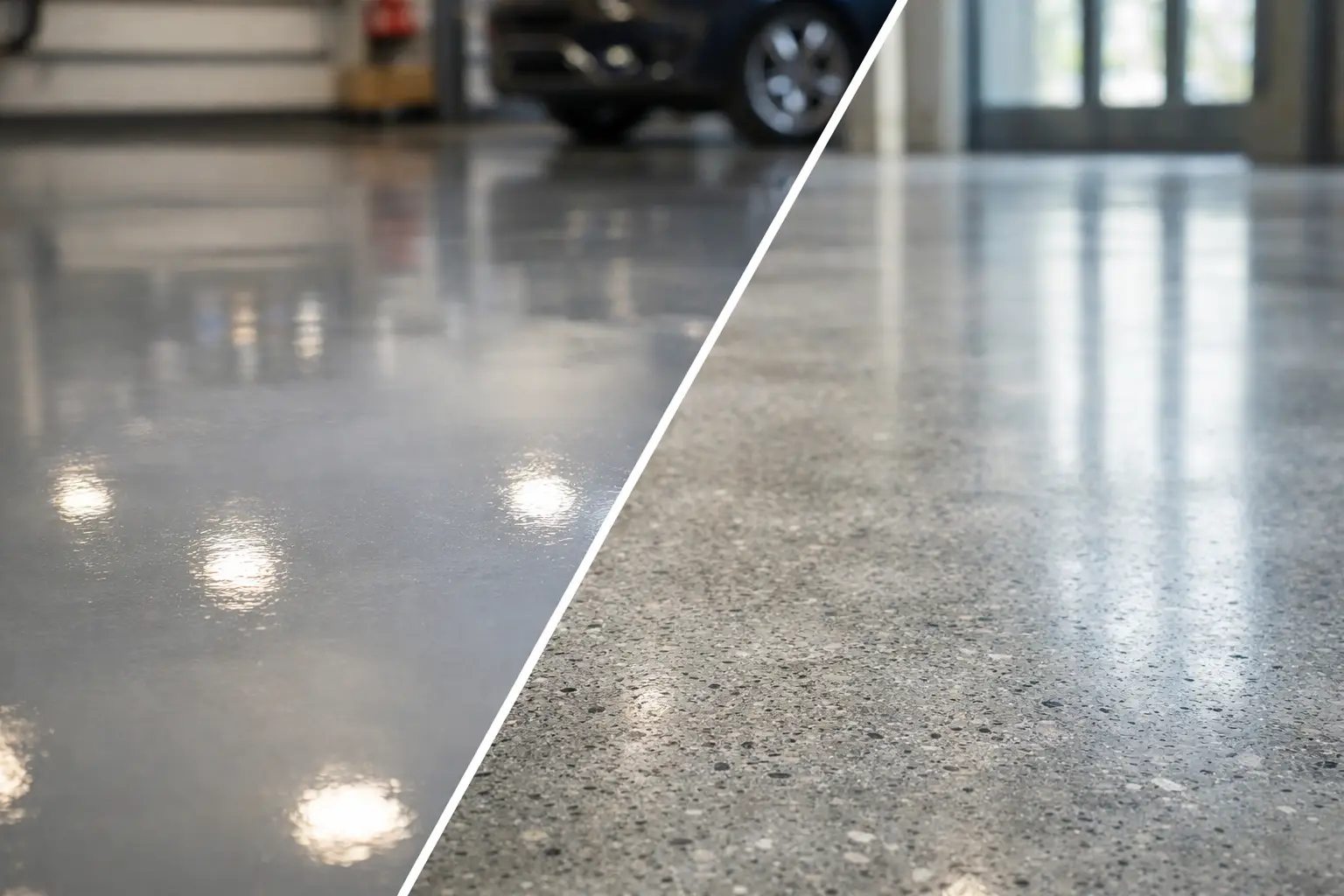
Epoxy vs Polished Concrete: Which Wins?
A floor can look impressive on day one and still be the wrong choice five summers later. That is usually where the real epoxy vs polished concrete decision gets made – not in a showroom, but under hot tyres, heavy foot traffic, cleaning chemicals and Queensland humidity.
Both options can outperform plain concrete by a long margin. Both can suit residential and commercial spaces. But they do very different jobs, and treating them as interchangeable often leads to disappointment, unnecessary maintenance or a finish that never quite suits the way the space is used.
Epoxy vs polished concrete: the real difference
The simplest way to look at epoxy vs polished concrete is this: polished concrete improves the slab you already have, while epoxy adds a high-performance protective coating over it.
Polished concrete is created by mechanically grinding, densifying and refining the concrete surface until it reaches the desired level of smoothness and sheen. The finished result is the concrete itself, exposed and enhanced.
Epoxy flooring is a resin-based coating system installed over prepared concrete. Once cured, it forms a seamless surface that can be decorative, slip-resistant, chemical-resistant and easier to control from a performance point of view.
That distinction matters because it affects everything else – appearance, maintenance, repairability, moisture behaviour, slip resistance and long-term durability.
Appearance and finish
If you want an architectural, natural look, polished concrete usually has the edge. It shows the character of the slab, including aggregate exposure, tonal variation and the subtle movement that comes from real concrete. In modern homes, retail spaces and some hospitality venues, that can be exactly the point.
Epoxy offers more control. You can choose solid colours, flake systems, metallic effects and different gloss levels. If you want a floor that looks clean, uniform and deliberately finished, epoxy gives you more design certainty. That is especially useful in garages, workshops, showrooms and commercial settings where presentation matters but so does practicality.
There is also a reality many people do not hear early enough: polished concrete only looks as good as the slab underneath. If the concrete has patching, cracks, inconsistent aggregate or previous contamination, those flaws can remain visible. Epoxy can often create a much more consistent visual result over less-than-perfect concrete, provided the preparation is done properly.
Durability under real use
Durability is where the conversation needs more nuance. Neither option is simply the strongest in every situation.
Polished concrete is hard-wearing under foot traffic. In large internal areas such as retail floors, offices and some residential living zones, it can perform well for years. It will not peel because there is no surface coating to delaminate in the usual sense. But concrete is still porous to a degree, and it can stain, mark or wear differently depending on traffic patterns and how well it is maintained.
Epoxy is better suited to environments where the floor needs protection from more than shoes. In garages, warehouses, plant rooms and working commercial spaces, a professionally installed epoxy system provides resistance to tyre pickup, oil, chemicals, abrasion and impact. It also gives you a sealed surface rather than exposed concrete.
That said, not all epoxy is equal. Cheap systems and rushed installs fail early, especially where moisture testing, grinding and crack treatment are skipped. In humid parts of Queensland, moisture control is not a small detail. It is one of the reasons professionally installed systems last and budget jobs often do not.
Maintenance and cleaning
This is one of the clearest points of separation.
Polished concrete is relatively low maintenance, but it is not maintenance-free. It still needs proper cleaning products and periodic care to preserve the finish. In some spaces, especially higher traffic commercial areas, the gloss can dull and require re-polishing or burnishing over time. Spills should not be left sitting if staining is a concern.
Epoxy is easier to clean day to day because the surface is seamless and non-porous when installed correctly. Dust, dirt and spills sit on top rather than soaking in. That makes it a strong option for garages, food-related commercial areas, medical spaces and warehouses where hygiene and cleaning efficiency matter.
If your priority is a floor that can be swept and mopped quickly without much fuss, epoxy usually wins.
Slip resistance and safety
Gloss alone tells you very little about safety. A polished floor can look dry and controlled but become more slippery in certain conditions, particularly when wet. The same is true of epoxy if the system has been selected for appearance only.
The difference is that epoxy systems can be engineered with slip-resistant additives and textures to suit the environment. That makes them easier to tailor for workshops, ramps, commercial kitchens, entries and other areas where compliance and risk reduction matter. For commercial sites, this needs to align with Australian slip-resistance requirements, not just visual preference.
Polished concrete can also be specified with safety in mind, but the achievable slip performance has to be considered carefully against the final sheen level and the conditions the floor will face.
Moisture, humidity and Queensland conditions
This is where local experience matters more than brochure claims.
Concrete holds moisture, and in South East Queensland that becomes a serious factor. Coastal humidity, temperature swings and moisture vapour transmission can all affect floor performance. Polished concrete tends to breathe more naturally because it is still the slab itself, treated rather than coated.
Epoxy demands a stricter approach. If moisture levels are not properly assessed and managed before installation, coating failure becomes a risk. On the other hand, when the slab is prepared correctly and the right primer or moisture mitigation system is used, epoxy can deliver a high-performing finish in conditions that would destroy a shortcut job.
This is one reason experienced contractors put so much emphasis on surface preparation. It is not sales language. It is the difference between a floor that lasts and a floor that starts lifting from the edges.
Cost and long-term value
Upfront pricing varies depending on slab condition, floor size, finish selection and how much preparation is required. There is no honest one-size-fits-all answer.
Polished concrete can be cost-effective if the existing slab is in good condition and already suitable for polishing. If the slab needs major repairs, levelling or extensive grinding to achieve a clean finish, the price can rise quickly.
Epoxy pricing depends heavily on the system. A basic coating is very different from a premium flake floor or a heavy-duty commercial build-up designed for forklifts, chemical exposure or strict safety requirements. The key question is not which is cheaper per square metre. It is which gives better value for the way the space is actually used.
For a decorative living area, polished concrete may offer strong value. For a working garage or warehouse floor, epoxy often provides better protection and lower maintenance costs over time.
Which suits each type of space?
In homes, polished concrete works well in open-plan interiors where the aim is a clean, minimalist finish with thermal mass benefits. Epoxy is often the stronger choice for garages, alfresco zones, laundries and utility areas that need stain resistance and easier cleaning.
In commercial settings, polished concrete suits showrooms, retail floors and offices where style and moderate durability are the main priorities. Epoxy suits back-of-house zones, medical spaces, workshops, kitchens and facilities where hygiene, slip resistance and chemical resistance matter.
In industrial environments, the balance usually shifts strongly toward epoxy. Polished concrete can handle traffic, but it is rarely the better answer where there is regular machinery use, pallet movement, spills or chemical exposure.
So which one should you choose?
If you want a natural concrete look and the slab quality is high, polished concrete can be an excellent finish. It has a refined, permanent feel that suits the right kind of space.
If you need a floor that protects the slab, handles harsher use, cleans easily and can be tailored for safety and appearance, epoxy is usually the smarter investment. That is especially true in garages, commercial premises and industrial settings where performance matters more than the romance of exposed concrete.
At Resin Masters, this is often the turning point in the conversation. Once the use of the space is clear, the right floor becomes far easier to specify.
The best flooring choice is not the one that looks best in a sample board. It is the one that still performs when the space is doing exactly what it was built for.