Servicing : Gold CoastBrisbaneSunshine CoastToowoomba

Menu
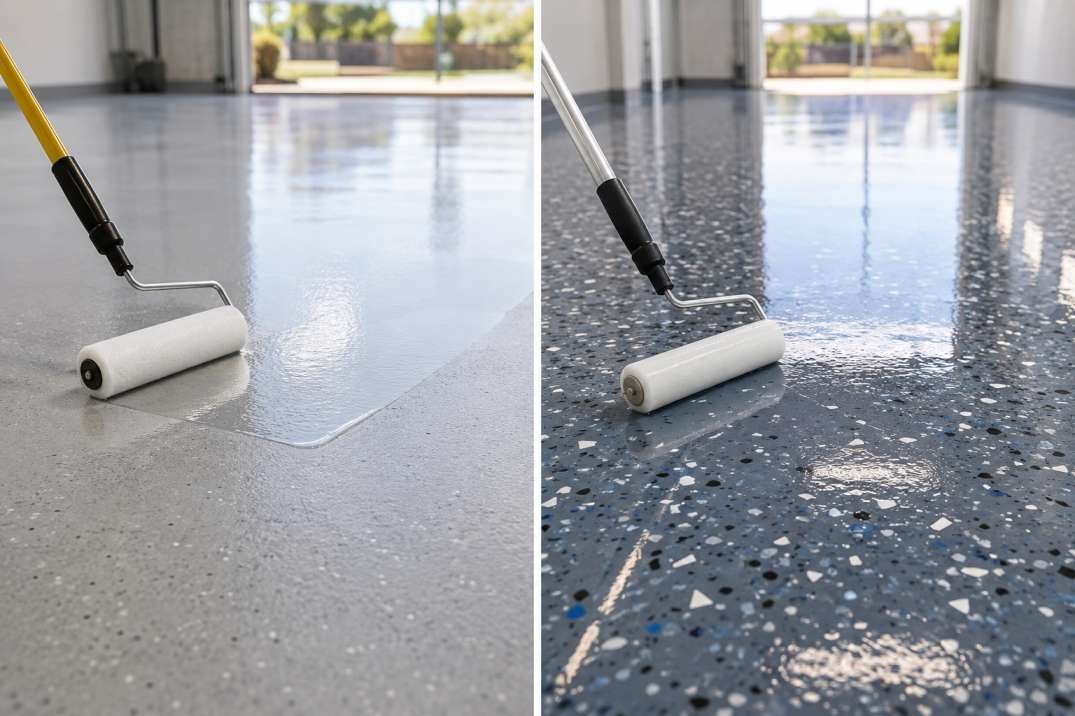
Epoxy Floor Sealer vs Topcoat: Do You Need Both?
October 10, 2026
Team
Not always, because “sealer” means three different products. A primer or penetrating sealer goes under an epoxy floor and helps it bond. A clear topcoat goes over it and takes the wear, sun and stains. A professional system does both jobs, even if you never see the primer once the floor is finished.
Buy the wrong one and the failure gets expensive. A concrete sealer where you needed a primer, or a clear coat that won’t bond to your kit, can end with the floor being ground off. Here’s how the layers fit.
What does “epoxy floor sealer” actually mean?
It can mean a primer that seals the slab before coating, a clear coat that seals the finished floor, or a concrete sealer used instead of epoxy. The three sit in different places and do different work. Buying by the word sealer alone is how people end up with the wrong product on the wrong layer.
- Under the floor. A primer or penetrating sealer soaks into ground concrete and gives the body coat something to grip.
- Over the floor. A clear coat or topcoat seals the coloured layer and takes the wear.
- Instead of epoxy. A concrete sealer is a thinner, cheaper treatment with no epoxy build. Our epoxy vs concrete sealer guide covers that choice.
What does each layer of an epoxy floor do?
A finished epoxy floor is a stack of layers, each with one job. The primer bonds to the slab, the body coat gives colour and build, the decorative layer adds flake or metallic effect, and the topcoat protects the lot. Leave one out and the weakest layer sets the floor’s life.
Layer | Job | What goes wrong if skipped |
|---|---|---|
Primer | Soaks into the ground slab and improves bond | Peeling, or vapour pushing the coating up |
Body coat | Colour, thickness and impact strength | A thin film that wears through |
Decorative layer | Flake chips or metallic pigment | A plain floor that shows more slab flaws |
Topcoat | Seals the system; sets gloss, UV, wear and slip | Scratching, yellowing, staining |
EpoxyAZ describes the same three-stage split of primer, base coat and topcoat. Resin Masters lists the same stack: moisture-tolerant primer, one or two colour coats and a UV-stable polyaspartic topcoat. See its installation guide for the sequence.
What does a topcoat actually protect against?
A topcoat protects the coloured layer from scratches, UV, chemicals and wet-floor slipping. It’s the surface everything touches. Resin Masters’ installation guide says the topcoat affects wear resistance, UV stability, chemical resistance and slip profile. Skip it and the body coat takes all of that instead.
All Garage Floors calls the clear coat a sacrificial layer and says it isn’t mandatory but is strongly recommended. Its rule of thumb is that the topcoat should match or beat the base coat, because a system is only as durable as its weakest layer.
Which topcoat: epoxy, polyurethane or polyaspartic?
Clear epoxy is cheapest but can amber in sunlight. Polyurethane resists abrasion better. Polyaspartic cures fastest and holds its colour under UV, but costs more. Resin Masters’ standard topcoat is polyaspartic. The right pick depends on sun exposure, how fast you need the floor back and your budget.
Topcoat | Strength | Trade-off |
|---|---|---|
Clear epoxy | Lowest cost; fine for some indoor floors | Can amber under UV, so poor outdoors |
Polyurethane | Better abrasion resistance than epoxy | Standard aromatic types can yellow in full sun |
Polyaspartic | Fast cure; strong UV stability | Costs more; less time to work if conditions are off |
The Paver Sealer Store’s epoxy clear coat guide warns that clear epoxy can amber under UV. All Garage Floors says polyurethane offers up to three times the abrasion resistance of epoxy. Resin Masters’ patio page says standard aromatic polyurethane can yellow within 12 to 18 months of full sun. Our polyaspartic vs epoxy guide goes further.
Does a flake or metallic floor need a topcoat?
Yes, in a professional system. Loose flake chips are locked in and sealed by clear coats, and a metallic floor gets its depth and gloss from them. Without the topcoat, the chips leave a rough, hard-to-clean surface and the pigment is unprotected. Resin Masters finishes flake, metallic and solid colour floors with polyaspartic.
A solid colour floor needs it just as much. The gloss also shows every flaw in the slab, so preparation counts. See solid colour epoxy flooring for how the system builds.
Can you add a clear coat over a DIY epoxy kit?
Sometimes, but check the kit’s data sheet first. Manufacturers often haven’t tested other brands’ clear coats over their epoxy, and adhesion is the risk. A kit maker may say the product stands alone. Anecdotes from forums show it can work, but they aren’t proof for your slab.
On the Bunnings Workshop forum, a Dy-Mark reply says its kit isn’t designed to have a clear coat applied and hasn’t been tested with another brand’s. It says the epoxy can last up to ten years without one. In a second thread, the maker said a clear coat can go on after 48 hours, and that waiting longer may need sanding first.
For kit-versus-professional trade-offs, read our Bunnings kit comparison.
What is a recoat window, and why does it matter?
A recoat window is the time in which a coat can be applied over the last one and chemically bond. Miss it and the next layer must be abraded first. The window varies by product, so the data sheet governs. It’s why installers plan topcoat timing rather than adding one later.
The Dy-Mark reply above says to apply after 48 hours. Leave it longer and you may need to sand with 120-grit paper and wipe with alcohol. The Paver Sealer Store makes the same point about recoating inside the window versus mechanically after it. Treat both as examples, not rules for your product.
What should your quote say about the layers?
A good quote names each layer separately: primer, body coat, decorative layer and topcoat, with the chemistry of each. That lets you compare quotes like for like. If a quote says only epoxy floor coating, ask what goes under it and what goes over it.
- Preparation method (diamond grinding, not acid etching) and moisture testing.
- Primer type and whether it suits the slab’s moisture reading.
- Body coat build and finish (solid colour, flake or metallic).
- Topcoat chemistry, how many coats, and anti-slip aggregate if needed.
Resin Masters says its quotes list grinding, moisture testing, primer, base coats and topcoat separately, and its solid colour page mentions a premium double-topcoat option for garages. If you’d like it priced for your slab, a free on-site quote is the next step. See also how to prepare concrete for epoxy.
Who is this guide not for?
This isn’t for anyone looking at a concrete sealer on its own, or fixing a floor that’s already peeling. A sealer coat won’t stop a floor failing from moisture or poor grinding. Those need the cause found first, not another layer on top.
- Owners who only want to seal bare concrete and skip epoxy.
- Floors that are bubbling or peeling, where the problem is below the topcoat.
- Anyone applying a clear coat to a floor of unknown chemistry.
Frequently asked questions
Do I need a sealer and a topcoat on an epoxy floor?
You need both jobs done, but not necessarily two products with those names. A primer, sometimes called a sealer, goes under the floor for bond. A topcoat goes over it for wear and UV. A professional system includes both layers. A kit may skip the clear coat.
Is a topcoat the same as a clear coat?
In everyday use, yes. A topcoat is the final protective layer, and it’s usually clear, though some are tinted. It can be epoxy, polyurethane or polyaspartic. The chemistry matters more than the name, so ask which one your installer specifies and why.
Can I seal a garage floor with epoxy sealer instead of full epoxy?
Concrete sealers are a different, thinner product. They reduce dusting and staining but build no epoxy film. Resin Masters’ Northern NSW comparison treats sealer as the lower-cost, shorter-life option. Choose epoxy if you want a thick, bonded, decorative finish.
Will a topcoat stop my epoxy floor yellowing?
A UV-stable topcoat helps, because standard epoxy can amber in direct sun. Polyaspartic is more UV-stable than clear epoxy. Sun exposure, product and application all matter, and no coating lasts forever. For floors near open doors or windows, ask which topcoat is in your quote.
How long should I wait before applying a topcoat?
Follow the data sheet for your products. Each system has a recoat window. One kit maker’s reply on a Bunnings forum said a clear coat could go on after 48 hours, with sanding needed if left longer. Applying too early or too late can hurt adhesion. Professional installers time the layers to suit the product.
Also Read:- Concrete Resurfacing vs Epoxy Coating: Which Suits Your Slab?
Tags: Epoxy Floor Sealer