Servicing : Gold CoastBrisbaneSunshine CoastToowoomba

Menu
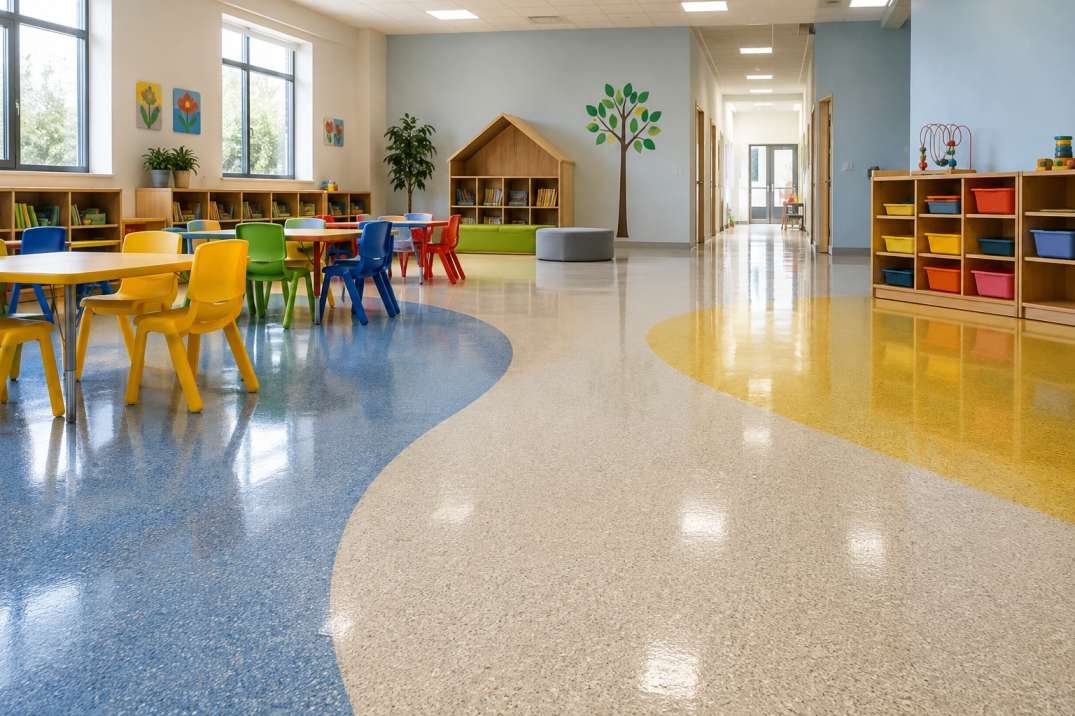
Epoxy Flooring for Childcare Centres and Schools
October 21, 2026
Team
Epoxy flooring can work in childcare centres and schools in kitchens, bathrooms, laundries, entries and utility rooms, where you want a wipeable, joint-free floor. It’s a hard surface, so think carefully about rooms where children crawl, fall or sleep. The choices that matter most are slip testing, low-odour products and a schedule that fits your closures.
No one wants to explain a slip or a smell to a parent. So the floor decision starts with how children really use each room: barefoot, in socks or in school shoes, wet or dry.
Where does epoxy make sense in a childcare centre or school?
Epoxy makes most sense in wet, messy and high-cleaning areas: kitchens and canteens, toilets and bathrooms, laundries, entries and plant rooms. In those spaces a joint-free surface is easier to clean than tiles with grout. Play rooms and sleep rooms need a separate decision.
|
Space |
Epoxy fit |
What to check |
|---|---|---|
|
Kitchen or canteen |
Good |
Coved edge and anti-slip finish; see food-safe commercial kitchen flooring |
|
Toilets and bathrooms |
Good with anti-slip |
Bare feet mean the barefoot slip test matters; see bathroom epoxy flooring |
|
Entries and corridors |
Good |
Wet shoes on gloss are the risk; use a textured finish |
|
Laundry and utility |
Good |
Chemical exposure and floor drains |
|
Baby and toddler rooms |
Think twice |
Hard, cool surface for crawling and falls |
|
Sleep rooms |
Think twice |
Comfort and warmth matter more than wipe-clean |
Is epoxy too hard for young children?
Epoxy is as hard as tile or polished concrete, and it feels cool underfoot. We couldn’t find an Australian rule that names a floor type for childcare rooms. Regulation 103 only requires premises to be safe, clean and in good repair, so the choice is a design judgement.
The ACECQA physical environment page cites regulation 103 and gives no flooring detail. Where children crawl and fall, consider mats or a softer surface instead. That’s a comfort call for you and your certifier, not a compliance finding.
What slip rating should a childcare or school floor have?
No single rating fits every room. Australian slip tests measure different things: a wet pendulum test (P ratings), an oil-wet ramp test (R ratings) and a wet barefoot test (classes A to C). For bare-foot areas such as toilets, ask for barefoot test results on the exact finish.
|
AS 4586 test |
What it measures |
Where it is relevant |
|---|---|---|
|
Wet pendulum (P1 to P5) |
Grip when the surface is wet |
Wet shoes at entries and corridors |
|
Oil-wet ramp (R9 to R13) |
Grip with oil on the surface, in safety shoes |
Kitchens, workshops, plant rooms |
|
Wet barefoot ramp (A to C) |
Grip for bare feet when wet; C is the highest class |
Toilets, showers, change rooms |
The barefoot test is described here and the P and R thresholds here. Resin Masters says independent AS 4586 testing can be arranged where a project needs it, and its slip resistance guide explains why texture and cleaning both matter.
How do you handle fumes and odour around children?
Ask for the safety data sheet and a written re-entry time before any work starts. Resin Masters describes its products as low-VOC to near-zero-VOC, 100% solids. Curing still gives off odour, so keep children out until the installer confirms the room is ready, and ventilate as the data sheet directs.
We’re not giving medical advice here. If a child or staff member has asthma or a chemical sensitivity, ask the family or the person’s own clinician. Your regulator or authority may also have views on reopening rooms, so check with them rather than assuming.
How do you schedule a floor around term time and centre hours?
Schools have holidays, and centres rarely close, so plan in stages. Resin Masters says it sections larger floors and schedules stages around your operating calendar. Most of its jobs take 2 to 4 days, with walkable floors in about 24 hours and full chemical cure at 7 days.
- Pick the rooms that must be ready first, such as kitchens and toilets.
- Ask for a written timeline per room, including grinding, coating, cure and re-entry.
- Confirm whether weekend or holiday work is possible and priced.
- Plan alternative facilities for the days a room is out of use.
- Ask the installer to follow your site sign-in and child-safety rules.
What does epoxy flooring cost for a childcare centre or school?
Resin Masters’ published rates, including GST, are $50 to $90 per m2 for solid colour and $60 to $110 per m2 for decorative flake. As a guide, a 60 m2 kitchen and utility area in solid colour would run about $3,000 to $5,400 before extras. Anti-slip aggregate and repairs are itemised in the quote.
Extras are published too: crack and defect repair is $5 to $20 per m2 for heavily damaged slabs, and a moisture barrier is $3 to $8 per m2. Small spaces such as a single toilet block may carry a flat minimum project fee, so ask. Our epoxy flooring cost page has the full picture, and Resin Masters offers a free on-site quote. Get a free Quote!
What should you ask before you book?
Ask which slip test applies to each room, what the data sheet says about your cleaning products, and how the job is staged. Then ask for the warranty in writing. Resin Masters gives a written 7-year workmanship warranty. Vague answers about “non-slip” finishes are a red flag.
- Test evidence for the exact finish, including barefoot results for toilets.
- Chemical resistance data for the cleaners and disinfectants you use.
- The safety data sheet, plus re-entry times room by room.
- How the installer separates the work area from children and staff.
Who is epoxy flooring not for in a childcare centre or school?
Epoxy isn’t ideal where you want a soft, warm surface, such as baby rooms and sleep areas. It also doesn’t suit slabs with active moisture, timber floors or outdoor play surfaces. If the budget is tight, painting a hall isn’t the same thing as coating it with epoxy.
- Crawling and sleeping areas where comfort beats wipe-clean.
- Slabs with damp problems that haven’t been tested and treated.
- Outdoor play surfaces, which are a different product and not covered here.
- Buyers who need a certified rating but haven’t asked their certifier what it is.
Frequently asked questions
Is epoxy flooring safe for children?
Once cured, epoxy is a sealed surface, and Resin Masters describes its products as low-VOC to near-zero-VOC. The risk window is during application and curing, when there’s odour. Ask for the safety data sheet and a re-entry time, and take medical questions to a clinician.
Is epoxy slippery for barefoot children?
A smooth gloss epoxy floor can be slippery when wet, and bare feet behave differently from shoes. For toilets and change areas, ask for the AS 4586 wet barefoot result, classes A to C, on the actual finish. Don’t accept “non-slip” as a rating.
Does epoxy flooring meet childcare regulations?
The regulation we found, number 103, says premises must be safe, clean and in good repair. It doesn’t name a floor type or slip rating. Ask your regulator or building certifier what applies to your rooms, and keep test records for the file.
Can epoxy go in a school canteen?
Yes, it’s a common choice for kitchens and canteens where you want a joint-free, easy-clean floor. Ask for a coved edge and a suitable anti-slip finish. Resin Masters installs coved solid colour systems for commercial kitchens; see its food-safe kitchen flooring guide.
How long does it take to install an epoxy floor at a school?
Most Resin Masters jobs take 2 to 4 days, and floors are usually walkable in 24 hours with full chemical cure at 7 days. Larger areas can be staged. Match the work to holidays or closures, and get the timeline in writing.
Also Read:- Epoxy Flooring for Medical Centres, Dental Clinics and Labs