Servicing : Gold CoastBrisbaneSunshine CoastToowoomba

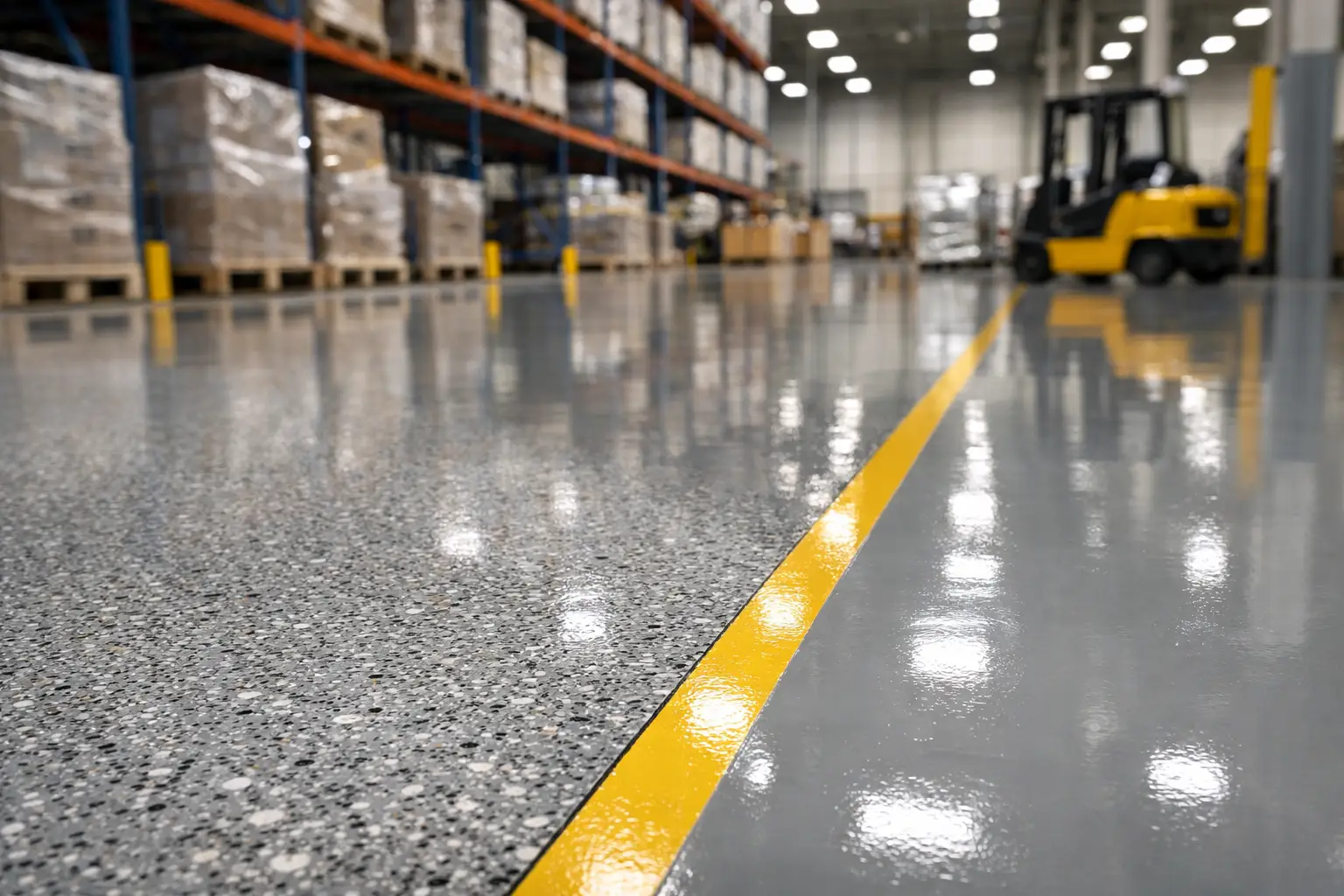
Top Warehouse Floor Coating Systems
Forklift tyres leave marks. Pallets get dragged. Oil, rainwater and dust build up fast. In a working facility, the top warehouse floor coating systems are not chosen for looks alone – they are chosen because the wrong system fails early, becomes slippery, or starts delaminating when moisture pushes up through the slab.
For warehouse operators, builders and facility managers, the right coating comes down to how the floor is used, what condition the concrete is in, and how well the installation is handled. Product selection matters, but surface preparation, moisture control and slip-resistance design matter just as much. A premium system on a poorly prepared slab will still underperform.
What makes a warehouse coating system worth installing?
A warehouse floor has to do more than cover concrete. It needs to resist abrasion, handle traffic, reduce dusting, improve cleanability and hold up under real operating conditions. In some sites that means constant forklift use. In others it means chemical exposure, washdowns, food handling or pedestrian traffic moving between wet and dry areas.
That is why there is no single best coating for every warehouse. The best result comes from matching the resin system to the site. Load levels, wheel type, turning points, storage layout, slab moisture and required slip rating all influence the specification.
In Queensland conditions, humidity and moisture vapour transmission often become a deciding factor. A floor that looks sound can still contain enough moisture to cause bubbling or adhesion failure if the installer skips proper testing and moisture mitigation. That is where many cheaper jobs come unstuck.
Top warehouse floor coating systems and where they work best
Epoxy coating systems
Epoxy remains one of the most widely used warehouse flooring solutions because it delivers strong adhesion, excellent surface hardness and a clean, seamless finish. For general warehousing, dispatch zones, light manufacturing and storage areas, a professionally installed epoxy system is often the most practical choice.
A standard epoxy coating can reduce dusting and make cleaning far easier than bare concrete. A high-build epoxy system adds more thickness and better wear resistance, which is useful where there is steady traffic and higher impact exposure. It also provides a more uniform, premium finish.
The trade-off is that epoxy is not automatically the answer for every heavy-duty site. Under constant point loading, steel wheel traffic or thermal shock, a basic epoxy may not be enough. It also needs careful installation timing in humid conditions. If moisture control is ignored, adhesion problems can appear long before the coating should wear out.
Epoxy mortar systems
When the concrete is damaged, uneven or exposed to harder industrial use, epoxy mortar systems sit near the top of the performance scale. These systems combine resin with graded aggregates to create a thicker, tougher surface that can take more punishment than a thin coating.
This makes them well suited to warehouses with heavy forklift traffic, hard-wearing production zones and service corridors where concrete abuse is part of daily operations. They are also useful when the slab needs repair and resurfacing rather than just sealing.
The downside is cost and installation time. Epoxy mortar systems require more preparation, more material and a higher level of installation skill. For a low-traffic storage shed, it can be more system than the site actually needs. For a busy industrial warehouse, it can be money well spent.
Polyurethane cement systems
Polyurethane cement is often specified where chemical resistance, thermal stability and hygiene matter more than decorative finish. You will see it in food production, beverage processing, commercial kitchens connected to warehousing, washdown areas and facilities that face steam cleaning or frequent temperature swings.
It performs extremely well in harsh environments and has strong resistance to impact, abrasion and chemical attack. It also manages thermal movement better than many standard resin systems, which helps where hot water or cleaning regimes would stress a conventional coating.
The finish is generally more functional than decorative, and it usually comes at a higher price point. For many warehouse operators, that extra investment only makes sense if the exposure conditions demand it. If the site is dry, moderate-use storage, a good epoxy system may still be the smarter option.
Polyaspartic and fast-cure systems
Fast-cure systems such as polyaspartic coatings are valuable when shutdown time is tight. In facilities where every day off the floor affects operations, rapid return to service can be a major advantage.
These systems can be useful for selected warehouse zones, line marking integration and staged refurbishment work where access must be restored quickly. They also offer good UV stability, which can help in loading areas or spaces with higher sunlight exposure.
That said, fast cure does not mean forgiving. These materials move quickly during application and leave less room for installation error. They also are not automatically better than epoxy for every internal warehouse setting. The practical question is whether speed of return outweighs the added material cost and application demands.
How to choose between the top warehouse floor coating systems
Traffic type matters more than most people think
Not all traffic wears a floor the same way. Rubber-wheeled forklifts, pallet jacks, static racking loads and pedestrian traffic each affect the coating differently. Tight turning circles and repeated braking points are often where failure shows first.
A coating that performs well in bulk storage may wear prematurely in a pick-and-pack zone with constant turning traffic. This is why a proper site assessment should look at movement patterns, not just floor area.
Concrete condition sets the foundation
No coating system performs better than the slab underneath it. If the concrete is weak, contaminated, cracked or moisture-affected, the specification has to account for that. Surface grinding, crack repairs, degreasing and mechanical preparation are not optional extras. They are part of the system.
Where the slab has moisture issues, a moisture-tolerant primer or vapour barrier may be needed before the main coating layers go down. In coastal and humid parts of South East Queensland, this is often one of the most important steps in the whole project.
Slip resistance needs to be designed, not guessed
Warehouse floors need to balance cleanability with safe footing. A very smooth gloss finish may be easy to mop, but it may not be suitable in entries, wash bays, loading zones or areas exposed to spills. On the other hand, an overly aggressive texture can make cleaning harder and create more tyre wear in the wrong environment.
The right approach is to specify the slip resistance for the actual use area and align it with Australian requirements where relevant, including AS 4586. This is not a detail to sort out later. It should be built into the system design from the start.
Why installation quality changes the result
Many coating failures are blamed on the product when the real issue is preparation or application. In warehousing, there is little room for shortcuts. Diamond grinding, moisture testing, profile preparation, edge work and cure control all influence whether the floor lasts.
A professionally installed system should also account for operational staging. Some sites need work completed in sections to keep stock moving. Others need line marking, coving or repairs integrated into the coating scope. The best coating decision is not just about chemistry. It is about how the whole project is planned and executed.
For clients comparing quotes, the cheapest number often excludes the steps that protect long-term performance. That may save money on day one, but it can cost far more when the floor needs patching, recoating or partial removal well ahead of schedule.
Which system is right for your warehouse?
If the goal is a clean, durable finish for general warehouse use, a high-quality epoxy system is often the leading choice. If the site takes heavier abuse or needs resurfacing, epoxy mortar may be better. If hygiene, chemicals and heat are major concerns, polyurethane cement usually earns its place. If downtime is the key constraint, a fast-cure system may be the better fit.
The right answer depends on the slab, the traffic and the risk points across the floor. That is why a proper inspection matters. A good contractor will recommend the system that suits the building, not just the one that is easiest to sell.
At Resin Masters, that practical approach matters because warehouse floors are expected to perform, not just look finished. When the coating is matched to the site and installed with proper preparation, you get a floor that works harder, cleans easier and holds its standard for years.
A warehouse floor is one of the most used surfaces on the property. Treating it like a long-term asset, rather than a quick cosmetic fix, usually pays for itself where it counts – safety, maintenance and day-to-day reliability.