Servicing : Gold CoastBrisbaneSunshine CoastToowoomba

Menu
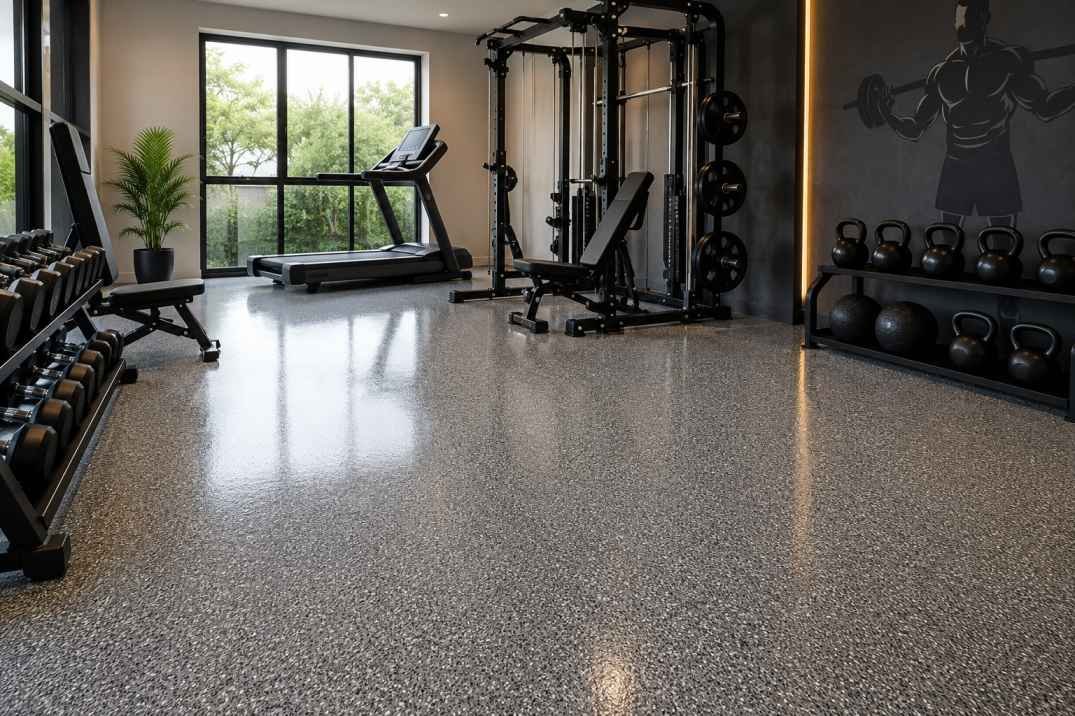
Epoxy Flooring for Gyms and Home Gyms
October 16, 2026
Team
Epoxy gym flooring suits cardio areas, machine zones, entries, garages and change rooms, where it gives a joint-free, easy-clean, slip-rated surface. It’s a poor landing pad for dropped weights. Australian rubber suppliers say epoxy can’t take them, so most lifters coat the slab in epoxy and add rubber only where the bar lands.
Search results push epoxy as a one-floor answer for gyms. It isn’t. The honest split is epoxy for the floor as a whole and rubber for the lifting zone, and it saves you from a chipped floor.
What does epoxy do well in a gym?
Epoxy gives a gym a sealed, dust-free, joint-free floor that wipes clean and can carry colour or zoning. It resists oil, sweat and spilt drinks, and there are no seams to trap grime. It works as a base under rubber and as the finished surface in cardio, entry and machine areas.
- Cleaning. No grout or seams, so a mop covers the lot.
- Sealed slab. The coating stops bare concrete dusting onto equipment.
- Zoning. Colours and flake blends mark cardio, stretching and weights areas. Resin Masters offers solid colour, multi-colour flake blends and metallic finishes.
- Base for rubber. A coated slab under mats is easier to sweep and doesn’t shed dust.
Can you drop weights on an epoxy floor?
No, not routinely. VERVE, an Australian gym supplier, states that epoxy has no impact absorption and that dropping weights on it can damage the floor and the weights. A 2 to 3 mm coating is a wear layer, not cushioning. Put rubber under every spot where a bar can land.
Suppliers agree on the layered approach. A US installer, Epoxy Armor Pro, calls epoxy the best base layer but not the complete solution. Here are the rubber depths quoted in two Australian guides:
Training | Rubber thickness | Source |
|---|---|---|
Cardio and machine areas | 5 to 7 mm, or epoxy alone | VERVE buying guide |
General free weights | 15 mm | VERVE and 24/7 Gym Equipment |
Deadlifts and habitual drops | Up to 20 mm | VERVE; 24/7 says 15 mm handles deadlifts to about 140 kg with controlled lowering |
Olympic lifting | 30 to 50 mm | VERVE gives 30 to 50 mm; 24/7 says 50 mm for routine 100 to 200 kg drops |
Both are retailers, so treat the numbers as guidance and check the product’s own data sheet.
Is epoxy or rubber better for a garage gym?
Use both. Coat the garage slab in epoxy for a clean, oil-resistant base, then lay rubber mats or tiles where you lift. Resin Masters’ garage systems are walkable within 24 hours, vehicle-ready in 48 to 72 hours, and fully cured at 7 days. Keep heavy racks off the floor until then.
If the car still parks in there, read our guide to hot tyre pickup on garage floors. The garage floor epoxy guide covers the base system, and a UV-stable polyaspartic topcoat is standard on Resin Masters’ work.
VERVE says home-gym tiles can be dry-laid on smooth concrete, because their weight holds them in place. That suits renters and movers.
How thick should epoxy be under gym equipment?
Most residential and light commercial epoxy systems sit at 2 to 3 mm, and that’s enough for a gym base. The thickness resists wear. It doesn’t cushion impact, so the rubber does that job. Heavy-duty epoxy mortar at 4 to 6 mm exists for forklift zones, but a gym rarely needs it.
Our epoxy floor thickness guide explains how builds differ. If you plan very heavy equipment or a rig on wheels, ask the installer to confirm the system can carry the point loads.
Is an epoxy gym floor slippery?
It can be, especially with sweat, spilt drinks or wet feet from a shower. Smooth gloss is the worst case. A flake finish or anti-slip aggregate adds grip. Ask for a wet-tested AS 4586 rating for change rooms and pool decks, because a dry rating doesn’t cover contamination.
A testing firm’s summary of AS 4586 says the dry test suits internal floors away from contaminants. D0 means a friction coefficient of 0.40 or greater. Sweat and spilt drinks make a gym a contaminated floor. Resin Masters uses AS 4586-rated anti-slip aggregate in its bathroom systems.
See our guides to choosing slip-resistant epoxy and slippery epoxy floors.
What does gym flooring cost?
Resin Masters publishes $50 to $90 per m2 for solid colour and $60 to $110 for decorative flake, including GST. A 20 m2 garage gym would run about $1,000 to $1,800 in solid or $1,200 to $2,200 in flake, before rubber or extras. Commercial gym floors are quoted per site.
Option | Indicative cost per m2 | Source |
|---|---|---|
Resin Masters solid colour | $50 to $90 | Resin Masters cost page |
Resin Masters decorative flake | $60 to $110 | Resin Masters cost page |
Standard rubber | $40 to $55 | VERVE gym guide |
EPDM rubber | $45 to $65 | VERVE gym guide |
Epoxy, installed | $80 to $150+ | VERVE gym guide |
Prices from different sellers use different scopes, so don’t compare them line by line. Extras such as crack repair at $5 to $20 per m2 and moisture barrier at $3 to $8 per m2 change the total. See the epoxy flooring cost guide. A free on-site quote will show what your slab needs.
What should a commercial gym owner check first?
Check fire requirements, slip ratings and downtime before you choose a surface. Rubber gym flooring is often sold with fire certification for commercial fitouts, and VERVE says home gyms generally don’t need it. Confirm what your building certifier requires, and get the slip rating and data sheet for any epoxy in writing.
- Fire and fitout rules. Ask your certifier which flooring certification your site needs.
- Wet zones. Change rooms and showers need a wet-tested slip rating.
- Noise. Epoxy does nothing for noise. 24/7 Gym Equipment says 15 mm rubber tiles cut impact noise to rooms below by about 18 to 22 decibels.
- Warranty. Read what it excludes. Resin Masters gives a written 7-year workmanship warranty; see the epoxy floor warranty page.
How do you clean an epoxy gym floor?
Sweep or vacuum daily, then damp mop with a cleaner your installer approves. Epoxy has no grout to scrub. Dry grit is the enemy, because it scratches the topcoat. Check the data sheet before using strong disinfectants, and wipe up spills and sweat pools quickly.
Our garage epoxy cleaning guide covers routines that also suit a home gym.
Who is epoxy gym flooring not for?
Epoxy on its own isn’t for serious lifters who drop barbells, or for upstairs and apartment gyms that need noise control. It also isn’t for studios that want a soft or sprung surface for classes. For those cases, rubber or a purpose-built system does the job.
- Olympic lifters and CrossFit-style training that involves regular drops.
- Gyms above other tenancies, where impact noise carries.
- Yoga, dance or mobility studios that want a soft underfoot feel.
- Slabs with active moisture, which need treating before any coating.
Frequently asked questions
Can you lift weights on an epoxy floor?
You can stand, walk and use machines on it, and controlled lifts are fine. Regular drops are the problem. VERVE says weights shouldn’t be dropped on epoxy without damaging the floor and the weights. Put rubber under the bar zone and keep the epoxy for the rest of the floor.
Do you need rubber mats over epoxy in a home gym?
Yes, in any zone where weights can land. VERVE recommends 15 mm rubber as a starting point for free weights and 20 mm for regular drops. Epoxy alone is fine for cardio, bikes and machines. Mats also protect the coating from dented feet and scratches.
Is epoxy good for a commercial gym?
It suits entries, reception, cardio, machine and stretching zones, and change rooms with anti-slip. It doesn’t suit free-weight platforms without rubber. Confirm slip ratings, fire requirements with your certifier, and the warranty terms. Commercial floors are quoted per site, so ask for an itemised quote.
How much does epoxy gym flooring cost?
Resin Masters publishes $50 to $90 per m2 for solid colour and $60 to $110 for decorative flake, including GST. Rubber costs extra, and extras such as crack repair or moisture barrier add to the total. Industrial and large commercial jobs are quoted per site.
Can Resin Masters coat a gym or garage gym floor?
Resin Masters coats concrete floors in garages, workshops and commercial spaces across South-East Queensland and Northern NSW. Book a free, no-obligation on-site quote and describe your training zones. You’ll get an itemised written quote within 48 hours of the visit.
Also Read:- Epoxy Flooring Gold Coast, Brisbane & Logan: Honest Answers to What Locals Ask (2026)
Tags: Epoxy Flooring for Gyms