Servicing : Gold CoastBrisbaneSunshine CoastToowoomba

Menu
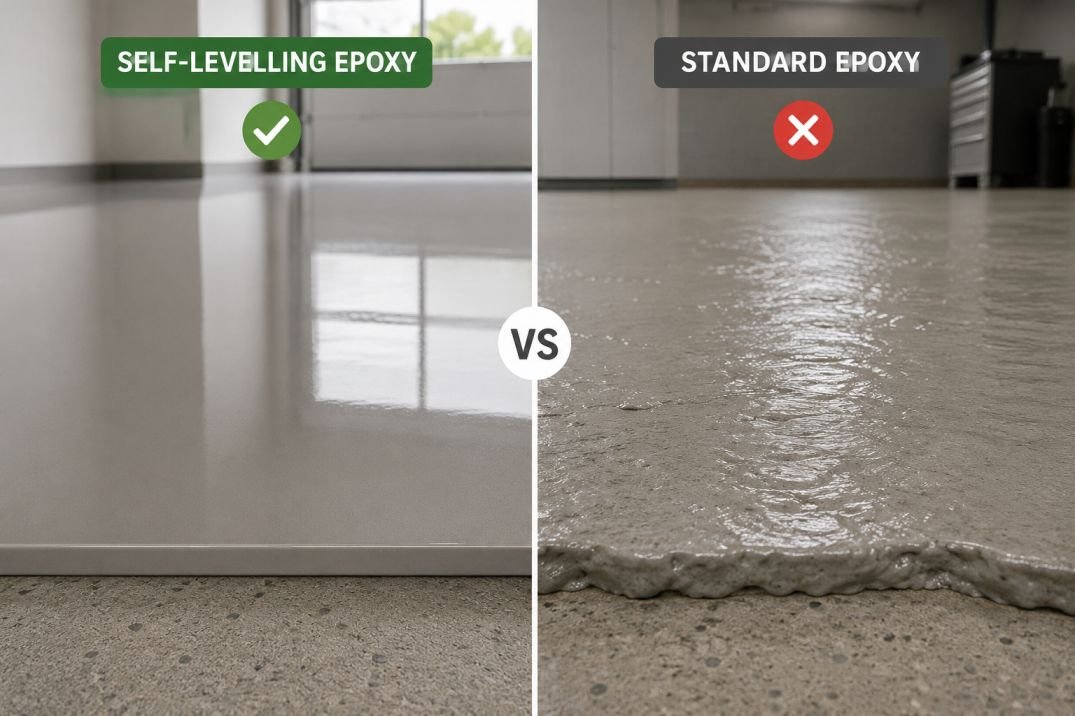
Self-Levelling Epoxy vs Standard Epoxy for Uneven Concrete
October 12, 2026
Team
Self-levelling epoxy is a thicker, poured epoxy that flows out flat. Standard epoxy is a thin rolled coat that follows the slab below it. Neither fixes a badly uneven slab. High spots get ground, low spots get filled, and then the coating choice decides how flat the finished floor looks.
Pick wrong and you’ll see it in every reflection. A gloss floor rolled over a rippled slab shows each dip. A poured floor over an unprepared slab costs more and can still fail.
What is the difference between self-levelling and standard epoxy?
Standard epoxy is rolled on in thin coats and takes the shape of the concrete. Self-levelling epoxy is mixed in bulk, poured, spread and worked with a spiked roller so it settles flat. The trade is build and cost: self-levelling uses far more material per square metre and needs more control over mixing and temperature.
Factor | Standard rolled epoxy | Self-levelling epoxy |
|---|---|---|
How it goes on | Rolled in thin coats, often with flake broadcast in | Poured, raked out, then worked with a spiked roller |
Typical build | Resin Masters residential and light commercial systems: 2 to 3 mm total | Sikafloor-263 SL is listed at about 2 to 3 mm as part of a system |
Material use | Sikafloor-264 data sheet: about 0.25 to 0.3 kg/m2 for a roller coat | Same data sheet: about 0.9 to 1.2 kg/m2 per mm for a self-smoothing coat |
Surface | Follows the slab; texture and flake hide small dips | Flatter, mirror-like finish that shows what sits under it |
Price | Lower material cost | Higher, because of the material volume |
Learn Coatings, a US training site, puts roller systems at 500 to 600 grams per square metre and a 3 mm self-levelling pour at about 3 kg. Sika’s data sheet shows the same pattern. Check the current sheets before you rely on any figure.
How uneven is too uneven for standard epoxy?
A thin coat hides small variation but not dips you can see or feel. Run a long straightedge across the slab and pour a little water on it. If puddles form, or the gap under the straightedge is more than a few millimetres, discuss levelling before any coating goes on.
Finish matters as much as flatness. A glossy solid colour is the least forgiving, which is why our solid colour epoxy flooring page suggests asking how the slab is levelled first. Flake blends hide far more.
One Brisbane surface-levelling contractor, Superfloor Australia, says its self-levelling compounds suit height variation up to about 10 mm. That’s a cement-based levelling job, not an epoxy pour. Ask which one you’re being quoted.
Does self-levelling epoxy fix an uneven or cracked slab?
No. Self-levelling epoxy is a coating, not a levelling compound for structural problems. It’s poured at a few millimetres, so a deep dip needs filling first and a raised ridge needs grinding off. Cracks need repair before either system goes down, or they can show through the finish.
For comparison, ARDEX’s technical bulletin describes its cement-based self-levelling compounds as suited to thin layers under 20 mm. Deep low areas belong to that kind of product or a repair mortar, not to a 3 mm epoxy pour.
- Grind. Diamond grinding takes off high spots, laitance and old coating. This is standard Resin Masters preparation.
- Repair. Cracks and defects are filled. Resin Masters lists crack and defect repair at $5 to $20 per m2 for heavily damaged slabs.
- Test moisture. The Sikafloor-264 data sheet gives a limit of under 4 percent by weight. Other products differ, so check the sheet.
- Fill low areas. A suitable repair or levelling product goes into dips.
- Prime, then coat. Only now does the choice of standard or self-levelling matter.
Our guide to preparing concrete for epoxy covers each step in detail.
When does self-levelling epoxy make sense?
Self-levelling epoxy suits floors where a smooth, even surface matters and the slab is already reasonably flat. Sika describes its self-levelling systems as suited to normal and medium-heavy wear in industrial, commercial and retail settings. In homes it’s less common, because flake or metallic finishes usually do the job for less.
- Laboratories, plant rooms and workshops where trolleys and pallet jacks roll across the floor.
- Showrooms and shops where a mirror-flat gloss is part of the look.
- Floors that need a wipe-clean surface with minimal texture.
- Slabs that are flat but pitted or worn and need a new even skin.
When is standard epoxy the better choice?
Standard epoxy is usually the better choice for garages and homes. It costs less, suits the 2 to 3 mm build Resin Masters uses for residential work, and a flake finish hides ordinary slab variation. Add a UV-stable polyaspartic topcoat, which is standard here, and you have a floor that copes with sun and traffic.
Flake also adds grip, which matters near wet zones and garage doors. Our garage floor epoxy guide shows what a typical home job includes, and the epoxy floor thickness guide explains where 2 to 3 mm sits against heavier builds.
What about heavy-duty floors and epoxy mortar?
Heavy traffic calls for a different tool. Resin Masters uses 2 to 6 mm systems for industrial floors and 4 to 6 mm heavy-duty epoxy mortar for forklift zones. A mortar is trowelled, carries load and fills damage in one build. A thin self-levelling pour isn’t designed for that job.
We cover workshop screeds in heavy-duty epoxy screeds for workshops, so we won’t repeat that here. The short version: if forklifts or heavy vehicles use the slab, ask about mortar first.
How much more does self-levelling epoxy cost?
Expect self-levelling epoxy to cost more than a rolled system, because it uses several times the material. Resin Masters publishes rates for solid colour ($50 to $90 per m2), decorative flake ($60 to $110) and metallic or custom quartz ($100 to $160+), all including GST. It doesn’t publish a self-levelling rate, so ask for an itemised quote.
Extras change the total more than the finish does. Moisture barrier runs $3 to $8 per m2, and old coating removal is assessed at quote. See the epoxy flooring cost guide for the full breakdown. If you’re unsure how flat your slab really is, a free on-site quote is the quickest way to find out.
What should you ask an installer who quotes self-levelling epoxy?
Ask what thickness they’ll pour, how they’ll fill low areas, and what moisture reading the product allows. Then ask about temperature. Pot life shrinks fast in Queensland heat, and a floor poured in a hurry usually shows it. Get every answer in writing before you accept.
- Thickness. How many millimetres, and over what area? A pour under about 2 mm risks marks, according to Learn Coatings.
- Levelling. What product fills dips, and how thick can it go?
- Moisture. What’s the product’s limit, and what did your slab read? Sika’s sheets say under 4 percent by weight.
- Temperature. Sikafloor-264 lists an application range of 10 to 30 degrees Celsius. The Sikafloor-263 SL kit listing gives a pot life of about 30 minutes at 20 degrees and about 15 at 30.
- Warranty. What does the written warranty cover? Resin Masters gives a written 7-year workmanship warranty on its own systems.
Who is this comparison not for?
This isn’t a guide for slabs with active moisture, deep structural damage or floors that must fall to a drain. Those need diagnosis first, and neither coating replaces it. It’s also not a DIY pour guide, since a short pot life and heat make large batches easy to ruin.
- Slabs that read damp or have rising moisture. Treat that first.
- Floors with deep dips or broken concrete. Repair comes before any coating.
- Owners hoping a coating will remove ripples without preparation.
- Anyone who wants a soft, warm underfoot surface.
Also Read:- Epoxy Floor Sealer vs Topcoat: Do You Need Both?
Frequently asked questions
Can you pour epoxy over uneven concrete to level it?
Only within limits. A self-levelling epoxy pour is a few millimetres thick, so it evens out minor variation but won’t fill deep dips. Grind high spots, repair cracks and fill low areas first, then apply the coating. Ask the installer to state the thickness in millimetres.
Is self-levelling epoxy stronger than standard epoxy?
Not automatically. Strength depends on the product, thickness and preparation. Self-levelling systems are thicker and suit trolley traffic and smooth finishes, but heavy forklift zones often call for epoxy mortar instead. Ask for the data sheet and compare compressive strength and wear ratings for the actual system quoted.
How thick is self-levelling epoxy?
Most sit around 2 to 3 mm. The Sikafloor-263 SL listing gives about 2 to 3 mm, and Learn Coatings describes 1 to 4 mm as typical with 2 mm as a sensible minimum. Standard rolled residential systems from Resin Masters run 2 to 3 mm in total.
Can I do self-levelling epoxy myself?
You can, but it’s unforgiving. Working time is short, especially in warm weather, and a whole batch has to be placed before it starts to set. Poor mixing or a damp slab ruins the finish. For a large garage or a slab with defects, professional application is safer.
Will self-levelling epoxy hide cracks?
No. Cracks need repair before any coating, because movement and gaps can telegraph through a thin finish. Resin Masters includes crack repair in its standard preparation, and heavily damaged slabs are priced at $5 to $20 per m2 for repair. Ask any installer how cracks are treated.