Servicing : Gold CoastBrisbaneSunshine CoastToowoomba

Menu
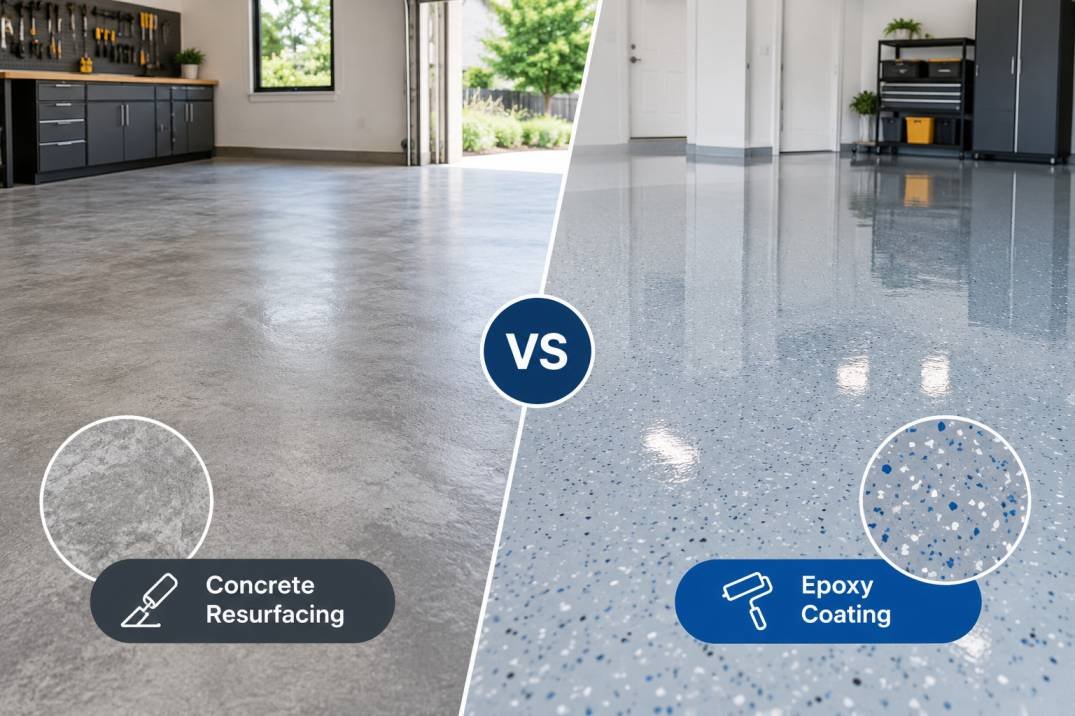
Concrete Resurfacing vs Epoxy Coating: Which Suits Your Slab?
October 6, 2026
Team
Resurfacing concrete floors with a cement-based overlay suits weathered outdoor slabs such as driveways and patios, where grip and sun exposure matter. Epoxy coating suits garages, workshops and commercial interiors where oil, cleaning and hot tyres matter. Both need a sound, well-prepared slab, so its condition and location usually decide.
People often ask which is stronger. That’s the wrong question. Each finish is built for a different job, and the wrong one fails in a way the other wouldn’t.
What is concrete resurfacing?
Concrete resurfacing is a cement-based overlay, often coloured or textured, applied over an existing slab to renew its look and grip. It bonds to the concrete below rather than forming a resin film. Applicators use it mainly on driveways, paths, pool surrounds and patios.
Conker, an Australian applicator, says its overlay bonds chemically and mechanically to the slab. It adds that the sealer coats need refreshing every 18 to 24 months. Thickness varies by product, so check the manufacturer’s data sheet rather than trusting a general figure.
What is an epoxy coating, and how is it different?
Epoxy is a two-part resin that cures into a hard, bonded film over ground concrete. Resin Masters builds 2 to 3 mm for homes and light commercial floors and adds a polyaspartic UV-stable topcoat as standard. Colour, easy cleaning and chemical resistance are what the resin is for.
Our garage floor epoxy guide covers the system in detail. What matters here is that epoxy is a resin, so it behaves very differently from a cement overlay on oil, sun and repairs.
How do resurfacing and epoxy compare?
Resurfacing wins outdoors on grip and sun tolerance, and epoxy wins indoors on cleaning, oil and chemical resistance. Costs overlap, with resurfacing quoted at $50 to $100 per m2 and epoxy at $50 to $110 per m2 by Resin Masters. Lifespans of 10 to 20 years depend on preparation.
Factor | Concrete resurfacing | Epoxy coating (Resin Masters) |
|---|---|---|
Best location | Driveways, paths, pool surrounds, patios | Garages, workshops, warehouses, interiors |
Typical cost per m2 | $50 to $100, decorative up to about $165 (Yellow Pages) | Solid colour $50 to $90; flake $60 to $110; incl. GST |
Typical life | 10 to 15 years or longer with maintenance (Yellow Pages) | 10 to 20 years with good preparation; 7-year workmanship warranty |
Sun exposure | Cement-based, with sealer refreshed every 18 to 24 months (Conker) | Needs a UV-stable topcoat; polyaspartic is standard |
Oil and chemicals | Not covered in the sources read; ask for the data sheet | A core strength of epoxy systems |
Slip resistance | P5-rated products exist (Conker) | Anti-slip aggregate; AS 4586 rating on request |
Repairs | Ask the applicator; the sources read say little | Small chips can be repaired; widespread failure needs grinding off |
The epoxy flooring cost page shows what changes an epoxy price, and resurfacing quotes vary with slab repairs and finish.
Which suits a garage floor?
Epoxy usually suits a garage better. It resists oil, tyre marks and regular washing, and a busy family garage sees all of those every week. Conker’s own guide, from a company that sells resurfacing, says resurfacing isn’t ideal indoors, which counts for something.
Resin Masters’ garage systems are ground, primed and coated, with hot-tyre-resistant polyaspartic topcoats as standard. If you’re weighing a garage floor, start with the garage floor epoxy guide.
Which suits a driveway, path or patio?
Resurfacing is usually the safer starting point for open driveways and paths, because it’s built for weather, wet and traffic. Epoxy can work outdoors with a UV-stable topcoat. Resin Masters’ Sunshine Coast comparison lists covered or semi-covered outdoor areas as suited. Ask how any system handles sun and rain.
For a covered patio or alfresco, the patio epoxy flooring page sets out how epoxy is specified outdoors. Spray Your Concrete lists both systems as needing periodic resealing, so budget for maintenance either way.
Can you resurface or coat a cracked slab?
Not without repair first. Both finishes need a sound base. Yellow Pages says severely damaged slabs may need repair or replacement first. Resin Masters prices crack and defect repair at $5 to $20 per m2 for heavily damaged slabs. Epoxy won’t stop an active crack moving.
Moving cracks reflect through either finish. If your slab has one, find out why before choosing. Our post on how to stop epoxy floor peeling explains what happens when a coating goes over a bad base.
What about moisture in the slab?
Moisture is a known risk for epoxy. Vapour rising through the slab can lift a resin film, so Resin Masters tests moisture first and adds a barrier where needed, at $3 to $8 per m2. The overlay guides we read say little about slab moisture, so ask the applicator directly.
That’s a gap in the evidence, not proof either way. If your slab has ever felt damp, get a moisture test before any coating goes down.
Where does polishing fit in?
Polishing is a third route: the slab itself is ground and refined rather than covered. It suits interior floors with good concrete and a natural look in mind. It isn’t a resurfacing overlay, and it depends heavily on slab quality. Resin Masters’ comparison covers polishing against epoxy in full.
Read epoxy vs polished concrete if you’re weighing that route. If a plain sealer is tempting, our epoxy vs concrete sealer guide for Northern NSW covers it.
How do you choose in five minutes?
Choose by location first: outdoors and sun-exposed points to resurfacing, indoors and oil-exposed points to epoxy. Then check the slab is sound and dry. The rest is budget and finish. When two options both fit, pick the one with the longer written warranty and clearer preparation.
- Where is the slab? Outdoors and open to weather leans resurfacing. Garage or interior leans epoxy.
- What lands on it? Oil, tyres and chemicals lean epoxy. Weather and foot traffic lean resurfacing.
- Is it sound? Cracks, spalling or damp need fixing before either.
- What will you maintain? Overlay sealer refreshes or a rarely needed epoxy recoat.
A quick worked example: a 36 m2 double garage in flake at $60 to $110 per m2 is about $2,160 to $3,960. A 36 m2 double driveway resurfaced at $50 to $100 is about $1,800 to $3,600, per the Yellow Pages ranges.
Who is this comparison not for?
It isn’t for anyone with a damp or structurally cracked slab, who needs repairs first. It also isn’t a substitute for a data sheet or a quote. Resin Masters installs epoxy, so its view leans that way, and the resurfacing figures here come from other Australian pages.
- Owners with damp or moving slabs.
- Anyone after a resurfacing quote, who should ask a resurfacing applicator.
- Buyers who need a certified slip rating on a commercial floor.
If epoxy suits your slab, a free on-site quote will show what preparation it needs.
Also Read:- Can You Put Epoxy Flooring Over Tiles?
Frequently asked questions
Is concrete resurfacing cheaper than epoxy?
Sometimes, but the ranges overlap. Yellow Pages puts standard resurfacing at $50 to $100 per m2. Resin Masters’ published epoxy rates are $50 to $90 for solid colour and $60 to $110 for flake. Slab repairs and finish choice decide which costs less on your floor.
Can you resurface a garage floor?
You can, but epoxy is usually the better fit. Garages face oil, hot tyres and washing, which epoxy handles well. Conker’s guide says resurfacing isn’t ideal indoors. Ask any resurfacing applicator for a written spec covering oil and tyre exposure first.
How long does concrete resurfacing last?
Yellow Pages says 10 to 15 years or longer with proper installation and maintenance. Conker says the sealer needs refreshing every 18 to 24 months. Lifespan depends on the product, so ask for the manufacturer’s data sheet and warranty terms in writing.
Can you put epoxy over a resurfaced slab?
Possibly, but ask the installer first. A cement overlay is another layer that has to be sound and well bonded. Resin Masters grinds and checks every slab before coating, and an overlay that sounds hollow or is flaking would need removal or repair.
Which is better for a driveway, resurfacing or epoxy?
Resurfacing is usually the better start for an open driveway, since it’s built for weather and wet. Epoxy outdoors needs a UV-stable topcoat, and Resin Masters lists covered areas as suited. Ask installers how each system handles sun, rain and grip.
Also Read:- Concrete Sealing vs Epoxy Coating in Queensland