Servicing : Gold CoastBrisbaneSunshine CoastToowoomba

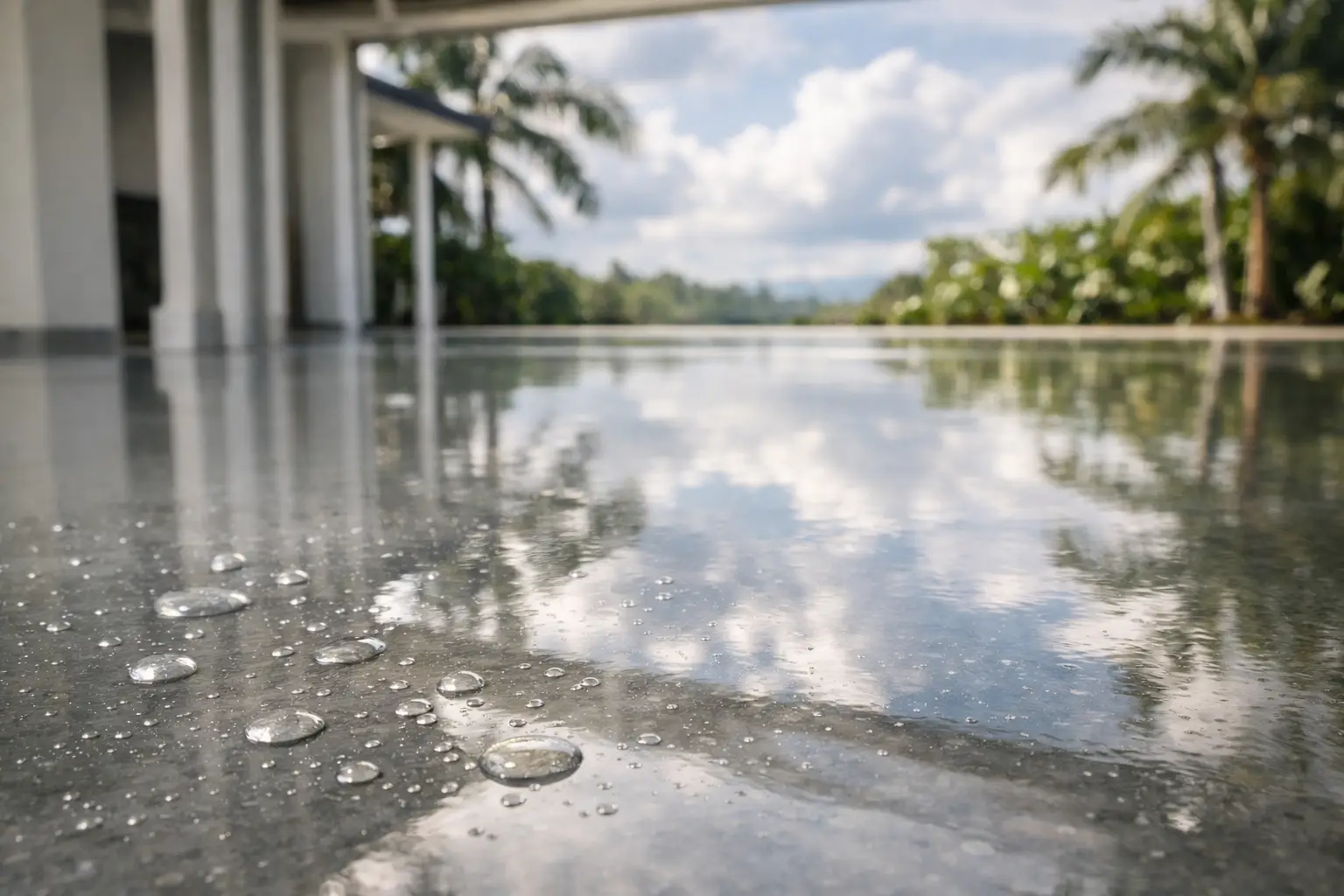
Can Epoxy Handle Humidity? Queensland Floor Facts
A coastal Queensland garage can feel dry at breakfast and be heavy with moisture by mid-afternoon. That change matters when a floor coating is being installed. So, can epoxy handle humidity? Yes, a professionally specified and installed epoxy system can perform exceptionally well in humid conditions. The critical issue is not whether epoxy exists in a humid climate. It is whether the concrete is dry enough, the surface is prepared correctly, and the coating is applied within its approved curing conditions.
Humidity is one reason premium epoxy flooring is a professional installation, not simply a weekend coating job. When moisture is ignored, even a quality product can lose adhesion, cure poorly or develop a cloudy finish. When it is managed properly, epoxy delivers the seamless, hard-wearing surface that garages, workshops, warehouses and commercial spaces need.
Can Epoxy Handle Humidity During Installation?
Epoxy can handle normal ambient humidity, but it has limits. Every epoxy product has a manufacturer-specified range for air temperature, concrete temperature and relative humidity. Work outside that range and the coating may not cure as intended.
High humidity slows evaporation and can affect the chemical reaction that turns liquid resin into a hard floor. In some conditions, moisture can condense on the slab or on the fresh coating. You may not see that condensation immediately, but it can interfere with bond strength and leave the finished surface vulnerable to peeling, patchiness or premature wear.
The risk rises when the concrete surface is cooler than the dew point. This is common in Queensland after rain, overnight cooling, or when a garage or warehouse is opened early on a humid morning. Warm, moisture-laden air meets a cooler slab and forms an almost invisible layer of water. Applying epoxy over it is a shortcut to a failed floor.
A skilled installer checks site conditions before coating begins. That means measuring concrete moisture, monitoring ambient humidity and temperature, and confirming the slab is safely above dew point. If conditions are unsuitable, the right decision is to wait or use a moisture-management approach, not push ahead to meet an arbitrary schedule.
Humid Air Is Only Part of the Moisture Problem
There are two different moisture sources to consider. The first is humidity in the air. The second, and often more serious issue, is moisture vapour moving up through the concrete slab.
Concrete is porous. Even a slab that looks completely dry can hold moisture beneath the surface. In ground-level garages, warehouses and older buildings, water vapour can migrate upward from the soil or from residual moisture within the slab. Once the floor is sealed with epoxy, that vapour pressure has nowhere easy to go.
If the coating system has not been selected for the slab’s moisture condition, the pressure can create blisters, bubbling or delamination. This is why visual inspection alone is not enough. A clean-looking concrete floor is not automatically ready for epoxy.
For property owners, this distinction is useful: a dehumidifier may improve the air in a room, but it will not solve moisture coming through the concrete. Surface preparation and moisture testing need to address both issues before the first coat is applied.
What Good Moisture Control Looks Like
A durable epoxy floor starts well before any resin is mixed. The process begins with a close assessment of the slab, including its age, condition, contamination, cracking and moisture profile.
Mechanical grinding is then used to remove weak concrete, old coatings, tyre residue, oils and surface contaminants. More importantly, it creates the correct surface profile for the epoxy to grip. Acid washing may appear easier, but it does not provide the consistency or contaminant removal needed for premium flooring work.
Where testing identifies elevated moisture, a compatible moisture barrier or specialised primer may be required. This is not a one-size-fits-all step. The correct product depends on the slab, moisture readings and the epoxy system going over the top. Using an incompatible primer can create a new adhesion issue rather than solving the original one.
Cracks and joints also need attention. Static cracks can be repaired and incorporated into the system, while moving joints generally need to remain functional. Coating straight across an active expansion joint without the right detailing can lead to cracking later, regardless of how well the epoxy handles humidity.
Why Curing Conditions Matter as Much as Preparation
Epoxy does not dry in the same way paint dries. It cures through a chemical reaction between resin and hardener. Temperature and humidity influence the speed and quality of that reaction.
In very humid weather, the surface may stay tacky for longer, particularly where ventilation is poor. In some epoxy systems, moisture can contribute to a surface film known as amine blush. This can look waxy, cloudy or greasy and may affect the bond of a subsequent coat if it is not removed correctly.
Heat adds another layer of complexity. Queensland summers can bring high humidity and high temperatures at the same time. A hot slab can make epoxy set too quickly, reducing working time and making it harder to achieve an even, seamless finish. Conversely, a cool slab can slow curing and increase the chance of condensation.
Experienced installers plan around the conditions rather than treating every day the same. They may adjust the work window, control ventilation, protect the area from weather exposure and use products suited to the temperature range. The goal is simple: a controlled cure that produces consistent colour, gloss, adhesion and long-term strength.
What Humidity Means for Different Epoxy Floors
A domestic garage usually faces humid air, hot tyres, occasional rainwater and vehicle contaminants. The coating needs strong adhesion to prevent hot tyre pickup, as well as a finish that is practical to clean after a wet weekend or a muddy trip away. Decorative flake systems are popular because they add texture and help disguise everyday dust and marks.
Commercial spaces may have different priorities. Entrances, showrooms, kitchens and work areas need a finish that supports hygiene, presentation and safe movement. Humidity control remains essential during installation, but the final texture also needs to suit the space. Where slip resistance is required, the system should be designed and tested with the intended use in mind, including relevant requirements under AS 4586.
Industrial warehouses face the highest demand. Forklifts, pallet jacks, dropped loads, chemical exposure and frequent cleaning can quickly expose weak preparation or moisture-related failures. A warehouse floor should be assessed for traffic, point loading, operational downtime and concrete moisture before a coating specification is chosen. The thickest product is not always the best answer. Correct preparation and the right system build are what create reliable performance.
Signs a Humidity or Moisture Issue Has Been Missed
A new epoxy floor should cure to a hard, uniform surface. It should not feel soft, remain persistently tacky or lift under normal use. Some problems appear immediately, while others develop over months as moisture vapour continues to act below the coating.
Watch for cloudy patches, pinholes, bubbles, peeling around edges, blistering, unusual odours or areas that sound hollow when tapped. These symptoms do not always have one cause, but they warrant inspection. Applying another coat over a failing surface rarely fixes the underlying problem.
The practical response is to identify whether the issue comes from slab moisture, contamination, poor surface profile, unsuitable product selection or curing conditions. A proper repair may involve removing failed material, re-preparing the concrete and installing a compatible moisture-control layer before recoating.
Is Epoxy a Good Choice for Coastal Queensland Properties?
Yes, provided the system is designed for the site and installed under controlled conditions. Humid locations around Brisbane, the Gold Coast and the Sunshine Coast do not rule out epoxy flooring. They make professional moisture assessment more valuable.
Epoxy offers a seamless surface that does not harbour dust in grout lines or joints, making routine cleaning straightforward. It protects concrete from staining and wear, improves the appearance of tired garages and workspaces, and can be tailored with flake, metallic or practical textured finishes. The trade-off is that successful results depend heavily on preparation. Cheap coatings and rushed installation often fail at the point where the concrete and coating meet.
For a floor expected to perform for years, ask how the installer tests concrete moisture, prepares the slab, manages dew point and specifies slip resistance. Those answers tell you far more about likely durability than a low price alone.
Resin Masters approaches humid-climate projects with that level of control, from mechanical preparation through to moisture management and final finish selection. A quality epoxy floor should look sharp on day one, but its real value is how confidently it performs through Queensland’s wet, hot and changeable conditions.