Servicing : Gold CoastBrisbaneSunshine CoastToowoomba

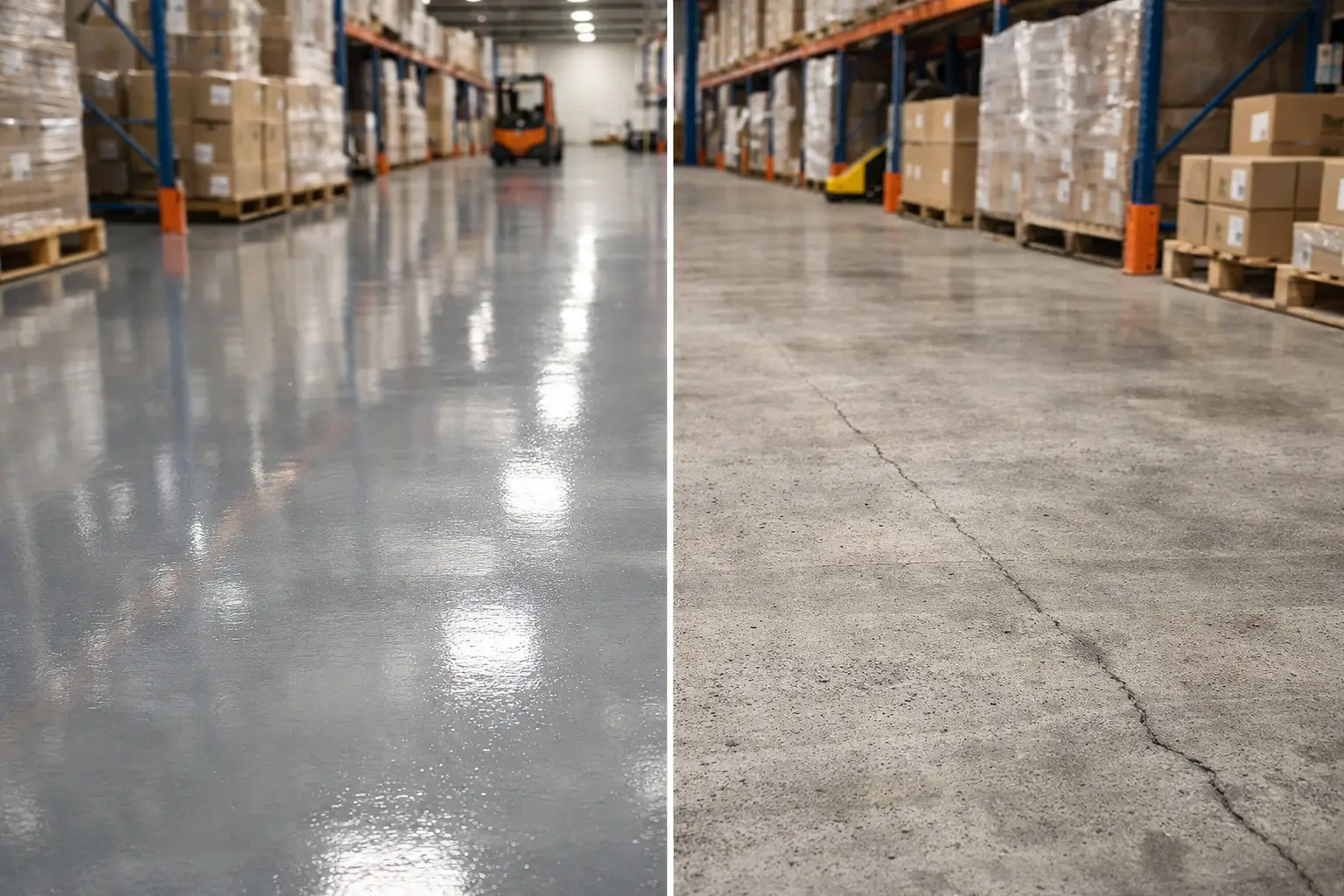
Warehouse Coatings vs Bare Concrete for Long-Term Value
A warehouse floor rarely fails all at once. It starts with dust tracked into offices, tyre marks that will not lift, oil darkening loading zones and small chips becoming rough edges under forklifts. When comparing warehouse coatings vs bare concrete, the practical question is not whether concrete is tough. It is whether an unprotected slab can keep meeting the demands of your operation without steadily adding cleaning, repair and safety costs.
For warehouses across South East Queensland, heat, humidity, vehicle traffic and occasional chemical exposure put ordinary concrete under real pressure. A professionally specified resin floor can protect the slab and make the workspace easier to run. But the right decision depends on the condition of the concrete, the traffic profile and how the space is used.
Warehouse coatings vs bare concrete: the core difference
Bare concrete is structural. It is designed to carry loads, not necessarily to provide a sealed, low-maintenance working surface. Even a well-finished concrete slab remains porous. Water, oils and chemicals can enter its surface, while abrasion gradually opens it up further.
A warehouse coating creates a bonded protective layer over the slab. In an industrial setting, this is commonly a high-build epoxy system, sometimes paired with other resin products where cure time, UV exposure or specific performance requirements call for them. The finished floor is seamless, non-porous and designed around the environment it will serve.
That difference affects daily operations. Bare concrete absorbs contaminants and releases fine dust as it wears. A quality coating resists penetration, contains dust and gives staff a smoother, more consistent surface to work across. It also makes line marking, traffic lanes and designated work zones clearer and more durable.
The distinction is especially relevant in facilities where presentation matters alongside performance. Distribution centres, workshops, food-adjacent areas, showrooms and mixed-use commercial spaces all benefit from a floor that looks controlled rather than constantly patched.
Durability is about more than load capacity
Concrete has excellent compressive strength, which is why it is the standard warehouse substrate. However, forklifts, pallet jacks and hard-wheeled trolleys create repeated point loading and abrasion at the surface. Wheel paths, turning circles and loading areas are often the first places to show wear.
Bare concrete can dust, polish unevenly, chip at joints and suffer surface erosion over time. Oils and hydraulic fluids may leave stains that are difficult to remove completely. If a spill is left in place, the issue is not only cosmetic. Contamination can weaken the surface and make later coating work more involved.
A correctly installed epoxy coating takes the operational punishment on behalf of the slab. It helps resist abrasion, impact, tyre marking and many common workshop or warehouse chemicals. That does not mean every coating is indestructible. A heavy-duty forklift fleet, steel-wheeled equipment or frequent chemical exposure needs a system built for that purpose, with the right thickness and finish.
The quality of preparation matters as much as the product. Coating over weak laitance, old sealer, dust or contamination does not create a durable floor. It creates a floor that may delaminate when traffic increases. Professional mechanical grinding or shot blasting opens the concrete profile so the resin can bond properly, rather than simply sitting on top.
Queensland moisture changes the specification
Moisture is one of the biggest reasons warehouse coatings fail prematurely. Concrete can hold moisture long after it appears dry, and Queensland’s humid conditions can complicate application further. Vapour pressure moving through the slab may cause blistering, bubbling or loss of adhesion if it is not assessed and controlled before installation.
A professional installer tests the substrate, checks site conditions and selects an appropriate moisture-control primer or system where required. This step can add cost at the outset, but it is considerably less expensive than removing a failed coating and starting again. For older warehouses, ground-floor slabs and coastal locations, it should never be treated as an optional extra.
Cleaning, hygiene and dust control
The day-to-day difference between coated and bare concrete is often most obvious to cleaning teams. Bare slabs trap grime in pores and surface texture. Even when they are swept regularly, concrete dust can migrate onto stock, shelving, equipment and vehicles.
A seamless resin coating creates a sealed surface that is easier to sweep, scrub and maintain. Spills stay on the surface for longer, allowing staff to respond before they become permanent stains. This can reduce cleaning effort and support better standards in spaces handling packaged goods, automotive parts, manufacturing inputs or customer-facing stock.
There is a trade-off. Coatings still need an appropriate cleaning program. Aggressive cleaners, neglected spills and abrasive cleaning methods can shorten the life of any finish. The benefit is that maintenance becomes planned and manageable instead of an ongoing battle with ingrained dirt and deteriorating concrete.
Safety and slip resistance need a considered approach
A clean-looking floor is not automatically a safe floor. In warehouse environments, slip resistance needs to suit the actual risks on site: footwear, wheeled traffic, water exposure, oil, wash-down practices and the likelihood of contaminants.
Bare concrete can become slippery when polished by traffic or contaminated by oil. Conversely, very rough concrete may create trip hazards, make cleaning difficult and interfere with pallet movement. A coated floor can be specified with a slip-resistant aggregate finish, balancing grip for pedestrians with practical movement for forklifts and trolleys.
The correct level of texture depends on the area. A loading dock exposed to rain needs a different finish from a dry picking aisle or a clean production zone. Where compliance is required, the system should be considered against relevant Australian slip-resistance requirements, including AS 4586 testing principles. Selecting a finish by appearance alone is not a safety strategy.
Upfront price versus whole-of-life cost
Bare concrete has the obvious advantage of no coating installation cost today. For a low-traffic storage shed with limited exposure to fluids, that may be a reasonable choice. Not every slab needs a premium resin system.
For an active warehouse, however, the initial saving can be misleading. Dust suppression, deep cleaning, stain treatment, concrete patching, joint repairs and disrupted work areas all carry costs. A deteriorating floor can also affect the impression made on clients, staff and tenants.
A warehouse coating is an investment in the usable life of the slab. It can reduce repair frequency, simplify cleaning and protect the surface from avoidable damage. The return is strongest where the floor sees regular vehicle movement, goods handling, fluid spills or public-facing activity.
Budget should be based on the entire job, not a square-metre figure alone. The slab condition, crack repairs, moisture mitigation, access restrictions, required cure time and slip-resistance specification all influence the proper scope. A low quote that ignores preparation is rarely a saving once repairs are required.
When bare concrete is still the sensible option
Coatings are not automatically the answer. If a warehouse is leased short-term, used only for dry bulk storage or awaiting major redevelopment, a local concrete repair and a practical cleaning regime may be enough. Likewise, a slab with significant structural movement or unresolved moisture issues should be repaired and assessed before any resin system is proposed.
In these situations, the best decision is to avoid applying a coating too early. Resin flooring performs exceptionally well when it is matched to a stable substrate and a clear operational need. It is not a substitute for structural rectification.
Choosing the right warehouse floor system
The best specification starts with how the warehouse actually operates. Consider vehicle types and turning loads, stored materials, likely spills, cleaning methods, staff foot traffic, lighting and downtime windows. Then assess the slab itself for strength, contamination, cracks, joints and moisture.
For high-use facilities, a professionally prepared epoxy system is often the strongest long-term option. It delivers a hard-wearing, seamless finish while allowing practical choices around colour, line marking and slip resistance. Resin Masters approaches warehouse projects with this site-specific focus, including rigorous preparation and moisture management suited to local conditions, backed by a 7-year warranty.
A warehouse floor should support the work happening above it, not create another maintenance problem below it. Before accepting bare concrete as the default, assess what dust, staining and surface wear are already costing your operation. A properly specified coating can turn that recurring burden into a controlled, durable asset.