Servicing : Gold CoastBrisbaneSunshine CoastToowoomba

Menu
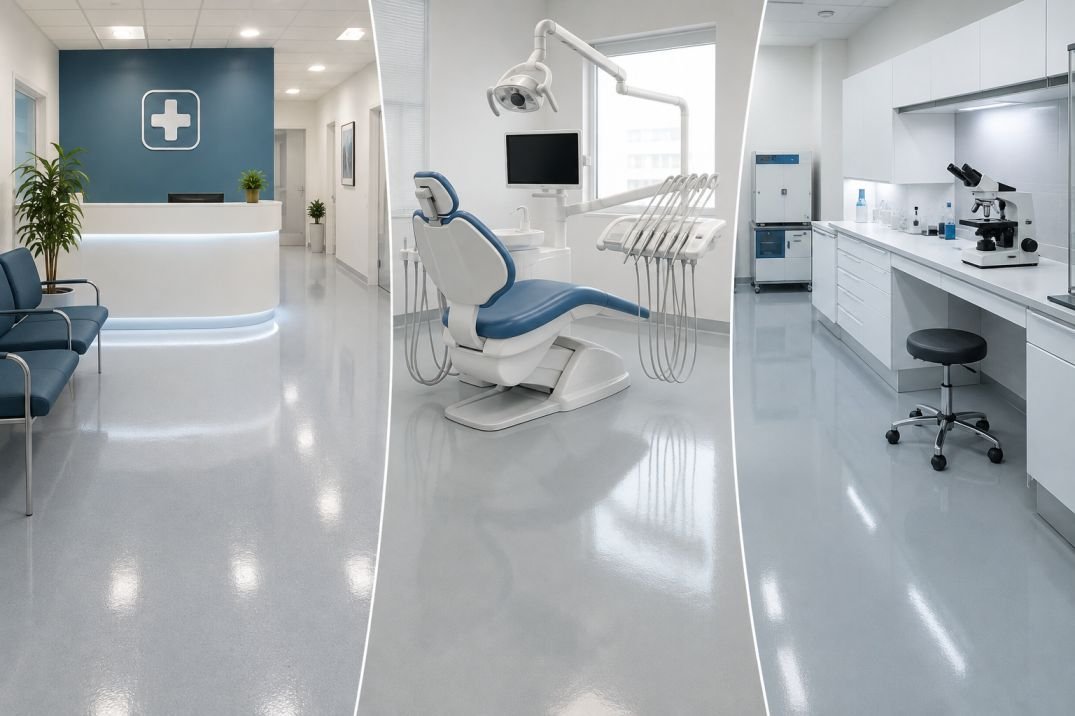
Epoxy Flooring for Medical Centres, Dental Clinics and Labs
October 19, 2026
Team
Epoxy flooring can suit medical centres, dental clinics and labs that want a joint-free, wipe-clean floor over a sound concrete slab. It isn’t the automatic choice for clinical rooms, though. Australian health facility guidance treats welded sheet vinyl as a mainstay, so ask your certifier and infection-control lead what they expect before you compare quotes.
Most clinic floors fail at the edges, not in the middle. The wall junction, the door threshold and the slab joint are where cleaning gets missed and coatings let go. This guide covers those details, plus disinfectants, slip, odour and closure time.
What does a clinic floor actually have to do?
A clinic floor has to clean easily, survive your disinfectants, stay safe underfoot when wet, and meet the wall in a way that doesn’t trap dirt. It also has to go in fast enough that you can keep trading. Colour and gloss come well behind those five jobs.
- Clean easily. Few joints, no porous grout, and no texture that holds soil.
- Survive your chemicals. The finish must tolerate the disinfectants your cleaners really use, at the strength they use them.
- Stay safe when wet. Spills, mopping and wet shoes are daily events in a waiting room.
- Meet the wall properly. A coved edge stops mop water and dirt sitting in a corner.
Epoxy or welded sheet vinyl: which do clinics choose?
Vinyl sheet with welded joints is the established clinical choice, and NSW Health’s floor coverings guide (AusHFG TS-7) calls it one of the principal healthcare floors. Epoxy is a credible alternative on slabs that are sound and dry, especially in wet-cleaned or chemical-exposed rooms. Neither wins everywhere.
Factor | Poured epoxy system | Welded sheet vinyl |
|---|---|---|
Joints | None across the field, but slab joints and cracks need a plan | Heat-welded seams; TS-7 describes these as impervious and hygienic |
Wall junction | Coved edge is possible; confirm it is in the quote | Integral cove recommended; TS-7 suggests 150 mm minimum height in clinical areas |
Slab movement | Rigid; movement joints must be honoured, not coated over | Flexible; TS-7 says it copes with minor differential movement |
Underfoot | Hard and cool | Slightly resilient |
Repair | Spot patch is possible, but colour matching takes care | Cut out and weld in a new section |
Downtime | Often 2 to 4 days for a system, staged by room | Depends on adhesive and substrate preparation |
TS-7 is generic guidance and dates from before many current resin products, so treat it as a checklist of questions, not a ruling on epoxy. Its section on joint-free coatings is thin. Ask your certifier which document they will assess against.
Where does poured epoxy make sense in a clinic?
Epoxy tends to fit best in rooms that get wet-cleaned or chemical exposure, on sound slabs: labs, cleaners’ rooms, plant rooms, loading bays and some back-of-house corridors. Resin Masters’ solid colour epoxy flooring page lists medical and allied health premises among the places it’s used. For consulting rooms, weigh comfort and noise too.
- Labs and wet-processing rooms. Chemical exposure decides the system. Send the manufacturer a list of your reagents and cleaners.
- Utility and plant rooms. Hard-wearing and easy to hose or mop.
- Waiting rooms and corridors. Flake or solid colour can work, but check echo and comfort with staff.
- Sterile or procedural areas. Follow the health facility guidelines and your designer. Don’t pick a floor on a contractor’s brochure.
Will epoxy survive clinic disinfectants?
Cured epoxy resists many cleaning agents, but not all of them equally, and strength and contact time matter. Ask for the manufacturer’s chemical resistance data sheet and check it against your actual disinfectant, concentration and dwell time. A general claim like “hospital grade” isn’t evidence.
Cleaning habits matter as much as chemistry. Resin Masters’ own slip resistance guide warns against waxes and silicone-based dressings, because they leave a film that cuts grip on any hard floor. Use a neutral cleaner where the data sheet allows, and train cleaners on it. TS-7 makes the same point for vinyl: neutral detergent, no abrasive methods.
How slippery is a clinic epoxy floor, and what rating do you need?
Slip resistance depends on the finish, the contaminant and the footwear, not on the word epoxy. A smooth gloss floor can be slippery when wet. Anti-slip aggregate helps, at the cost of harder cleaning. No single rating fits every room, so ask your designer to set one per area.
Read the test result carefully. TS-7 warns that the common R value comes from an oil-wet ramp test and doesn’t represent other conditions. For water-wet areas, the AS 4586 wet pendulum test gives P ratings from P1 to P5. WorkSafe Queensland notes that a floor that grips when dry may not when wet, and that the wrong cleaning method can make it worse.
Our slip-resistant epoxy guide covers aggregate choices in more detail.
How long will the clinic be closed, and what about odour?
Most Resin Masters jobs take 2 to 4 days, and larger floors can be staged room by room so part of the practice keeps trading. Its site describes low-VOC to near-zero-VOC, 100% solids products. Ask for the safety data sheet and a written re-entry time for each room.
- Ask whether grinding uses dust extraction, and how the work area is sealed off from patients.
- Ask when each room is walkable and when it reaches full chemical cure. Resin Masters quotes walkable within 24 hours and full cure at 7 days for garages, so confirm the timings for your system.
- Ask about odour on the day. Patients with respiratory conditions or chemical sensitivities should get advice from their own clinician; this isn’t medical advice.
- Ask about after-hours or weekend work if you can’t close a room during the week.
What does epoxy flooring cost for a clinic?
Resin Masters‘ published rates, including GST, are $50 to $90 per m2 for solid colour and $60 to $110 per m2 for decorative flake. For example, a 30 m2 treatment room in solid colour runs about $1,500 to $2,700. Coving, anti-slip aggregate and repairs are itemised in your quote.
Item | Published figure | What it means for a clinic |
|---|---|---|
Solid colour system | $50 to $90 per m2 | Base price for a plain, wipe-clean floor |
Decorative flake | $60 to $110 per m2 | Hides marks better in waiting areas |
Crack and defect repair | $5 to $20 per m2 for heavily damaged slabs | Older suites often need it |
Moisture barrier | $3 to $8 per m2 | Needed if the slab tests damp |
Small rooms | Flat minimum project fee may apply | Ask what it is before you book |
Prices are for the system only. See epoxy flooring cost for the full breakdown, and how to prepare concrete for epoxy for what grinding and moisture testing involve. Resin Masters offers a free on-site quote if you’d like a number for your rooms. Contact Us!
What should you ask an installer before you sign?
Ask six questions in writing. They cover the wall junction, slab joints, disinfectant compatibility, slip test evidence, room staging and the warranty. Written answers separate a real specification from a sales pitch, and they give you something to hold the installer to.
- How will the floor meet the wall, and is a cove included in the price?
- What happens at slab movement joints and existing cracks?
- Does the chemical resistance data sheet list our cleaning products?
- Can you provide slip test results for this exact finish?
- How will rooms be staged, and when is each one usable?
- What does the warranty cover in writing? Resin Masters gives a written 7-year workmanship warranty; see the epoxy floor warranty page.
Who is epoxy flooring for clinics not for?
Epoxy isn’t the right pick for every clinic. Skip it on damp or crumbling slabs, timber or suspended floors, and rooms where staff want a soft, quiet surface. It also shouldn’t replace the specified floor in sterile or procedural areas without your designer’s sign-off.
- Slabs with active moisture that hasn’t been tested and treated.
- Practices in leased premises where the landlord requires a particular floor.
- Rooms that need a resilient, quiet surface, such as long staff corridors.
- Anyone hoping a coating alone will meet an infection-control requirement.
Frequently asked questions
Is epoxy flooring hygienic enough for a dental clinic?
A well-installed epoxy floor has no grout lines and wipes clean, which suits many dental surgeries. Hygiene still depends on the wall junction, cleaning routine and disinfectant compatibility. Confirm the details with your infection-control lead and the manufacturer’s data sheet, not the brochure.
Does a clinic epoxy floor need coving?
Most clinics benefit from a coved edge, because it removes the sharp corner where dirt collects. NSW Health’s TS-7 recommends integral coved skirtings for vinyl wherever hygiene matters. Ask any epoxy installer to state in the quote whether a cove is included and how high it runs.
Can epoxy go over existing tiles in a clinic?
Sometimes. Resin Masters says epoxy over tiles adds about 5 to 8 mm to the floor height. Hollow or loose tiles must come out first, and adhesion is checked before it agrees to coat. Check door clearances and thresholds.
Is epoxy flooring safe for patients?
Cured epoxy is an inert, sealed surface, and Resin Masters describes its products as low-VOC to near-zero-VOC. Curing does give off odour, so ask for the safety data sheet and a re-entry time. Patients with health concerns should ask their own clinician.
How long does an epoxy floor last in a clinic?
It depends on traffic, cleaning and slab condition. Resin Masters gives a written 7-year workmanship warranty, and its industrial page says a well-prepared floor can serve 10 to 20 years or more. Clinic carts, chairs and daily disinfecting all count as wear.
Also Read:- Epoxy Flooring for Gyms and Home Gyms