Servicing : Gold CoastBrisbaneSunshine CoastToowoomba

Menu
Epoxy Flooring for Home Kitchens: Heat, Hygiene and Cost
October 15, 2026
Team
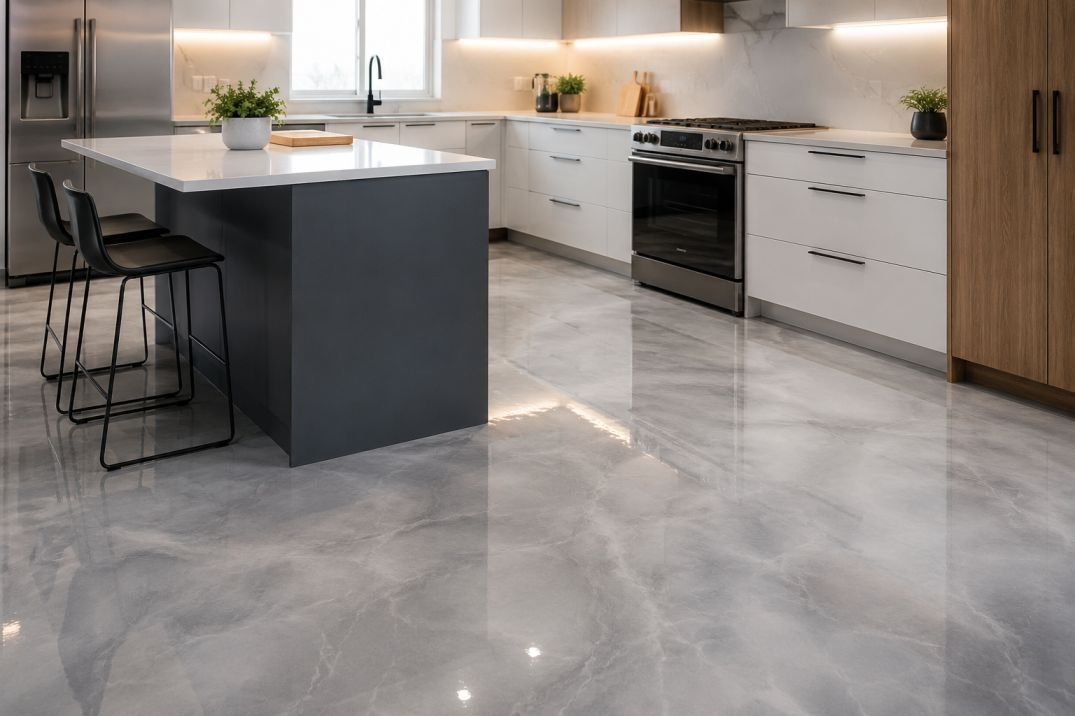
Epoxy flooring works well in a home kitchen built on a concrete slab. It gives a joint-free floor with no grout lines to trap grime, and spills wipe off. Three things need thought: hot cookware, grip when wet and the hard feel underfoot. Resin Masters publishes $50 to $110 per m2 for solid or flake finishes.
Most epoxy pages online are written for garages or commercial kitchens. A home kitchen is a different job. Spills are small, the room is lived in daily, and you’ll be barefoot on it.
Which home kitchens suit an epoxy floor?
Kitchens on a concrete slab suit epoxy best, which covers most ground-floor kitchens in Queensland homes. Timber-framed or upper-storey floors don’t, because epoxy needs a stable, dry concrete base. If tiles are already down, a coating can go over them once the tiles are checked for hollow or loose spots.
Resin Masters says epoxy over tiles adds about 5 to 8 mm to the floor height. That matters at door thresholds, dishwashers and cabinet plinths. Hollow or loose tiles have to come out first, and adhesion is checked before the coating is agreed. Our guide to epoxy flooring for Queensland homes covers the other rooms.
How much heat can an epoxy kitchen floor take?
Epoxy handles normal kitchen warmth, but it’s not heat-proof. Product data sheets rate floors for exposure, not for a hot pan set down on the surface. Use a trivet, and check the data sheet for the actual system quoted. Resin Masters doesn’t publish a heat rating, so ask for one.
For a sense of scale, the Sikafloor-264 data sheet, a commercial epoxy, lists these limits:
- Permanent dry heat: +50 degrees Celsius.
- Short-term dry heat: +80 degrees Celsius for up to 7 days, or +100 degrees Celsius for up to 12 hours.
- Occasional moist heat, such as steam cleaning: up to +80 degrees Celsius.
That’s one product, not Resin Masters’ system. Sudden swings are the harder test. J&P Coatings, a US contractor, says standard epoxy is hard and rigid and can crack under thermal shock, and it calls polyaspartic more temperature-tolerant. Its examples are fryer lines, which no home kitchen matches. A polyaspartic topcoat is standard on Resin Masters’ systems.
Is an epoxy kitchen floor hygienic?
A joint-free epoxy floor is easy to keep clean, because there are no grout lines for food and moisture to settle into. That’s the real hygiene gain at home. The weak points are the edges, where the floor meets cabinets and walls. Ask the installer how those junctions are finished.
Regular sweeping and a mop do most of the work. Sydney Epoxy Floors suggests warm water and a soft brush, and our guide to maintaining epoxy floors covers care. Don’t rely on claims that epoxy is antibacterial. None of the pages we read for this post backed that with test data.
Food-business rules apply to restaurants, not homes. If you run a commercial kitchen, start with our commercial kitchen flooring guide.
Is epoxy slippery in a kitchen?
Smooth gloss epoxy can be slippery when wet or greasy. A flake finish or an anti-slip additive adds grip. The trade-off is texture, which holds a little more dirt and takes a firmer brush. Ask for a wet slip rating tested to AS 4586, not just a promise of grip.
AS 4586 wet pendulum classes run from P0 to P5. One testing firm’s summary puts P3 at 35 to 44 and P4 at 45 to 54 on the slip resistance value scale, with P5 above 54. We couldn’t find a mandated rating for a home kitchen floor in the sources we read. Resin Masters uses AS 4586-rated anti-slip aggregate in bathrooms, so ask for the same data in a kitchen.
Our guides on choosing slip-resistant epoxy and whether epoxy floors are slippery go further.
How much does an epoxy kitchen floor cost?
Resin Masters publishes $50 to $90 per m2 for solid colour, $60 to $110 for flake and $100 to $160+ for metallic or custom quartz, all including GST. A 15 m2 kitchen in flake would land around $900 to $1,650 before extras. Small rooms may carry a flat minimum fee.
|
Finish |
Rate per m2 |
15 m2 kitchen |
25 m2 kitchen and dining |
|---|---|---|---|
|
Solid colour |
$50 to $90 |
$750 to $1,350 |
$1,250 to $2,250 |
|
Decorative flake |
$60 to $110 |
$900 to $1,650 |
$1,500 to $2,750 |
|
Metallic or custom quartz |
$100 to $160+ |
$1,500 to $2,400+ |
$2,500 to $4,000+ |
Extras sit on top. Crack and defect repair is $5 to $20 per m2 for heavily damaged slabs. Moisture barrier is $3 to $8 per m2, and old coating removal is assessed at quote. Other installers advertise less: Sydney Epoxy Floors quotes $30 to $35 per m2 for two coats. Ask what coats, thickness and topcoat a price includes.
Use the epoxy flooring cost guide or the cost calculator for your own area. A free on-site quote gives an itemised written price within 48 hours of the visit.
How does epoxy compare with tiles and vinyl in a kitchen?
Tiles outlast epoxy on paper, and vinyl is softer and cheaper to lay. Epoxy wins on joint-free cleaning and a coating that goes straight over a slab. Sydney Epoxy Floors, an epoxy seller, lists lifespans of 10 to 20 years for epoxy, 5 to 20 for vinyl and 20 to 50 for tiles.
|
Floor |
Lifespan (Sydney Epoxy Floors) |
Main trade-off |
|---|---|---|
|
Epoxy |
10 to 20 years |
Joint-free and easy to clean, but hard underfoot and needs a sound slab |
|
Tiles |
20 to 50 years |
Long life, but grout lines stain and can crack; heavy to rip out |
|
Vinyl |
5 to 20 years |
Softer and quicker to lay, but can dent and lift at joins |
Resin Masters backs its work with a written 7-year workmanship warranty. Our epoxy vs tiles comparison goes deeper. If you want to refresh the benchtop rather than the floor, we have a page on benchtop epoxy resurfacing.
How long is the kitchen out of action?
Plan on several days without a usable kitchen floor. Resin Masters says most jobs take 2 to 4 days. Its 24-hour walkable, 48 to 72-hour vehicle-ready and 7-day full-cure times are for garages, so ask for a kitchen timeline in writing. Set up a temporary kitchen elsewhere.
Sikafloor-264 lists foot traffic at about 24 hours and full cure at about 7 days at 20 degrees Celsius. Ask about ventilation during application, and read the product’s safety data sheet. Keep children and pets out until the installer says the room is ready.
Which finish and colour suit a kitchen?
Fine flake or a light solid with anti-slip suits most kitchens. Flake hides crumbs, small dips and daily scuffs. A glossy dark solid shows every speck and slab imperfection. Resin Masters offers multi-colour vinyl chip flake blends and brings colour samples to the free consultation.
Compare shades in the room’s own light, not just under a showroom lamp. Our epoxy floor colours guide shows how each finish reads. Contact Us!
Who is an epoxy kitchen floor not for?
Epoxy isn’t for kitchens on timber floors, for slabs with active moisture, or for anyone who wants a soft surface. It’s also the wrong pick if you expect a heat-proof floor. Tiles or sheet vinyl may suit those cases better.
- Upper-storey or timber-framed kitchens.
- Slabs with untreated damp. Moisture testing and, where needed, a barrier come first.
- Cooks who stand for hours and want cushioning. Epoxy is hard, so plan an anti-fatigue mat.
- Renters, since the coating is bonded to the slab and can’t be lifted out.
Frequently asked questions
Can you put hot pans on an epoxy floor?
Avoid it. A data sheet rating covers general heat exposure, not a pan set down on the surface, so use a trivet and let cookware cool. The Sikafloor-264 sheet allows short-term dry heat up to 100 degrees Celsius for 12 hours. Ask your installer for the sheet on your system.
Can epoxy go over existing kitchen tiles?
Sometimes. Resin Masters checks adhesion before agreeing to coat, and hollow or loose tiles must come out first. Coating over tiles adds about 5 to 8 mm to the floor height, which affects thresholds, appliances and cabinet plinths. Ask for a site check before you decide.
How long does an epoxy kitchen floor last?
Sydney Epoxy Floors puts epoxy at 10 to 20 years. Real life depends on slab preparation, moisture and wear, and Resin Masters backs its installs with a written 7-year workmanship warranty. Ask any installer what the warranty covers, in writing, before you sign.
Is epoxy comfortable to stand on in a kitchen?
It’s hard and can feel cool underfoot, more like tile than vinyl. If you cook a lot, an anti-fatigue mat near the bench and sink makes a real difference. Choose a mat with a non-slip base so it doesn’t slide on a smooth coating.
Can Resin Masters coat my kitchen floor?
Resin Masters coats concrete floors in garages and home interiors across South-East Queensland and Northern NSW. Book a free, no-obligation on-site quote. We’ll check the slab, moisture and any tiles, then send an itemised written quote within 48 hours of the visit.
Also Read:- Self-Levelling Epoxy vs Standard Epoxy for Uneven Concrete