Servicing : Gold CoastBrisbaneSunshine CoastToowoomba

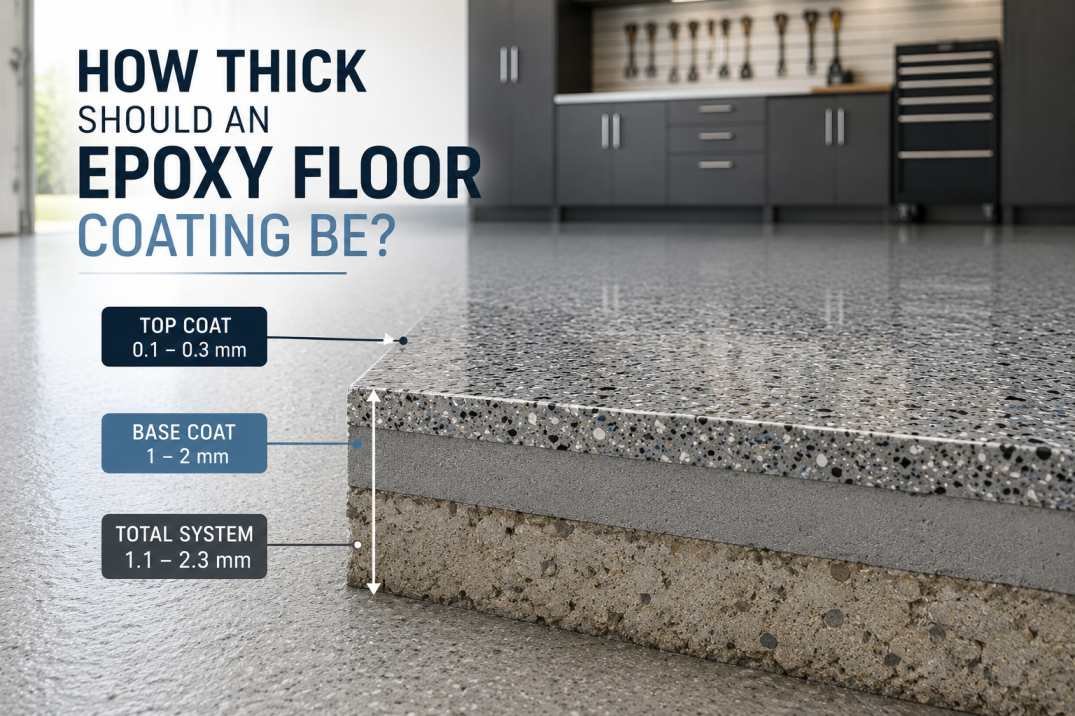
How Thick Should an Epoxy Floor Coating Be?
Professional epoxy floor systems range from about 0.5 mm to 6 mm thick, and heavy-duty systems reach 9.5 mm or more, according to Sherwin-Williams’ published guidance. Thin coatings suit light foot traffic. Resin Masters’ residential and light commercial systems build to 2 to 3 mm, and its industrial systems reach 2 to 6 mm.
Thickness is the number most people ask about and the one installers explain worst, partly because it’s quoted in mils, microns and millimetres depending on who you ask. This page puts all three side by side.
How thick is a typical epoxy floor coating?
Thickness depends on the system. Sherwin-Williams lists thin epoxy systems at 11 to 25 mils (0.28 to 0.64 mm). Professional systems run 20 to 250 mils (0.5 to 6.4 mm), and heavy-duty systems 375 mils (9.5 mm) or more. Resin Masters’ systems are in the table.
| System | Mils | mm | Typical use |
|---|---|---|---|
| Thin coating (Sherwin-Williams) | 11 to 25 | 0.28 to 0.64 | Light foot traffic |
| Professional range (Sherwin-Williams) | 20 to 250 | 0.5 to 6.4 | Garages, workshops, commercial floors |
| Heavy-duty (Sherwin-Williams) | 375 or more | 9.5 or more | Heavy industrial, impact and chemical exposure |
| Resin Masters residential and light commercial | about 79 to 118 | 2 to 3 | Garages, homes, retail, bathrooms |
| Resin Masters industrial | about 79 to 236 | 2 to 6 | Warehouses, workshops, factories |
| Resin Masters heavy-duty epoxy mortar | about 157 to 236 | 4 to 6 | Forklift-intensive zones |
Source for the first three rows: Sherwin-Williams, “How Thick Should an Epoxy Floor Coating Be?”. The first three rows are US-based product guidance; the Resin Masters rows come from its published system pages. Conversion used: 1 mil is one thousandth of an inch, or 0.0254 mm (25.4 microns).
How is epoxy floor thickness measured?
Thickness is measured in mils, microns or millimetres. One mil is 25.4 microns or 0.0254 mm, and 1,000 microns is 1 mm. Installers check wet film thickness with a gauge during application and dry film thickness after curing. Ask for the dry figure, because some products lose thickness as they dry.
That last point matters. A water-based coating can lose part of its volume as the water leaves, so a thick wet coat can end up thin once dry. Solvent-free two-part epoxies lose little. Ask the installer to state the finished system thickness, not just the wet coat.
What decides how thick an epoxy floor should be?
Four things decide it: how much traffic and weight the floor carries, the condition of the concrete, exposure to chemicals or impact, and the finish. Heavier loads, damaged slabs and harsher environments call for a thicker system. Sherwin-Williams lists the same factors in its guidance.
- Traffic and vehicle weight. A family car is a different job from a loaded forklift.
- Slab condition. Cracks, pitting and gouges need filling, and rough slabs need more build.
- Chemicals and impact. Workshops and warehouses see spills and dropped loads.
- Finish. Flake and quartz systems add build compared with a plain solid coat.
Is a thicker epoxy floor always better?
No. Thicker isn’t automatically better. Extra thickness adds cost, can raise the floor height at doors and thresholds, and very thick single pours can generate heat as they cure and crack. Thick systems are built in layers instead. The goal is the right thickness for the load, not the maximum.
Check garage door clearance, thresholds and any adjoining floors before you approve a thick system. A system that’s too high can catch a door or leave a step at the edge.
What thickness do you need for a garage, home or warehouse?
Homes and light-use areas need the thinnest systems, garages usually need a mid-range build, and warehouses and workshops need thicker systems for impact and heavy traffic. Resin Masters’ recommended thicknesses are in the table, and a site inspection confirms them for your slab.
| Space | Suggested build | Notes |
|---|---|---|
| Home interior, laundry, patio | 2 to 3 mm, solid, flake or metallic | Light traffic; finish and slip matter most |
| Home garage | 2 to 3 mm with polyaspartic topcoat | Cars, hot tyres, moisture |
| Workshop | 2 to 3 mm high-build, assessed on site | Impact, tools, chemicals |
| Warehouse or forklift area | 2 to 3 mm standard; 4 to 6 mm epoxy mortar for forklift zones | Heavy loads; specify by load and traffic |
Does Queensland heat affect epoxy thickness?
Heat doesn’t change the design thickness, but it changes how easily installers achieve it. Hot slabs make resin set faster and thin out as it flows, so coverage per coat needs care. Humidity affects the surface. Good installers check the dry film thickness and work in the cooler parts of the day.
Resin Masters schedules peak-summer jobs with morning application starts.
What should you ask an installer about thickness?
Ask three questions: what is the finished dry film thickness of the system, how do you measure it, and how many coats and layers make up that build. A clear answer shows the installer is working to a specification. Vague answers usually mean the thickness isn’t being checked.
For the process itself, see our epoxy flooring installation guide.
Who is this guide not for?
This guide isn’t a specification for engineered industrial floors. Those need a design by load, chemical exposure and substrate, often with a written specification. It also doesn’t replace a manufacturer’s data sheet, which sets the required thickness for each product.
For a standard garage or home, the table and questions above are enough to compare quotes.
Frequently asked questions
How thick is epoxy flooring in mm?
Professional systems run from about 0.5 mm to 6.4 mm, and heavy-duty systems reach 9.5 mm or more, per Sherwin-Williams’ guidance. Thin coatings are under 1 mm. Resin Masters’ residential and light commercial systems build to 2 to 3 mm, and its industrial systems to 2 to 6 mm. Always check the data sheet for the exact product.
How many microns is 1 mm of epoxy?
One millimetre is 1,000 microns. One mil is 25.4 microns, so 1 mm is about 39 mils. That conversion helps when a US data sheet quotes mils and an Australian installer quotes millimetres.
Can I add more coats to make epoxy thicker?
Sometimes, but not indefinitely. Each coat has recoat windows and a maximum build per layer. Very thick single pours can overheat and crack. Installers build thickness in layers, following the manufacturer’s data sheet.
Will an epoxy floor stop my garage door closing?
A typical coating adds a fraction of a millimetre to a few millimetres, which rarely matters. Thick industrial systems add more. Tell the installer about any tight clearance or door track, and check it before work starts.
How thick is epoxy paint compared to an epoxy coating?
Epoxy paint is a thin film, usually the thinnest option. A professional coating is thicker because it’s built in layers over a ground slab. Exact figures vary by product, so check the data sheet on any tin.