Servicing : Gold CoastBrisbaneSunshine CoastToowoomba

Best Epoxy Flooring for Garages in QLD
A garage floor usually tells the truth before the walls do. If the concrete is dusty, stained, lifting or always looks dirty no matter how often it is cleaned, the coating system is either wrong for the space or it was never installed properly in the first place. When clients ask about the best epoxy flooring for garages, the real answer is not one product in a tin. It is the right system for the condition of the slab, the way the garage is used, and the local climate.
That matters even more in Queensland. Heat, humidity, coastal moisture and hot tyre pickup can punish low-grade coatings fast. A garage floor that looks good for three months is not a good floor. The standard should be long-term adhesion, easy maintenance, reliable slip resistance and a finish that still presents well after years of traffic.
What is the best epoxy flooring for garages?
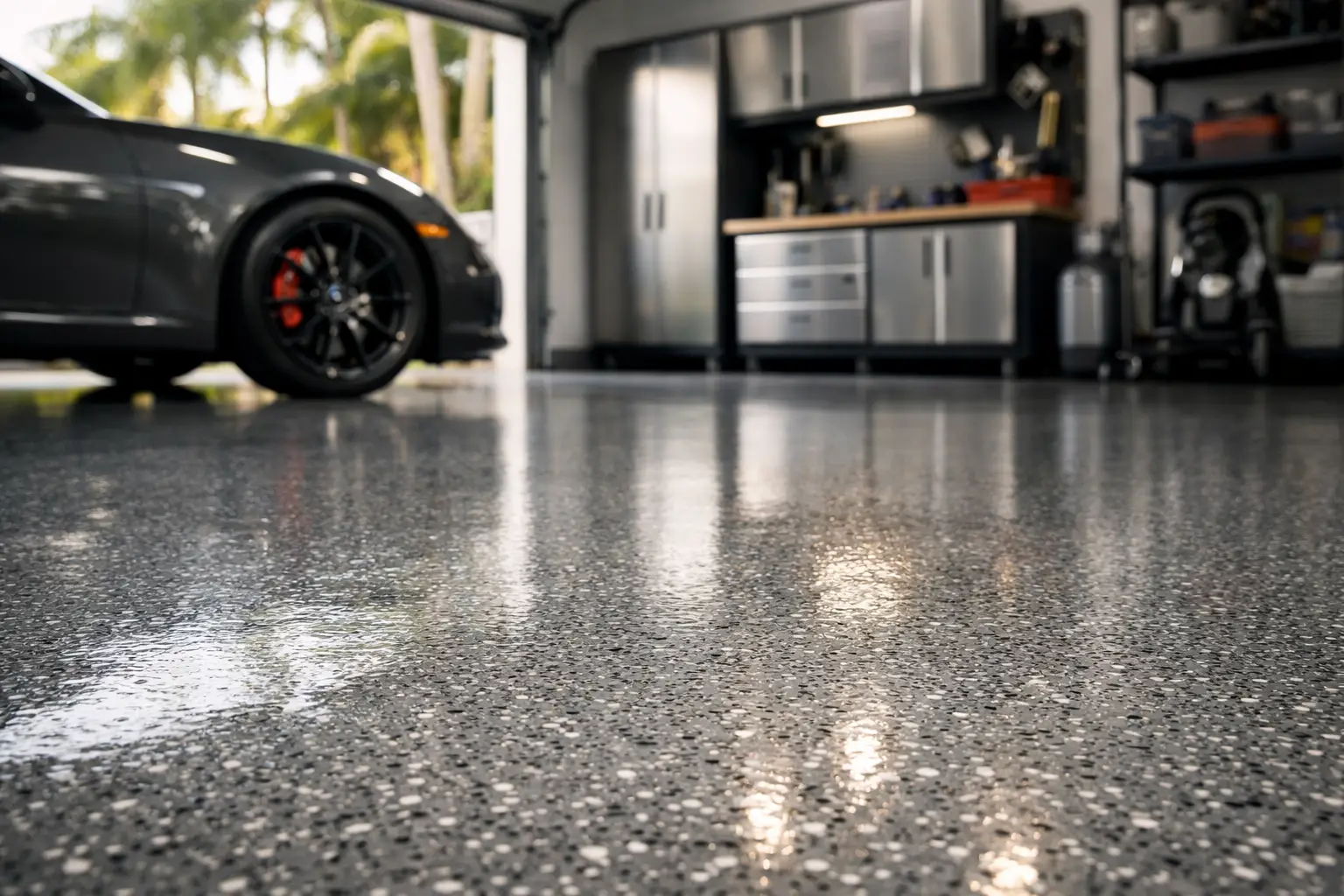
For most residential garages, the best epoxy flooring for garages is a professionally installed flake epoxy system with a high-build epoxy basecoat and a durable UV-stable topcoat. It gives you the balance most owners actually need – strong adhesion, impact resistance, stain resistance, texture underfoot and a finish that hides dust and marks better than plain solid colours.
That said, there is no single answer for every site. A home garage used for parking two cars has different demands from a workshop with tool chests, trolley jacks and frequent chemical spills. A showroom-style garage where presentation matters may suit a metallic or solid colour system, while a practical family garage often performs better with a flake blend that is forgiving to live with.
The coating is only part of the equation. Surface grinding, crack repair, moisture testing and correct topcoat selection are what separate a premium floor from a coating that starts peeling around the tyres.
Why some garage epoxy floors fail early
Most coating failures do not happen because epoxy is a poor material. They happen because the slab was not prepared correctly, moisture was ignored, or the installer used a light-duty system better suited to a storeroom than a working garage.
Concrete needs to be mechanically prepared so the coating can bond properly. Acid washing and quick clean-ups are not enough for a professional result. If the slab has contamination from oil, old sealers or tyre residue, that needs to be addressed before any resin goes down.
Moisture is another common issue, especially in humid and coastal parts of South East Queensland. Concrete can hold moisture long after it looks dry on the surface. If that pressure is not managed with the right prep and primer approach, bubbling, delamination and patchy curing can follow.
Then there is topcoat choice. Standard epoxy is tough, but it is not the best option as the final exposed layer if the garage gets strong natural light. In spaces with open roller doors or regular sun exposure, a UV-stable polyurethane or polyaspartic topcoat helps the floor keep its appearance longer.
The main epoxy flooring options for garages
Flake epoxy systems
Flake floors are the most practical choice for many Australian garages. Decorative flakes are broadcast into the epoxy basecoat and sealed with clear topcoats. The result is a seamless floor with visual depth, better grip than a plain gloss finish, and strong resistance to wear.
This system suits family garages, premium residential builds and many workshop-style spaces. It also does a better job of disguising fine dust, minor scuffs and day-to-day marks than a single-colour floor.
Solid colour epoxy coatings
A solid colour system delivers a clean, sharp finish that works well in minimalist garages or commercial utility areas. It can look excellent, but it is less forgiving visually. Dust, scratches and tyre marks tend to show more clearly, especially in darker colours or high-gloss finishes.
Where appearance is the priority, this can be the right fit. Where ease of day-to-day living matters more, flake often has the edge.
Metallic epoxy floors
Metallic epoxy is chosen for visual impact. It creates movement and depth that can look outstanding in a feature garage, display space or high-end home. It is not usually the first recommendation for a hard-working garage where practicality comes first.
Metallic finishes demand a very high installation standard and a site that suits the look. If the goal is luxury presentation, it can be a strong option. If the goal is a floor that hides the mess of real life, flake is generally the safer choice.
How to choose the right garage floor system
Consider how the garage is actually used
If the garage is only for parking vehicles and storing household items, a premium flake epoxy system is often ideal. If it doubles as a workshop, the floor may need additional thickness, stronger chemical resistance or a more aggressive anti-slip profile.
For builders and commercial operators, it is worth thinking beyond appearance. Will pallet jacks, tool trolleys, fuel, oils or heavier point loads be part of daily use? Those details should shape the specification from the start.
Look at the slab, not just the finish
A newer slab is not always a better slab. New concrete can still hold moisture, while older slabs may have cracks, contamination or weak surface laitance. The right installer will assess the substrate first and recommend the system second.
This is where quality providers earn their place. A floor is only as good as the condition of the concrete underneath it and the preparation work done before coating begins.
Think about slip resistance
A garage floor should be easy to clean, but not slippery when wet. That balance matters in residential garages and even more in commercial settings where compliance may be required. The texture level needs to match the use of the space. Too smooth and it can become hazardous. Too coarse and it becomes harder to mop and maintain.
In Queensland, where wet shoes, pooled rainwater and humid conditions are common, this is not a detail to leave to chance.
What matters most in Queensland conditions
Heat and humidity change the conversation. A coating that might hold up in a mild inland climate can struggle in a coastal garage with high moisture and warm slab temperatures. Hot tyres can soften weaker coatings, especially if the system is thin or poorly cured. Moisture vapour can also create pressure beneath the film over time.
That is why garage epoxy in Brisbane, the Gold Coast and the Sunshine Coast needs a more disciplined approach. Moisture control, proper curing windows and premium-grade materials are not upsells. They are part of getting the floor right.
A UV-stable topcoat also makes sense for many garages in this region. If the door is often open or the slab gets regular sunlight, the top layer needs to cope with it. That helps the floor retain its finish and reduces the risk of yellowing over time.
Professional installation versus DIY kits
DIY kits promise a quick result, but most are light-duty systems with limited film build and minimal surface prep. They can improve the look of a floor short term, but they rarely deliver the same adhesion, thickness or service life as a professionally installed resin system.
The biggest difference is not the roller or the resin. It is the preparation equipment, moisture management and application control. Professional installers use mechanical grinding, repair methods and coating schedules designed for the slab and environment. That is why the finish lasts longer and performs properly under vehicle traffic.
For owners who want a premium garage, or facility managers who cannot afford failure, cheap coating shortcuts usually end up costing more.
A good garage floor should still look good in five years
The best garage floor is not the one that looks the glossiest on day one. It is the one that still cleans up easily, resists lifting, and handles real traffic without becoming a maintenance problem. That requires proper preparation, Australian-standard materials, the right topcoat and an installer who understands local conditions.
For most properties, a professionally installed flake epoxy system with a UV-stable clear topcoat is the strongest all-round choice. For feature spaces, solid colour or metallic systems may suit better. The right answer depends on use, slab condition and exposure.
If you are comparing options, ask harder questions than just price. Ask how the concrete will be prepared, how moisture will be managed, what slip rating is appropriate, and what guarantee backs the work. That is where a quality floor starts – and where long-term value becomes obvious.