Servicing : Gold CoastBrisbaneSunshine CoastToowoomba

Menu
Restaurant Epoxy Flooring in Logan
Premium Resin Floors for Restaurants
We install restaurant epoxy flooring and commercial kitchen floor systems across Logan — food-safe, non-slip commercial floor coatings that satisfy Queensland Food Act 2006 requirements for food premises flooring. Every Resin Masters restaurant and commercial kitchen installation in Logan uses 100% solids commercial-grade epoxy with low-VOC to near-zero-VOC chemistry, AS 4586-documented anti-slip specification, and a 7-year warranty.
Get a FREE Quote Now!
Logan’s commercial food sector spans a diverse range of food business types — from the established restaurant precincts of Logan Central and Springwood through to the commercial kitchen operations of Browns Plains, Beenleigh, and the growing hospitality sector of the Logan City corridor. Every food premises in this market operates under Queensland Food Act 2006 compliance requirements, and Resin Masters services the full Logan region from single-kitchen café installations to large-scale commercial kitchen resurfacing projects.
What is Restaurant Epoxy Flooring?
Restaurant epoxy flooring is a seamless resin-based floor coating designed for demanding restaurant, café and commercial kitchen environments. It creates a durable, non-porous surface over prepared concrete that can withstand heavy foot traffic, food spills, grease, moisture, cleaning chemicals and frequent washing. Unlike traditional tiled floors, epoxy has minimal joints, making the surface easier to clean and maintain.
For busy food premises, restaurant epoxy flooring can also incorporate anti-slip aggregates to improve traction in wet or greasy areas. The seamless finish helps reduce places where dirt, moisture and food debris can collect, while different colours and finishes allow the flooring to complement front-of-house and back-of-house areas. Proper surface preparation and product selection are essential for long-term performance.
Resin Masters provides professional restaurant epoxy flooring solutions in Logan, tailored to the requirements of commercial kitchens and hospitality businesses. Their flooring systems are designed for durability, easy maintenance and reliable performance in demanding food-service environments, helping businesses achieve a practical and long-lasting floor surface.
Restaurant Epoxy Flooring Logan — Commercial Kitchen Epoxy Flooring for Logan Food Businesses
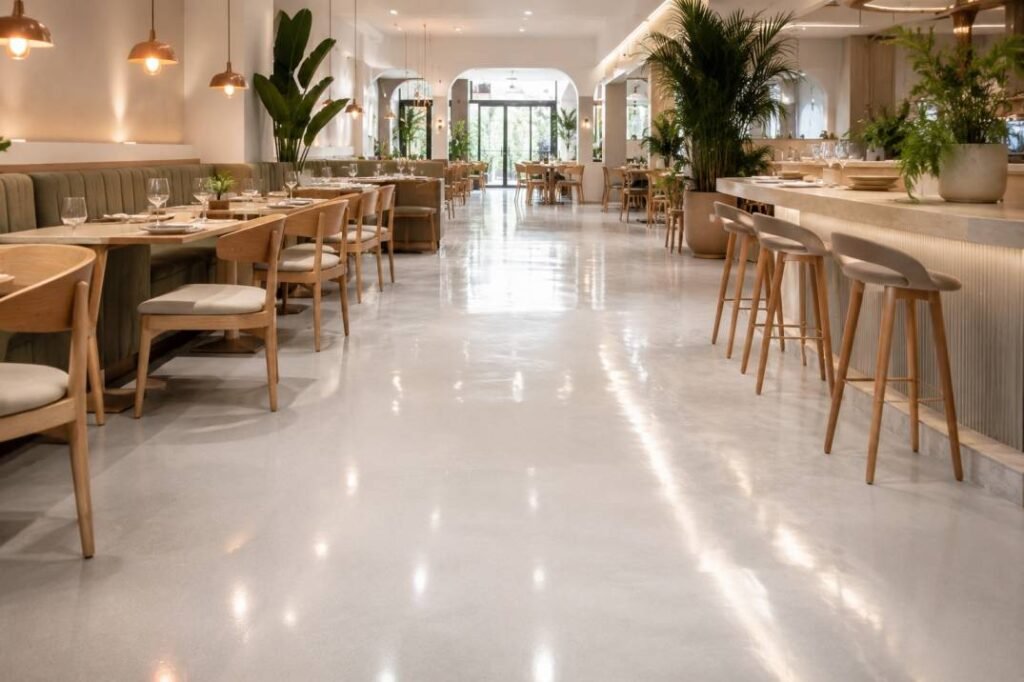
Non-Slip Restaurant Epoxy Flooring in Logan — AS 4586 Compliance
Non-slip commercial epoxy flooring is a food safety compliance requirement for Logan food businesses — not an optional specification. The Queensland Food Act 2006 and Australia New Zealand Food Standards Code and Work Health and Safety legislation require adequate slip resistance for commercial kitchen operating environments. Resin Masters specifies AS 4586 ratings for every Logan restaurant and kitchen installation:
- R10 for dry preparation and storage areas
- R11 for general wet kitchen floor and commercial kitchen standard specification
- R12 for heavy-wet zones, dishwashing areas, and food processing wet zones
Why Logan Restaurant Operators Choose Resin Masters
7-Year Warranty — In Writing
Every Logan restaurant epoxy floor comes with a written 7-year warranty. Any delamination or adhesion failure from our preparation or installation process within 7 years is fixed at no cost.
Low-VOC to Near-Zero-VOC Products
We use 100% solids commercial-grade epoxy with low to near-zero VOC chemistry on every Logan restaurant installation. No solvent odour in food environments, no extended facility evacuation required.
Anti-Slip Aggregate — Always Included
We broadcast AS 4586-appropriate anti-slip aggregate into the topcoat on every commercial kitchen installation as standard — not as an optional extra.
Overnight and Weekend Installation
Resin Masters installs restaurant kitchen floors overnight or over weekend shutdowns to minimise trading disruption. Fast-cure systems achieve foot traffic readiness within 4–6 hours.
Diamond Grinding — Never Skipped
We mechanically profile every slab with industrial diamond grinders before coating. This preparation quality is what makes the 7-year warranty deliverable on restaurant kitchen floors.
Food-Safe After Full Cure
Our 100% solids low-VOC to near-zero-VOC epoxy chemistry achieves food-contact safety after full chemical cure (7 days from installation).
Restaurant Epoxy Flooring Installation Process
Free On-Site Restaurant Assessment
We visit your restaurant or food premises before quoting. We assess the slab condition and substrate, test for moisture vapour emission, evaluate chemical exposure from your cleaning regime, confirm AS 4586 requirements for each kitchen zone, and discuss front-of-house and back-of-house specification separately. The assessment is free and obligation-free.
Surface Preparation (Diamond Grinding or Tile Surface Preparation)
We mechanically profile the slab with industrial diamond grinders, removing any existing coating, paint, or sealer. For kitchens with existing tiles being retained as a substrate, we grind the tile surface to create an adhesion profile and confirm tile adhesion across the entire floor area before proceeding. We treat any oil contamination, inject cracks, and pH-test the prepared surface.
Moisture Testing and Primer
We test for moisture vapour emission and apply a primer matched to the slab's reading. For commercial kitchens near wet areas, coolrooms, or with elevated moisture readings, we apply moisture-tolerant primer or vapour barrier systems that prevent the moisture-driven delamination that causes epoxy floor failures in high-humidity food environments.
Commercial Epoxy Floor Coating Application
We apply the specified 100% solids low-VOC commercial-grade epoxy in the appropriate colour direction — typically off-white, light grey, or the specified front-of-house colour. Base coat(s) are applied to the specified build thickness with flake or other aggregates.
Anti-Slip Aggregate Broadcast and Food-Safe Topcoat
We broadcast the specified AS 4586-appropriate anti-slip aggregate into the wet topcoat during final coat application, then seal with a food-safe, chemical-resistant polyaspartic topcoat. We hand over the completed floor with the 7-year warranty document and a written aftercare guide.
Cure and Handover
The completed flooring is left to cure fully before normal restaurant operations resume. We carry out a final quality check, clean the surface, remove installation materials, and ensure the floor is ready for use. The handover includes your 7-year warranty documentation and simple care and maintenance instructions to keep the flooring performing well.
Restaurant Epoxy Flooring Cost Logan — 2026
| Application | Cost/m² | Example — 50m² Kitchen | Example — 80m² Kitchen |
| Standard Commercial Kitchen Epoxy | $70–$95 | $3,500–$4,750 | $5,600–$7,600 |
| Chemical-Resistant Kitchen Epoxy | $85–$120 | $4,250–$6,000 | $6,800–$9,600 |
| Solid Colour Dining Area Epoxy | $55–$80 | $2,750–$4,000 | $4,400–$6,400 |
| Decorative / Metallic Dining Epoxy | $120–$170 | $6,000–$8,500 | $9,600–$13,600 |
| Epoxy Over Existing Restaurant Tiles | $70–$110 | $3,500–$5,500 | $5,600–$8,800 |
Logan Areas We Service for Restaurant Epoxy Flooring
Resin Masters installs restaurant epoxy flooring and commercial kitchen floor systems across the following Logan locations:
Logan Central · Springwood · Browns Plains · Beenleigh · Slacks Creek · Underwood · Loganholme · Shailer Park · Daisy Hill · Woodridge · Kingston · Marsden · Crestmead · Waterford · Eagleby · Park Ridge
Get Your Free Logan Restaurant Epoxy Flooring Quote
Contact Resin Masters for a free, no-obligation on-site assessment for restaurant epoxy flooring and commercial kitchen floor systems across Logan. We assess your kitchen, confirm food safety compliance requirements, discuss your installation window, and provide a fully itemised written quote within 48 hours. Every installation includes low-VOC to near-zero-VOC products, AS 4586-appropriate anti-slip aggregate, and a 7-year warranty. Get a free quote!
What Customers Are Saying About Resin Masters
Discover why homeowners and businesses across Queensland trust Resin Masters for premium restaurant epoxy flooring, exceptional craftsmanship, and long-lasting results.
Posted on GoogleTrustindex verifies that the original source of the review is Google. Bobby was super friendly and extremely knowledgable. Amazing with his craft, the end result was fantastic. 100% recommend to anyone.Posted on GoogleTrustindex verifies that the original source of the review is Google. Got our outdoor patio sorted before the weekend. The boys were super punctual, easy to deal with, and handled the whole job here in Yarrabilba with zero hassle. Our flake floor looks so amazing. Cheers and Thank you Resin Masters.Posted on GoogleTrustindex verifies that the original source of the review is Google. Had the Resin Masters team out to do my garage floor in Ormeau last week. The old concrete was constantly dusty and had a couple of nasty cracks in it. The boys ground it all back, patched up the cracks, and laid down the full flake epoxy. Honestly looks insane, like a proper showroom. No more dust tracking into the house. Highly recommend these guys if you want a quality finish.
Get a FREE Quote Now!
Frequently Asked Questions — Restaurant Epoxy Flooring Logan
Epoxy flooring is the best choice for most Australian restaurant kitchens and food premises. It satisfies all the flooring requirements under the Queensland Food Act 2006 and Australia New Zealand Food Standards Code: seamless, non-porous, easily cleanable, and slip-resistant when specified with anti-slip aggregate. For front-of-house dining areas, epoxy is increasingly used as a design feature — metallic or decorative epoxy creates a distinctive floor that integrates into the restaurant’s visual identity. Resin Masters installs restaurant epoxy flooring in Logan using 100% solids low-VOC to near-zero-VOC commercial-grade epoxy with a 7-year warranty.
Yes — 100% solids commercial-grade epoxy from Resin Masters is specifically appropriate for commercial kitchens and passes Australian food safety inspections when correctly specified and installed. Our commercial kitchen epoxy satisfies Queensland Food Act 2006 and Australia New Zealand Food Standards Code requirements for seamless, non-porous, slip-resistant, and easily cleanable floor surfaces. We broadcast anti-slip aggregate to achieve the required AS 4586 rating on every kitchen installation.
Restaurant epoxy flooring from Resin Masters in Logan costs $55–$170 per square metre installed in 2026, depending on system specification and floor area. A standard commercial kitchen (50m²) runs $3,500–$6,000 for standard to chemical-resistant systems. A larger restaurant kitchen (80m²) costs $5,600–$9,600. Front-of-house decorative or metallic epoxy for dining areas runs $120–$170/m². Epoxy over existing restaurant tiles runs $70–$110/m². All prices include diamond grinding, primer, 100% solids low-VOC epoxy system, anti-slip topcoat, GST, and 7-year warranty.
Yes on all three — 100% solids commercial-grade epoxy from Resin Masters is completely waterproof once cured. The seamless, non-porous surface repels water, grease, food acids, and cleaning chemicals without absorption. Cleaning is straightforward: sweep to remove debris, then mop with a pH-neutral diluted cleaner or commercial kitchen cleaning agent compatible with the system. Grease and oil wipe away without penetrating the surface. For high grease-load kitchens, we specify chemical-resistant topcoat chemistry during the on-site assessment.
Yes — Resin Masters specifies and achieves AS 4586 anti-slip ratings for every commercial kitchen and restaurant floor installation. Restaurant kitchens and food preparation areas require AS 4586 R11 minimum for wet conditions; heavy wet processing zones require R12. We broadcast approved anti-slip aggregate into the topcoat during installation to achieve the required rating for each kitchen zone. Non-slip epoxy flooring is a standard specification on every Resin Masters restaurant kitchen installation — not an optional extra.
Restaurant and commercial kitchen epoxy flooring from Resin Masters lasts 8–15 years under normal commercial kitchen operating conditions. Back-of-house kitchen floors with daily hot water and caustic cleaning: 8–12 years. Front-of-house restaurant dining area floors with regular pedestrian traffic and minimal chemical exposure: 12–20 years. Key factors are the chemical resistance specification match to the kitchen’s cleaning regime, preparation quality (diamond grinding), and maintenance practice. Our 7-year warranty covers installation-related defects — any delamination or adhesion failure from our preparation or installation process is fixed at no cost within 7 years.
Yes — Resin Masters installs restaurant epoxy flooring over existing tiles where the tiles are sound, well-adhered, and in good condition. We grind the tile surface to create an adhesion profile, apply a tile-compatible primer, and install the full epoxy system over the prepared tile substrate. This avoids tile removal cost and disruption but adds approximately 5–8mm to the finished floor height, which must be considered at doorway transitions and drainage points. The cost is $70–$110/m² for epoxy over tiles, comparable to fresh concrete installation. We assess tile adhesion and condition during every free on-site quote.
A standard restaurant kitchen epoxy installation (50m²) takes 2–3 days from initial diamond grinding through to final topcoat cure. Light foot traffic is possible within 24 hours of the final coat. Full operational cleaning and heavy use is safe after 48–72 hours. Full chemical cure takes 7 days. Resin Masters regularly installs restaurant kitchen floors in Logan over a weekend shutdown to avoid trading disruption — our fast-cure polyaspartic topcoat options achieve foot traffic readiness within 4–6 hours. Contact us at +61 433 733 956 to discuss your restaurant’s operational schedule.
Commercial kitchens and food preparation areas: 100% solids chemical-resistant epoxy with AS 4586 R11–R12 anti-slip aggregate and food-safe pigments. Solid colour (light grey, off-white) is standard for food safety visibility. Dining areas and front-of-house: decorative epoxy options — solid colour for a clean contemporary floor, flake epoxy for a textured commercial look, or metallic epoxy for a premium feature floor that becomes part of the restaurant’s visual identity. Resin Masters installs both kitchen and dining area systems and can coordinate them into a single installation programme to minimise restaurant closure time.
The best non-slip epoxy for a commercial kitchen is a 100% solids chemical-resistant epoxy base coat sealed with a polyaspartic topcoat containing AS 4586-rated anti-slip aggregate. Aluminium oxide aggregate in medium broadcast density achieves R11 (the minimum required for commercial kitchen wet areas) while maintaining a surface that is cleanable without aggregate void zones trapping food debris. For heavy-wet processing zones, coarser aggregate at higher density achieves R12. Resin Masters specifies the correct aggregate type, particle size, and broadcast density for each kitchen zone during the on-site assessment.
Yes — within the temperature ranges typical of commercial kitchen floor surfaces. Our 100% solids epoxy with polyaspartic topcoat handles hot water mopping and steam cleaning up to approximately 70–80°C, chemical sanitiser contact at ambient temperatures, and thermal cycling from coolroom adjacency to hot kitchen environments. The topcoat specification we use for commercial kitchens is specifically selected for thermal resistance in food service environments. We confirm temperature exposure conditions during every commercial kitchen assessment and adjust topcoat specification where unusually high thermal exposure is identified.
Resurfacing an existing restaurant floor with epoxy from Resin Masters in Logan costs $55–$120/m² installed, depending on the substrate condition and system specified. The main cost variable in resurfacing is substrate preparation: sound concrete or well-adhered tile requires standard diamond grinding. Heavily damaged concrete with crack networks, previous coating removal, or oil contamination requires additional remediation work disclosed transparently in the written quote after on-site assessment. Resin Masters provides free on-site assessments and itemised quotes — call +61 433 733 956 to book.
Resin Masters installs restaurant epoxy flooring and commercial kitchen floor systems across Logan and all 7 service locations. When choosing any restaurant epoxy flooring company, ask: Do they use 100% solids commercial-grade epoxy? Do they broadcast anti-slip aggregate to achieve AS 4586 ratings as standard? Do they offer a written warranty for how many years? Resin Masters answers: 100% solids low-VOC epoxy, AS 4586-appropriate anti-slip aggregate on every kitchen installation, and a 7-year written warranty. Call +61 433 733 956 or visit resinmasters.com.au to arrange a free restaurant assessment.
Yes — Resin Masters uses 100% solids commercial-grade epoxy with low-VOC to near-zero-VOC chemistry on every restaurant and commercial kitchen installation. Unlike older solvent-based industrial systems, our 100% solids chemistry emits minimal to no volatile organic compounds during curing. This makes our installation safe for food businesses — no extended facility evacuation required beyond the standard installation and cure period, no solvent odour contaminating stored food product, and no VOC exposure risk for kitchen staff during the cure phase.