Servicing : Gold CoastBrisbaneSunshine CoastToowoomba

What Is Epoxy Flooring? A Plain-English Guide for Queensland Homes
Epoxy flooring is a hard, joint-free coating made by mixing a two-part resin and hardener and applying it to prepared concrete. The mix cures by chemical reaction into a bonded layer that resists water, oil and wear. Resin Masters installs epoxy floors in garages, homes, workshops and warehouses across Queensland and Northern NSW.
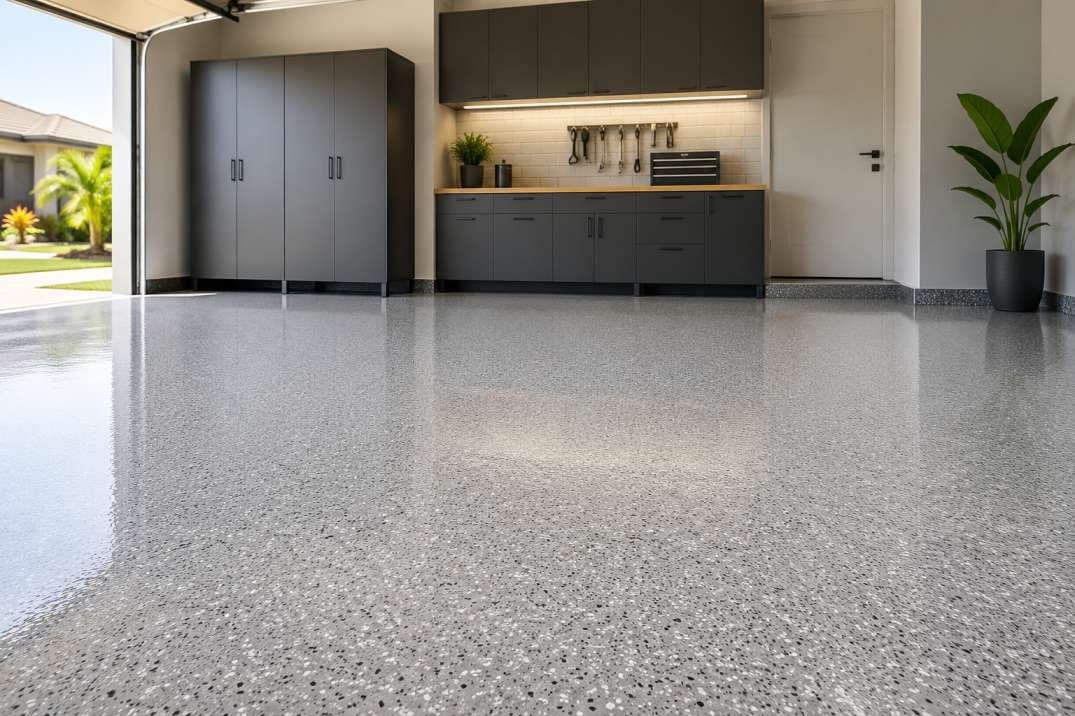
If you’ve searched this, you’ve probably seen a garage floor that looks like polished granite and wondered whether it’s just paint. It isn’t. The difference is chemistry, and it decides how long the floor lasts.
What is epoxy flooring made of?
Epoxy flooring is made from two liquids: an epoxy resin and a hardener. Mixed together, they react and set hard within hours. Pigment gives the colour, and fillers or decorative chips add texture. Because most professional systems cure by reaction rather than by drying, they bond far more firmly to concrete than paint does.
A finished floor is a system of layers, not one coat:
- Primer. A thin first coat that soaks into the ground concrete and gives the next layer something to grip.
- Body coat. The coloured layer that does most of the work against wear and stains.
- Decorative layer. Flakes, metallic pigment, or nothing at all for a plain solid colour.
- Clear topcoat. The final seal that sets the gloss, the slip resistance and how well the floor handles sunlight.
How is an epoxy floor installed?
Installation has five stages: grinding the slab, repairing cracks and holes, priming, applying the coloured body coat, and sealing with a clear topcoat. Flakes or metallic pigment go in between. Preparation decides how long the floor lasts, so it’s the stage to ask every installer about before you compare prices.
- Grind. A diamond grinder removes the laitance (the weak skin on top of the concrete) and opens the surface. What goes wrong: skipping this and relying on acid etching, which is a common reason coatings peel.
- Repair. Cracks, spalls and old anchor holes are filled and levelled. What goes wrong: a hairline crack left unrepaired usually shows through within months.
- Prime. The primer seals the slab and improves bond. What goes wrong: coating over a damp slab, which is why moisture testing comes first.
- Body coat and decoration. The resin is applied and, for flake floors, chips are broadcast into the wet coat and swept back once cured.
- Topcoat. One or more clear coats lock everything in. What goes wrong: a topcoat that isn’t UV-stable can yellow under direct sun.
Full preparation is covered in how to prepare concrete for epoxy. Most Resin Masters jobs take 2 to 4 days. Garage floors are usually walkable within 24 hours and vehicle-ready in 48 to 72 hours, with full chemical cure at 7 days.
Where can you use epoxy flooring?
Epoxy suits garages, workshops, laundries, kitchens, patios and commercial floors such as warehouses and showrooms. It works best on sound, dry concrete. Resin Masters coats garages, home interiors, workshops and warehouses, and lighter systems suit homes while thicker ones suit forklifts and heavy vehicles.
Garages are the most common job by far, and they’re covered in detail in our garage floor epoxy guide. Inside the home, epoxy is growing in laundries, kitchens and open-plan living areas where owners want an easy-clean floor with no grout lines.
What types of epoxy floor are there?
There are three main finishes: solid colour, decorative flake and metallic. Solid colour is a single flat colour, flake adds speckled chips for texture, and metallic swirls pearlescent pigment through the resin for a marbled look. Each can take a clear topcoat, and all three are applied over ground concrete.
| Finish | Look | Suits | Trade-off |
|---|---|---|---|
| Solid colour | Flat, even colour | Workshops, warehouses, garages | A glossy solid shows every slab imperfection |
| Flake | Speckled, granite-like | Garages, homes, patios | Texture and chips hide flaws; a little harder to wipe than a smooth floor |
| Metallic | Swirled, three-dimensional depth | Feature floors, showrooms, living areas | Smooth surface can be slippery when wet without an anti-slip additive |
Read more about the plain option on our solid colour epoxy flooring page. A full colour and finish guide is coming later this week.
How long does an epoxy floor last in Queensland?
A well-prepared epoxy floor can last 10 to 20 years under normal use, and Resin Masters backs its installations with a written 7-year workmanship warranty. Actual life depends on slab preparation, traffic and sun exposure. Ask any installer for warranty terms in writing, because a lifespan number without conditions is only a claim.
Four things shorten a floor’s life. Moisture rising through the slab is one, and hot car tyres on a thin coating is another. Direct UV on a topcoat that isn’t UV-stable is a third, and poor preparation is the fourth. Most early failures trace back to preparation.
Why does Queensland climate matter for epoxy?
Queensland’s heat, humidity, strong UV and damp slabs all affect how epoxy cures and how long it lasts. Moisture rising through concrete can lift a coating, and a hot slab can make the resin set too fast. Coastal air adds salt. Good installers test slab moisture and schedule work around temperature and rain.
Bunnings’ own DIY epoxy guide gives a working range of 15 to 29 degrees Celsius for curing. A slab in direct summer sun can run hotter than the air, so start times and shade matter. Resin Masters schedules peak-summer jobs with morning application starts to stay inside that range.
Who is epoxy flooring not for?
Epoxy isn’t the right choice for every floor. It needs a sound, dry concrete slab, and it feels hard and cool underfoot. If your slab has an active moisture problem, or you want a soft or warm floor, look at other options first. A cheap DIY paint job is a different product altogether.
- Slabs with active moisture that hasn’t been treated.
- Timber, carpet or floating floors (epoxy needs concrete or a suitably prepared tiled base).
- Anyone who wants a soft, warm surface for bare feet in winter.
- Owners hoping to replace waterproofing. A coating is not a wet-area membrane.
Frequently asked questions
Is epoxy flooring the same as paint?
No. Paint dries into a thin film. Epoxy is a two-part resin that cures by chemical reaction and bonds to ground concrete. Products sold as “epoxy paint” sit between the two, and a separate post in this series compares them in detail.
Can epoxy go over existing concrete?
Yes, if the slab is sound and dry. Resin Masters grinds the surface, repairs cracks and checks moisture first. Concrete that is crumbling or has active moisture problems needs treatment before any coating goes on.
Is epoxy flooring slippery?
Smooth gloss epoxy can be slippery when wet. Flake finishes have natural texture, and an anti-slip additive can go into any finish. If the floor will get wet, ask for a slip-resistance rating tested to AS 4586.
How soon can I use the floor?
Timing depends on the system and the weather. Most Resin Masters garage floors are walkable within 24 hours and vehicle-ready within 48 to 72 hours, with full chemical cure at 7 days. Cool, dry conditions cure faster, and installers should give you a written timeline before starting.
Does epoxy yellow in the sun?
Standard epoxy can chalk and yellow under direct UV. A UV-stable polyurethane or polyaspartic topcoat reduces this. For garages with open doors or floors beside large windows, ask which topcoat is included in your quote.