Servicing : Gold CoastBrisbaneSunshine CoastToowoomba

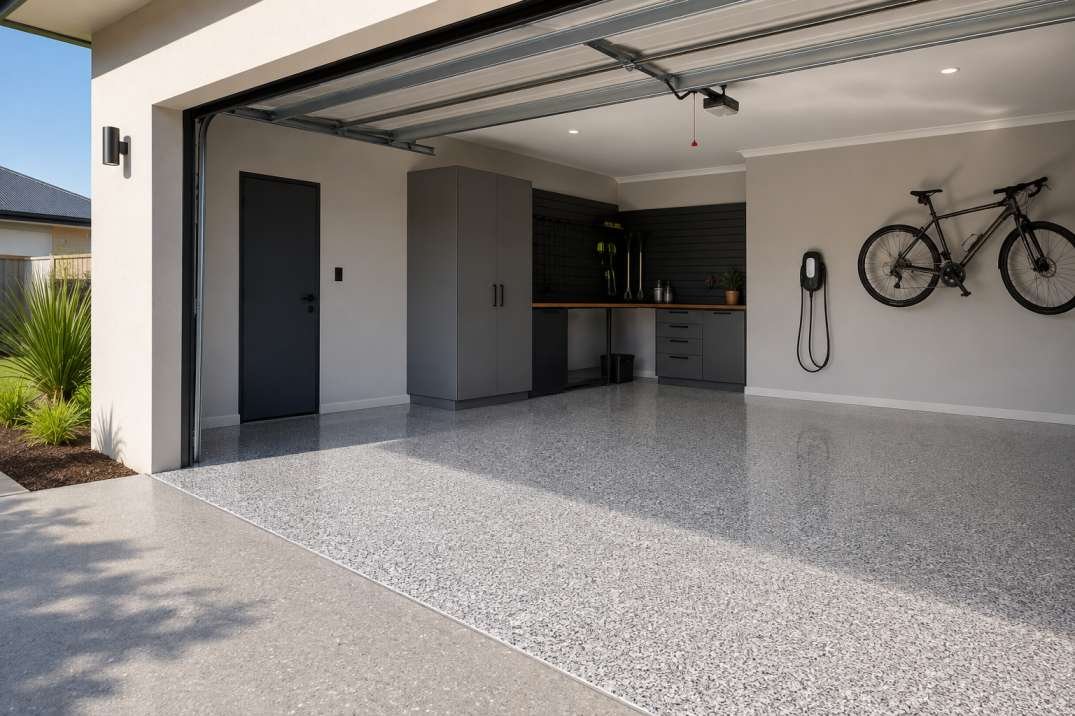
Garage Epoxy Flooring for New Builds — The Perfect Time to Install
You’re building a new home in Springfield, Coomera, Ripley, Yarrabilba, or one of SEQ’s rapidly growing residential estates. The builder has ticked every item on the handover checklist. The garage floor is bare concrete — flat, clean, and freshly finished. Before the first vehicle rolls in, before the first oil drip, before the first year of Queensland summer heat begins cycling through that concrete — this is the single best moment in the life of any Australian garage floor to apply a professional epoxy coating.
Resin Masters installs garage floor epoxy across Brisbane, Gold Coast, Logan, Sunshine Coast, Toowoomba, Ipswich, and Northern NSW. We install on new slabs and on established garage floors that have seen decades of use. And without exception, new slabs produce the cleanest, most cost-effective, and most durable epoxy installation outcomes of any substrate we work on — because every advantage that makes a quality installation possible is at its peak on a fresh concrete slab.
This guide covers the exact timing for new slab epoxy installation, why early application is significantly better than waiting, what preparation a new slab still needs, and how to coordinate the garage floor epoxy with your builder’s programme across SEQ’s active new estate markets.
Why New Slabs Are the Best Substrate for Garage Epoxy
Experienced epoxy installers see significant differences in installation complexity, preparation cost, and long-term performance outcomes between new slabs and established garage floors. New slabs have a decisive advantage on every dimension that matters for epoxy installation quality.
No Contamination — The Biggest Preparation Variable Eliminated
Oil contamination from vehicle maintenance and engine drips is the single most common complication in established garage floor preparation — and the most costly to address. Petroleum products impregnate concrete progressively over years of vehicle use, creating contaminated zones that must be treated with specialist degreasers, scarified in severe cases, and verified clean before any grinding proceeds. A new slab has none of this. The concrete is chemically clean from the pour. Diamond grinding profiles directly to bare concrete with no contamination treatment required.
No Previous Coatings — No Removal Cost
Established garage floors frequently have previous paint, sealer, or a failed epoxy system that must be completely removed before new installation. This removal stage — grinding through the existing coating layer — adds both time and cost to the preparation programme. New slabs have no previous coatings: the diamond grinder profiles the concrete surface directly without needing to strip anything above it.
Optimal and Consistent Concrete Profile
New slabs have a consistent, uniform concrete surface across the full floor area — no wear paths from vehicle traffic, no impact damage from dropped tools, no surface variation from years of mechanical stress. This consistency means the diamond grinding process is more predictable and produces a more uniform adhesion profile than grinding an established floor with variable surface condition.
Better Per-m² Economics
Because new slabs require less preparation time and no contamination treatment or previous coating removal, the total cost of a new build garage installation is typically 10–20% lower per m² than an equivalent finish system on a comparable established slab. The preparation cost savings from a clean substrate translate directly to lower installation cost.
THE FIRST-USE ADVANTAGE: Once the first vehicle parks on a bare concrete garage floor, the contamination clock starts. Tyre rubber deposits onto the concrete surface. Engine oil and vehicle fluid drips begin penetrating the concrete’s pore structure. Even a single month of unprotected use in a Queensland summer creates contamination that complicates preparation compared to a clean new slab. Applying epoxy before first vehicle use preserves every new-slab advantage.
The Curing Timeline — When Can You Apply Epoxy After the Pour?
Understanding concrete curing is essential for scheduling new build garage epoxy correctly. Concrete doesn’t ‘dry’ — it cures through a chemical hydration reaction between the Portland cement and water, which continues for months after the pour. The practical question for epoxy installation timing is not when curing is complete, but when the slab has cured sufficiently and the moisture vapour emission has reduced sufficiently for the epoxy system to achieve the adhesion and performance the 7-year warranty requires.
The 28-Day Rule — Minimum, Not Guarantee
The standard industry guidance is 28 days from pour date before epoxy installation. At 28 days, concrete typically reaches approximately 80% of its design compressive strength, and moisture vapour emission has reduced substantially from the initial high levels immediately post-pour. However, 28 days is a minimum threshold, not a guarantee of readiness. Queensland and Northern NSW’s subtropical climate creates conditions that can delay adequate curing: high-humidity pour conditions where the ambient moisture slows evaporation; thick slabs (above 150mm) that retain more mix water than standard residential slabs; and enclosed garage spaces with limited ventilation that slow vapour release.
The Moisture Vapour Test — The Decisive Measurement
Resin Masters tests every new slab’s moisture vapour emission (MVE) before applying any primer, regardless of the pour date provided by the builder. We use calibrated MVE measurement equipment that gives a specific reading in grams per square metre per 24 hours — and we compare that reading to the tolerance threshold of the primer we’re specifying. If the reading falls within the standard primer’s tolerance, installation proceeds with standard primer. If it exceeds that threshold, we specify a moisture-tolerant primer or vapour barrier primer and confirm a re-test date. The slab is ready for installation when the MVE measurement says it is — not when the calendar says 28 days have passed. Contact Us!
|
Moisture Reading |
Slab Status |
Primer Specification |
Timing |
|
Within standard primer tolerance |
Ready to install |
Standard penetrating epoxy primer |
Proceed to installation |
|
Above standard, within moisture-tolerant tolerance |
Proceed with modified spec |
Moisture-tolerant primer — additional cost noted in quote |
Proceed to installation |
|
Above moisture-tolerant primer tolerance |
Not yet ready |
Moisture vapour barrier system required |
Re-test in 1–2 weeks |
|
Significantly elevated — likely structural moisture issue |
Investigation required |
Structural moisture source must be identified |
Further assessment before installation |
New Build Garage Epoxy in SEQ’s Active Estate Markets
The highest volume of new build garage epoxy installations Resin Masters completes each year comes from SEQ’s rapidly expanding residential estate corridors. The specific new estate markets where we regularly install garage floors include:
- Ipswich growth corridor: Springfield, Springfield Lakes, South Ripley, Deebing Heights, Bellbird Park, Collingwood Park — the most active new estate epoxy market in SEQ outside Brisbane. New homeowners in the Springfield and Ripley corridors regularly contact Resin Masters in the 3–6 week window before handover to schedule garage floor installation.
- Gold Coast northern growth: Coomera, Upper Coomera, Pimpama, Ormeau Hills, and Hope Island’s continued estate releases — consistent demand driven by the volume of new residential construction across the M1 corridor and Hope Island’s prestige residential development.
- Logan growth corridor: Yarrabilba, Park Ridge, Greenbank, and Jimboomba — large-format new estates with double and triple garages providing cost-effective per-m² new slab installations.
- Sunshine Coast: Aura City of Colour, Nirimba, and Caloundra South — the Sunshine Coast’s major new estate corridor creates consistent new slab demand from buyers who want to complete the garage floor as part of their initial move-in fit-out.
- Brisbane growth zones: Calamvale, Pallara, Rochedale South, and the southern suburban growth corridor.
- Northern NSW: Tweed Heads South, Banora Point, and Ballina’s expanding residential releases — increasingly active new estate market driven by the Northern NSW population growth corridor.
Coordinating with Your Builder — Practical Scheduling Advice
The key to a smooth new build garage epoxy installation is early engagement with Resin Masters before the slab is poured — not after move-in. Here is the recommended sequencing:
- Before or shortly after slab pour: contact Resin Masters at +61 433 733 956 with the confirmed pour date. We register your job for the 28-day moisture test scheduling.
- At 28 days post-pour: Resin Masters conducts the on-site moisture vapour test. We bring physical colour and finish samples for colour selection in the actual garage space. If MVE is within specification, we schedule the installation date. If elevated, we schedule a re-test.
- Installation date: 2-day programme. Day one — diamond grinding, laitance removal, MVE-matched primer, base coat. Day two — topcoat application.
- Post-installation: walkable at 24 hours, vehicle-ready at 48–72 hours. Full cure at 7 days. For homeowners moving in before full cure, we provide written aftercare instructions for the curing period.
- Handover: 7-year warranty documentation and aftercare guide provided.
BUILDER COORDINATION TIP: Tell your builder the garage floor epoxy is being installed by Resin Masters between the slab cure and move-in date. Ask them to keep the garage roller door accessible and confirm the slab is free of plasterboard stacking, paint tins, and builder’s material for our installation date. Most builders on active Queensland estates are familiar with this coordination — it’s a common pre-handover trade sequence.
Finish Options for New Build Garage Floors — What Works Best?
Every Resin Masters finish system is available for new build garage installations, and the choice is driven by how the garage will be used and the homeowner’s aesthetic priorities — not by the substrate, which is equally suitable for all three systems.
- Seamless flake epoxy ($65–$90/m²): most popular for new estate garages across SEQ. The multi-colour chip pattern conceals oil and workshop marks that accumulate over years of use — practical foresight for a garage that will see real vehicle and household use. Natural texture from embedded chips provides everyday grip without additional anti-slip specification.
- Solid colour epoxy ($50–$75/m²): popular for budget-conscious new homeowners and for garages where a clean, minimal look is the priority. Standard grey and charcoal are most popular. The most cost-effective professional floor finish available for a new slab.
- Metallic and marble-effect epoxy ($90–$165/m²): increasingly common in prestige new estate homes across Springfield Lakes, Coomera, Hope Island, and Aura, where the garage is designed as a showcase space and the floor is part of the initial design brief rather than an afterthought.
Resin Masters — New Build Garage Floors Across All 7 Locations
|
Brisbane |
Gold Coast |
Logan |
Sunshine Coast |
|
Toowoomba |
Ipswich |
Northern NSW |
Free Quote Before Pour Date |
 Call Resin Masters: +61 433 733 956
 Email: info@resinmasters.com.au
 resinmasters.com.au | 7-Year Warranty | Low-VOC to Near-Zero-VOC Products
 Brisbane · Gold Coast · Logan · Sunshine Coast · Toowoomba · Ipswich · North NSW
Also Read:- Marble Garage Floor Epoxy — How Metallic Resin Creates a Prestige Garage
Frequently Asked Questions — Garage Epoxy Flooring for New Builds
How soon after a concrete slab is poured can I apply garage epoxy?
A new concrete garage slab requires a minimum curing period before any epoxy coating can be applied. The standard recommendation is 28 days from the pour date — this is the point at which concrete reaches approximately 80% of its design compressive strength and moisture vapour emission has reduced to levels within the tolerance of most standard epoxy primers. In Queensland and Northern NSW’s subtropical climate, this 28-day timeline is a minimum rather than a guarantee: high-humidity pour conditions, thick slabs, and slabs with limited ventilation may still show elevated moisture vapour emission at 28 days. Resin Masters tests every new slab’s moisture vapour emission before applying any primer — regardless of the pour date provided by the builder. The test result, not the calendar date, determines when the slab is ready. Most new estate slabs in Springfield, Ripley, Coomera, Yarrabilba, and Palmview that have cured correctly through Queensland’s climate are ready for epoxy at 28–42 days after pour.
What is the best garage floor for a new build in Queensland — and should I epoxy before moving in?
Professional epoxy flooring is the best garage floor specification for a new build in Queensland — and installing before moving in is strongly recommended. The reasons are both practical and logistical. Practically: the new slab is at its cleanest and most installation-ready state before any vehicle traffic, tool storage, or household goods arrive. No contamination treatment, no previous coating removal, no working around stored items — just a clean, fresh concrete substrate that the 100% solids epoxy bonds to in optimal conditions. Logistically: installing after move-in requires clearing the entire garage of contents, which most homeowners underestimate as a significant disruption. Before move-in, the garage is empty by default. Resin Masters regularly coordinates with builders and new homeowners across Springfield, Ripley, Coomera, Yarrabilba, Ormeau, and Pallara to schedule installation in the final weeks before the handover date — completing the garage floor as part of the property fit-out rather than as a later renovation.
What are the advantages of installing epoxy flooring on a new garage slab compared to an established slab?
New concrete slabs offer five preparation advantages over established garage floors that make them the easiest and most cost-effective substrate for professional epoxy installation. (1) No contamination: fresh concrete contains no oil, no petroleum products, and no tyre rubber — the contamination categories that most commonly complicate established garage floor preparation and add cost. (2) No existing coatings: no paint, sealer, or previous epoxy to remove before grinding — the grinder profiles directly to concrete. (3) Consistent surface profile: new slabs have consistent surface hardness across the full area without the wear variations and surface damage that years of use create in established garage floors. (4) Lower preparation cost: without contamination treatment, coating removal, or damage remediation, new slab preparation is more straightforward — translating directly to lower preparation cost and faster installation. (5) Optimal moisture profile: a properly cured new slab has lower and more predictable moisture vapour emission than slabs that have absorbed ground moisture, had plumbing penetrations, or experienced flooding events.
How much does epoxy garage flooring cost for a new build in Australia?
Resin Masters installs garage floor epoxy for new builds across Brisbane, Gold Coast, Logan, Sunshine Coast, Toowoomba, Ipswich, and Northern NSW at $50–$165 per square metre depending on the finish system chosen. Solid colour epoxy: $50–$75/m². Seamless flake epoxy: $65–$90/m². Metallic and marble-effect epoxy: $90–$165/m². For a standard new-build double garage (36m²), budget $1,800–$2,700 for solid colour, $2,340–$3,240 for flake, or $3,240–$5,940 for metallic. New slab installations typically sit at the lower end of each price range because preparation is more straightforward — no oil treatment, no previous coating removal — reducing total preparation cost. All prices include the free on-site assessment, diamond grinding, moisture testing, primer, 100% solids low-VOC epoxy system, UV-stable polyaspartic topcoat, GST, and 7-year warranty.
What preparation does a new garage slab need before epoxy — doesn’t fresh concrete need less work?
New concrete slabs still require full professional preparation before any quality epoxy installation — the preparation requirements differ from established slabs in type rather than in necessity. Diamond grinding is mandatory on new slabs. Fresh concrete has a surface layer of laitance — a thin, weak layer of calcium silicate paste that forms on the concrete surface during finishing. Laitance looks smooth and uniform but has poor tensile strength and creates a weak adhesion layer if epoxy is applied over it. Diamond grinding removes the laitance and opens the concrete’s pore structure to the depth the epoxy bonds into. Moisture vapour emission testing is also mandatory on new slabs — new concrete is saturated with mix water that evaporates through the surface over weeks and months, and residual MVE at the time of installation must be confirmed within the tolerance of the specified primer. Crack repair may be required on new slabs where plastic shrinkage cracks have formed during curing — common in hot Queensland summer pours where the slab surface dries faster than the interior. Resin Masters assesses and treats these on every new slab installation.
What finish types are available for new build garage floors — which is most popular for new estates?
Resin Masters installs all three finish systems on new build garage floors across Queensland and Northern NSW’s new estate corridors. Seamless flake epoxy ($65–$90/m²) is the most frequently chosen finish for new estate garage floors — the multi-colour vinyl chip pattern conceals the oil, grime, and workshop marks that accumulate over years of garage use, and the natural texture of the embedded chips provides practical everyday grip. New homeowners who prioritise low maintenance and practical durability consistently choose flake. Solid colour epoxy ($50–$75/m²) is popular for new estate homes where a clean, minimal aesthetic and budget efficiency are the priorities — standard grey, charcoal, or brand-colour solid colour creates a professional finish at the most competitive price point. Metallic and marble-effect epoxy ($90–$165/m²) is increasingly popular in prestige new estate homes — particularly in Springfield Lakes, Coomera, and Hope Island — where the garage is designed as a showcase space from the build outset rather than retrofitted as a functional space.
How long does new build garage epoxy installation take — and what is the cure timeline?
A standard new build single or double garage epoxy installation from Resin Masters takes 2 days on-site: day one for diamond grinding, moisture testing, primer, and base coat application; day two for topcoat application. The floor is walkable within 24 hours of the final topcoat. Vehicle access is safe within 48–72 hours. Full chemical cure and maximum hardness is achieved at 7 days. For new build scheduling: book Resin Masters approximately 4–6 weeks after the slab pour date, confirming the pour date so we can schedule moisture testing before committing the installation date. For builders coordinating multiple trades, our installation programme fits neatly between the floor completion stage and the pre-settlement inspection — typically with a 2-day installation window that doesn’t conflict with other trades.
Is epoxy or polyaspartic better for a new garage floor in Queensland?
For most new build garage floors in Queensland and Northern NSW, Resin Masters recommends 100% solids epoxy as the base coat with UV-stable polyaspartic as the topcoat — the combination that uses the adhesion and build thickness of epoxy at the substrate level and the UV stability and hot-tyre resistance of polyaspartic at the surface. A full polyaspartic system (polyaspartic base and topcoat) is available for new build clients who need vehicle access within 12–24 hours rather than 48–72 hours — for example, homeowners who are installing the epoxy floor on the day of handover and moving in the following morning. Full polyaspartic systems cure faster but cost 15–25% more per m² than the equivalent epoxy + polyaspartic combination. For most new build timelines, the epoxy + polyaspartic combination is the correct specification.
Should I coordinate my new build garage epoxy with the builder — or organise it separately?
We recommend organising new build garage epoxy independently from the builder for three reasons. (1) Specification control: builders typically subcontract floor coatings to the cheapest available option — often water-based products applied over acid-etched concrete with a polyurethane topcoat that yellows and tracks within two summers. Organising directly with Resin Masters gives you control over the specification. (2) Timing flexibility: Resin Masters can schedule precisely around the slab curing timeline and handover date, whereas builder-subcontracted trades are scheduled around the builder’s programme. (3) Warranty ownership: a Resin Masters installation comes with a 7-year written warranty in your name — a builder-supplied floor coating typically comes with a brief defect liability period that doesn’t cover performance failure. Contact Resin Masters at +61 433 733 956 as soon as your slab pour date is confirmed — we’ll schedule the moisture test and installation date to fit your build programme.
What are the most popular new build garage floor estates in Resin Masters’ service area?
Resin Masters installs new build garage floors across the most active new estate corridors in SEQ and Northern NSW. In Brisbane: Calamvale, Pallara, and the southern growth zones. On the Gold Coast: Coomera, Upper Coomera, Pimpama, Ormeau, and Hope Island’s ongoing new estate releases. In Logan: Yarrabilba, Park Ridge, and Greenbank. On the Sunshine Coast: Aura City of Colour, Nirimba, and the Caloundra South growth corridor. In Toowoomba: Highfields, Kearneys Spring, and the western growth zone. In Ipswich: Springfield, Springfield Lakes, South Ripley, Deebing Heights, and Bellbird Park — the most active new estate epoxy market in SEQ outside Brisbane. In Northern NSW: Tweed Heads South and the northern growth corridor, Ballina’s expanding residential releases. If your new estate isn’t listed, contact us — Resin Masters services properties across the full SEQ and Northern NSW region.
Are there health or VOC concerns with epoxy flooring in a new home?
Resin Masters uses 100% solids commercial-grade epoxy with low-VOC to near-zero-VOC chemistry on every new build installation. Unlike older solvent-based systems that produce strong chemical odours requiring extended ventilation periods before re-entry, our 100% solids chemistry emits minimal to no volatile organic compounds during curing. For new build homeowners who are moving in within days of the installation, this low-VOC specification is important: the garage is typically an enclosed space during the curing phase, and a low-VOC product is significantly safer for new occupants than solvent-based alternatives. The floor is safe for entry within 24 hours (walkable) and fully chemically inert at 7 days. We provide full product data sheets confirming VOC content for any homeowner or building certifier requiring environmental specification documentation.
What warranty does a professional new build garage epoxy floor come with?
Every Resin Masters new build garage floor installation comes with a written 7-year warranty from the installation date. The warranty covers any delamination or adhesion failure arising from our preparation or installation process — including preparation of the new slab (laitance removal, moisture testing, primer selection) as well as the coating system itself. The 7-year warranty is written into your quote acceptance and provided as a separate document at handover. It is not a verbal assurance or a builder’s defect liability period — it is a specific, enforceable warranty from Resin Masters covering the installation on your property for 7 years from completion date. Contact us at +61 433 733 956 if you experience any issue with your installation within the warranty period — we assess and remediate without charge.
Can I get a quote for new build garage epoxy before my slab is poured?
Yes — and early engagement is specifically what Resin Masters recommends for new build clients. Contact us at +61 433 733 956 or via info@resinmasters.com.au as soon as your slab pour date is scheduled. We provide a preliminary written quote based on your garage floor plan dimensions and chosen finish system before the slab is poured, and confirm the final quote after the post-pour on-site assessment at 28 days. This approach allows you to include the garage floor epoxy in your new home budget with a confirmed price rather than a retrospective renovation cost. We service all new build areas across Brisbane, Gold Coast, Logan, Sunshine Coast, Toowoomba, Ipswich, and Northern NSW and provide free on-site assessments at the appropriate post-cure timing.
Can I compare epoxy kits vs professional installation for a new build garage — which is better value?
For a new build garage, professional installation consistently delivers better long-term value than a retail epoxy kit. The key reasons specific to new builds: laitance removal requires industrial diamond grinding — retail kits rely on acid etching that doesn’t adequately address laitance, producing adhesion that fails within the first vehicle-use season. New slab moisture vapour emission must be tested and matched with the correct primer — retail kits include a standard primer that may be inadequate for the specific MVE reading of your new slab. And the long-term cost comparison changes significantly when you factor in re-application: a retail kit may need re-application every 2–4 years under Queensland vehicle use conditions, while a Resin Masters professional installation with a 7-year warranty represents one cost across the warranty period, and 12–20 years total service life. For a new home where you want the garage floor to be right from day one, professional installation backed by a 7-year warranty is the correct investment.