Servicing : Gold CoastBrisbaneSunshine CoastToowoomba

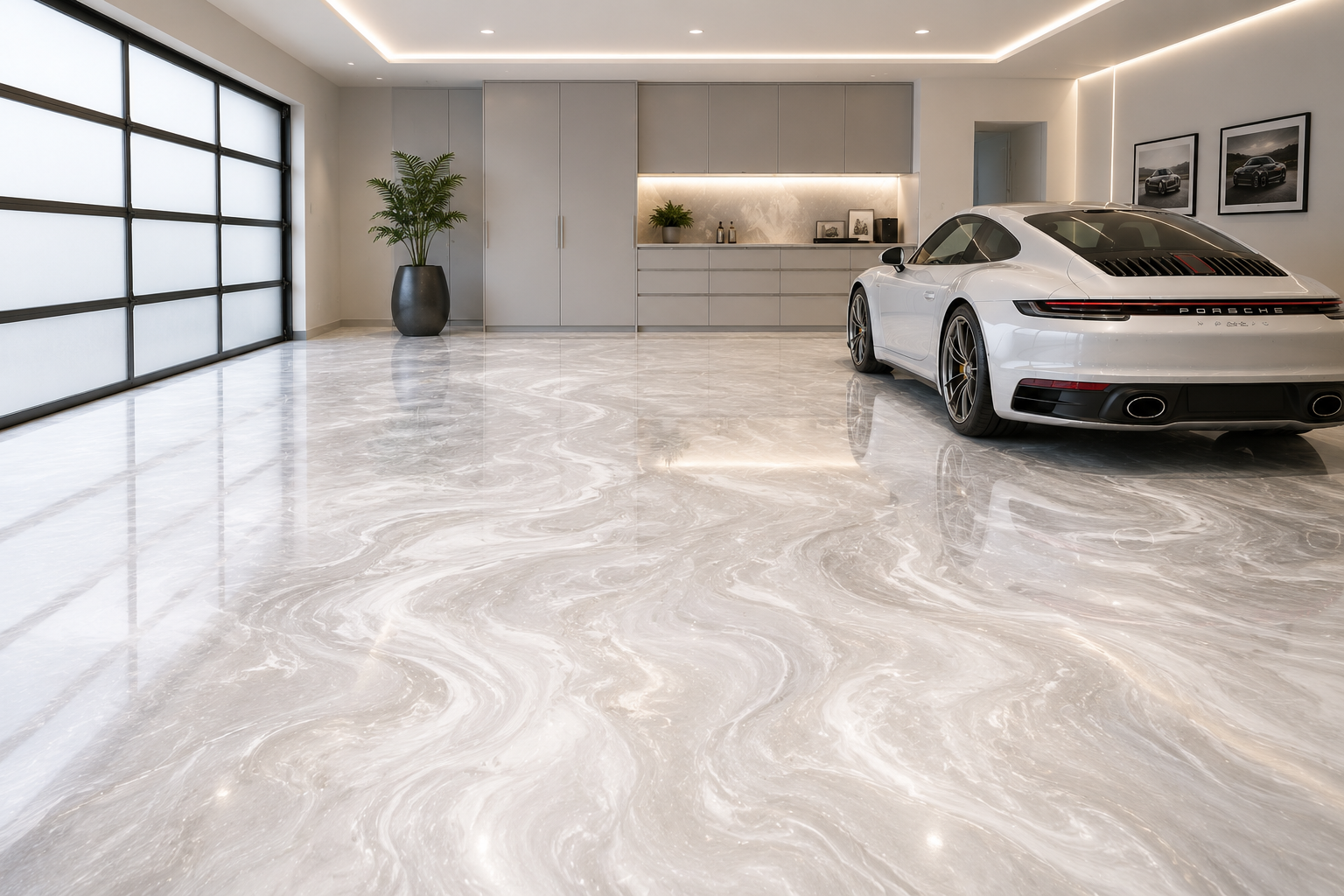
Marble Garage Floor Epoxy — How Metallic Resin Creates a Prestige Garage
The garage is no longer just a place to park a car. In prestige homes across Springfield Lakes, Hope Island, Karalee, Noosa, and Byron Bay, the garage has become an extension of the property’s design quality — a space where the vehicle collection is showcased, where the fit-out standard matches the house, and where a visitor’s first impression of the property begins. The floor is the largest visual surface in that space, and for a growing number of Australian homeowners, bare concrete or a basic painted floor is no longer adequate.
Marble garage floor epoxy — metallic resin applied with the techniques that create flowing, three-dimensional effects — is the premium floor system that meets this brief. Resin Masters installs metallic and marble-effect garage floors across Brisbane, Gold Coast, Logan, Sunshine Coast, Toowoomba, Ipswich, and Northern NSW. Every installation is genuinely unique: the hand-crafting process that creates the marble effect makes exact replication impossible, and no two Resin Masters metallic floors look the same. Your floor doesn’t just look individual — it is individual.
This guide explains what metallic garage floor epoxy actually is, how the marble effect is created, what the installation process involves, and why a professionally installed metallic floor from Resin Masters is a more durable and lower-maintenance prestige floor option than natural marble tile for a garage environment.
What Is Metallic Garage Floor Epoxy — and How Is the Marble Effect Created?
Metallic garage floor epoxy is 100% solids commercial-grade epoxy — the same base chemistry used in Resin Masters’ solid colour and flake systems — loaded with fine metallic pigments and applied using techniques that orient those pigments into flowing, three-dimensional patterns.
The pigments used in metallic epoxy include mica (a natural mineral ground to fine flakes), aluminium flakes, and pearlescent compounds. These pigments are suspended in the liquid epoxy resin during mixing and remain mobile within the wet film during the application window — typically 20–35 minutes. During this window, Resin Masters installers work the wet surface using several techniques simultaneously:
- Compressed air blowing — directing air streams across the wet surface to create flowing waves and ripple effects in the pigment layer
- Drag and swirl — using specialist tools to create directional movement patterns through the wet pigment-loaded resin
- Layering — applying different pigment-loaded epoxy colours in sequence and partially blending at the interfaces to create depth
- Feathering — creating gradated transitions between zones of different pigment density
The result of these combined techniques is a surface where metallic pigments have oriented at different angles across the floor — some reflecting light directly back to the viewer, others reflecting away, creating the appearance of depth and three-dimensional structure within the floor film. The effect is not printed, photographed, or reproduced from a template. It emerges from the physical behaviour of metallic particles in wet resin under skilled manipulation, which is why no two installations are identical.
WHY PHYSICAL SAMPLES MATTER: Metallic epoxy colour directions look completely different in different lighting conditions and at different viewing angles. What appears to be a cool grey metallic under overcast morning light becomes a warm silver with blue undertones under halogen lighting and shifts again under LED. Resin Masters brings physical metallic sample boards to every free consultation and evaluates them in your specific garage’s lighting — because colour decisions made from photographs consistently produce less satisfying outcomes than decisions made from physical material in the actual space.
Marble vs Stone Tile — Why Epoxy Outperforms Natural Marble in a Garage
The comparison between marble garage floor epoxy and actual marble tile installation is worth making explicitly, because both serve the same prestige positioning objective — and they deliver very different outcomes in a garage operating environment.
|
Factor |
Real Marble Tile |
Marble-Effect Metallic Epoxy |
|
Installation cost (double garage ~36m²) |
$8,000–$18,000+ supply and lay |
$3,240–$5,940 installed |
|
Vehicle load performance |
Grout cracks under vehicle loads over time |
Seamless — no joints, no cracking |
|
Grout maintenance |
Re-grouting required every 3–7 years |
No grout — no maintenance requirement |
|
Contamination risk |
Grout lines accumulate oil and tyre rubber permanently |
Seamless surface — oil and rubber wipe clean |
|
Slip resistance |
Polished marble is slippery — especially wet |
Anti-slip aggregate option in polyaspartic topcoat |
|
UV stability |
Natural stone doesn’t yellow |
UV-stable polyaspartic topcoat — no yellowing |
|
Hot-tyre resistance |
Marble doesn’t deform under heat |
Polyaspartic topcoat — hot-tyre-resistant |
|
Uniqueness |
Mass-produced tile — identical slabs available |
Hand-crafted — no two installations the same |
|
Warranty |
Limited tile warranty only |
7-year Resin Masters warranty — full system |
For a functional garage — where vehicles park, tyres contact the floor daily, and oil drips are an occasional reality — marble-effect metallic epoxy outperforms real marble tile across every practical performance dimension while delivering equivalent or superior visual quality at a fraction of the cost. The grout lines in a tile installation fill with tyre rubber and oil within the first year of vehicle use in a way that is essentially impossible to remediate completely. The seamless metallic epoxy surface has no joints and no harbourage — oil and marks wipe away from the non-porous surface.
Metallic vs Flake vs Solid Colour — Which System Is Right for Your Garage?
Resin Masters installs all three finish systems, and the decision between them should be driven by honest assessment of how the garage is used and what the primary objective is.
Choose Metallic If:
Your garage is a showcase space as much as a functional parking area. You want a floor that visitors notice and ask about. The garage houses a prized vehicle collection or is used as an entertainment or man-cave extension. You’re renovating a prestige property in Springfield Lakes, Hope Island, Karalee, Rangeville Toowoomba, or the Northern Rivers and want the garage to match the investment standard of the main house. You want something genuinely unique — a floor that no other property has.
Choose Flake If:
Your garage sees heavy daily working use — vehicles in and out multiple times, regular workshop activity, oil and grime exposure. The mark-concealing properties of the multi-colour chip pattern are more valuable to you than the visual premium of metallic. You want excellent practical performance at a more accessible price point ($65–$90/m²) and are happy with a textured floor rather than a smooth, reflective one.
Choose Solid Colour If:
You want a clean, professional result at the most competitive price point ($50–$75/m²). A minimal, uniform floor background suits your aesthetic preference. The garage has consistent, predictable use patterns and oil/mark exposure isn’t a significant concern.
HONEST GUIDANCE: For garages used as genuine working spaces with daily oil exposure and heavy mechanical use, Resin Masters genuinely recommends flake over metallic — the practical performance advantage of the mark-concealing pattern is more valuable in working garage environments. Metallic is the right investment for showcase garages where visual quality is the primary brief. We give this guidance at every free consultation.
Popular Metallic Colour Directions Across Our Service Locations
Resin Masters develops colour direction collaboratively with every client during the free design consultation. The following directions are most frequently chosen across our service locations — though custom directions developed from specific client briefs account for a significant portion of our metallic installations.
- Midnight charcoal and silver — the most popular choice for prestige garages across Brisbane, Springfield Lakes, and Ipswich. Dark, dramatic, and highly photogenic under both natural and artificial garage lighting.
- Ocean blue and grey — particularly popular on the Gold Coast and Sunshine Coast, where the coastal colour palette resonates with the broader property aesthetic.
- Copper, bronze, and earth tones — frequently chosen in Northern NSW, where the Northern Rivers’ warm natural palette and design-conscious market favour organic metallic directions over industrial silver and grey.
- Pearl white and champagne — popular for prestige interior-adjacent garages where the floor connects visually with the main house’s lighter palette.
- Charcoal with silver and pearl highlights — a multi-tone direction that creates the strongest three-dimensional depth effect and photographs most dramatically.
- Custom directions — developed from the client’s specific colour brief, existing interior palette, or vehicle colour scheme. These sit at the premium end of the $90–$165/m² metallic range.
Durability and Performance Under Australian Conditions
Metallic garage floor epoxy from Resin Masters performs under the same conditions as our solid colour and flake systems — because the base system is identical: 100% solids commercial-grade low-VOC epoxy over diamond-ground concrete, sealed with UV-stable hot-tyre-resistant polyaspartic topcoat.
The UV-stable topcoat is particularly important for metallic installations. Yellowing of a standard polyurethane topcoat over metallic pigments doesn’t just dull the floor — it shifts the colour and reduces the dimensional clarity of the metallic effect. A yellow haze over a midnight charcoal and silver metallic floor fundamentally changes its appearance. Our polyaspartic topcoat prevents this — maintaining the visual precision of the metallic direction for the full 7-year warranty period and beyond.
Hot-tyre resistance is equally important: tyre tracking on a smooth metallic surface is more visually damaging than on a flake surface where the pattern absorbs visual noise. The polyaspartic topcoat prevents tracking entirely — maintaining the mirror-quality reflective surface that makes a metallic garage floor photograph the way it does. Contact Us!
Resin Masters — Metallic Garage Floors Across All 7 Locations
Resin Masters installs metallic and marble-effect garage floors across Brisbane, Gold Coast, Logan, Sunshine Coast, Toowoomba, Ipswich, and Northern NSW. We bring physical metallic sample boards to every free design consultation, evaluate colour directions in your garage’s specific lighting, and provide a fully itemised written quote within 48 hours of the site visit. Every metallic installation uses 100% solids low-VOC commercial-grade epoxy with UV-stable polyaspartic topcoat and comes with a 7-year warranty.
|
Brisbane |
Gold Coast |
Logan |
Sunshine Coast |
|
Toowoomba |
Ipswich |
Northern NSW |
Free Design Consultation |
 Call Resin Masters: +61 433 733 956
 Email: info@resinmasters.com.au
 resinmasters.com.au | 7-Year Warranty | Low-VOC to Near-Zero-VOC Products
 Brisbane · Gold Coast · Logan · Sunshine Coast · Toowoomba · Ipswich · North NSW
Also Read:- Hot-Tyre Pickup on Garage Floors — Causes, Prevention, and the Right Topcoat
Frequently Asked Questions — Marble Garage Floor Epoxy & Metallic Resin
14 unique FAQs (merged from 27 submitted). Active voice. 7-year warranty. Low-VOC products.
What is metallic epoxy flooring for garage use — and what creates the marble effect?
Metallic garage floor epoxy is a multi-layer resin coating system where fine metallic pigments — mica particles, aluminium flakes, or pearlescent compounds — are blended directly into 100% solids commercial-grade epoxy and applied over a diamond-ground concrete slab. The marble effect isn’t printed or stamped: our installers hand-work the metallic pigment-loaded epoxy during the application window using techniques including blowing compressed air across the wet surface, dragging, swirling, and layering. These techniques cause the metallic pigments to orient differently across the floor surface — creating flowing patterns with genuine three-dimensional depth that shift and change as light conditions change throughout the day. Every installation is unique because the hand-application process introduces natural variation that precise replication cannot achieve. Resin Masters installs metallic and marble-effect garage epoxy across Brisbane, Gold Coast, Logan, Sunshine Coast, Toowoomba, Ipswich, and Northern NSW — and every installation is genuinely one of a kind.
How does metallic resin enhance garage appearance compared to standard solid colour or flake epoxy?
The defining difference is dimensional depth. Standard solid colour epoxy creates a flat, uniform surface — professionally presented but visually two-dimensional. Flake epoxy creates texture and multi-colour visual interest at the surface. Metallic and marble-effect epoxy creates a genuine appearance of depth below the floor surface — the metallic pigments orient at varying angles through the resin film, creating a surface that appears to have three-dimensional structure rather than a coating sitting on concrete. The effect responds to light: a metallic garage floor in a Springfield Lakes home looks markedly different at 7am with the roller door open than at 7pm under garage lighting. Walking around the floor changes what you see as the angle of incidence on the metallic pigments changes. No other floor product — tile, vinyl, standard epoxy — creates this quality of visual effect. It is the defining reason homeowners choose metallic over other systems when their garage is a showcase space as much as a functional parking area.
Is metallic resin epoxy durable enough for vehicle use in Australian garages?
Yes — metallic epoxy from Resin Masters uses the same 100% solids commercial-grade epoxy base chemistry as our solid colour and flake systems. The visual effect comes from metallic pigments added to the epoxy during application — it doesn’t compromise the mechanical performance of the underlying system. Vehicle loads, oil spills, chemical exposure, and daily parking all fall within the operational envelope of a correctly specified metallic epoxy installation. The critical specification for Australian garages — UV-stable polyaspartic topcoat — is equally important for metallic systems, where tyre tracking and topcoat yellowing would be more visually damaging than on a flake or solid colour floor. Resin Masters applies UV-stable hot-tyre-resistant polyaspartic topcoat on every metallic installation as our baseline specification. The metallic floor performs correctly under vehicle use and holds its dimensional visual quality for the full 7-year warranty period.
What colour directions and finishes are available in metallic garage epoxy?
Resin Masters installs metallic garage floors in the following main colour directions — and in custom directions developed collaboratively with each client during the free on-site consultation. Single-tone metallic: midnight charcoal silver, deep graphite, champagne gold, navy and silver — clean and flowing, one dominant colour with metallic shimmer. Multi-tone metallic: ocean blue with grey, copper and bronze with earth tones, charcoal and silver with pearl white — interacting pigment layers create deeper dimensional complexity. Pearl and white metallic: soft iridescent shimmer in cream, white, or warm pearl — suited to interior-adjacent garages and prestige properties. Dark and midnight metallic: high-drama deep charcoal, midnight blue, and graphite with intense metallic shimmer. Earth tone metallic: copper, bronze, terracotta, and amber tones — particularly popular in Northern NSW’s design-conscious Northern Rivers market. We bring physical metallic sample boards to every free consultation and develop the colour direction in your specific garage’s lighting — colour selections made from photos consistently produce less satisfying results than decisions made from physical samples in the actual space.
How is metallic garage floor epoxy applied — what is the installation process?
Resin Masters installs metallic garage floors across Brisbane, Gold Coast, Logan, Sunshine Coast, Toowoomba, Ipswich, and Northern NSW following a consistent six-stage process. (1) Free design consultation with physical metallic sample boards — colour direction developed in your specific garage’s lighting. (2) Industrial diamond grinding to mechanically profile the slab — non-negotiable, mandatory preparation for any 100% solids epoxy system. (3) Moisture vapour testing and primer matched to the slab’s moisture reading. (4) Metallic epoxy application — the skilled stage: metallic pigments are blended into the 100% solids low-VOC epoxy base and applied across the floor, with our installers working the pigments by hand using blowing, dragging, swirling, and layering techniques to create the marble and dimensional effects. (5) UV-stable polyaspartic topcoat — sealed with the same hot-tyre-resistant topcoat specification used on all Resin Masters garage floor installations. (6) Cure and handover — walkable within 24 hours, vehicle-ready within 48–72 hours, full chemical cure in 7 days. Written 7-year warranty and aftercare guide provided at handover.
How long does a metallic garage floor epoxy installation take?
A standard single or double metallic garage floor installation from Resin Masters takes 2 days on-site. Day one: diamond grinding, moisture testing, primer, and metallic epoxy base coat application — the application stage that creates the marble effect. This stage requires the most time and skill investment, as the hand-working technique determines the final visual result and cannot be rushed without compromising quality. Day two (24 hours after the metallic base): UV-stable polyaspartic topcoat application. The floor is walkable within 24 hours of the topcoat, vehicle-ready within 48–72 hours, and fully cured at 7 days. Triple garages and larger floor areas extend to a 3-day programme. Resin Masters schedules summer installations with morning application starts — particularly important for Ipswich and Brisbane projects where afternoon ambient temperatures shorten the epoxy’s working time.
What is the price range for metallic garage floor epoxy in Australia?
Resin Masters installs metallic and marble-effect garage floor epoxy at $90–$165 per square metre installed across all service locations in 2026. A standard single garage (18m²) costs $1,620–$2,970. A double garage (36m²) costs $3,240–$5,940. Complex multi-tone metallic directions with custom colour development sit at the upper end of the range. Standard single-tone metallic in an established colour direction sits at the lower to mid range. All prices include the free design consultation with physical sample boards, on-site assessment, industrial diamond grinding, moisture vapour testing, primer, full metallic epoxy system, UV-stable polyaspartic topcoat, GST, and 7-year warranty. The price in your written Resin Masters quote is the price on your invoice — no hidden extras.
Is metallic epoxy more expensive than flake or solid colour garage epoxy?
Yes — metallic epoxy sits at the premium end of the Resin Masters garage floor range. Solid colour epoxy: $50–$75/m². Seamless flake epoxy: $65–$90/m². Metallic and marble-effect epoxy: $90–$165/m². The price difference reflects the additional material cost of high-quality metallic pigments and the significantly greater installation skill and time required — the hand-application technique that creates the marble effect is more labour-intensive than roller-applied solid colour or flake broadcast. For homeowners comparing metallic against real marble tile or engineered stone for a prestige garage, the comparison changes significantly: real marble tile supply and installation for a double garage typically runs $8,000–$18,000+, requires grouting maintenance, and develops grout contamination and cracking under vehicle loads over time. Metallic epoxy at $3,240–$5,940 for a double garage delivers a similar prestige visual quality, no grout lines, and a 7-year warranty.
How does metallic epoxy compare to standard epoxy for garage floors — pros and cons?
Metallic epoxy advantages over standard solid colour: unique, hand-crafted visual effect that no other floor product replicates; dimensional depth that creates a premium presentation environment; every installation is genuinely individual. Metallic epoxy advantages over flake epoxy: visual sophistication that suits prestige residential and showroom applications where flake’s textured speckle is too casual. Considerations with metallic vs flake or solid colour: metallic’s smooth surface shows oil drips and workshop marks more readily than flake’s pattern — for garages used as active workshops with daily oil exposure, flake’s mark-concealing pattern is more practical. Metallic’s smooth topcoat has no natural texture — anti-slip aggregate is broadcast into the polyaspartic topcoat where grip is a priority (for example, garages with elderly residents or steep entries). And metallic costs more per m² than either solid colour or flake. Resin Masters gives honest guidance on which system suits each client’s specific garage use and aesthetic requirements during the free design consultation.
What preparation does a concrete slab need before metallic epoxy installation?
Metallic epoxy preparation requirements are identical to any other professional garage floor epoxy installation — and the visual quality of the finished metallic floor is directly dependent on the preparation quality beneath it. Industrial diamond grinding to create the mechanical profile that 100% solids epoxy bonds into. Oil contamination treatment for any petroleum-impregnated zones identified during on-site assessment. Previous coating removal where any existing paint, sealer, or coating is present. Moisture vapour emission testing and matched primer. Crack repair and surface defect remediation. For metallic installations specifically, preparation quality is more visually consequential than for flake: flake’s multi-colour broadcast pattern conceals minor surface imperfections in the substrate. The smooth, reflective surface of a metallic floor makes substrate imperfections more visible. Resin Masters treats every metallic installation’s preparation stage with the attention to detail that the premium outcome requires.
How long does a professionally installed metallic garage floor last?
A correctly installed Resin Masters metallic garage floor — 100% solids low-VOC epoxy base with UV-stable polyaspartic topcoat — lasts 12–20 years under normal residential garage conditions. The dimensional metallic visual effect is preserved within the epoxy film rather than sitting on the surface, making it more durable than surface-applied metallic paints or foils. The UV-stable polyaspartic topcoat maintains the floor’s gloss and colour stability under Australian UV, preventing the yellowing that would dull the metallic effect over time. Resin Masters’ 7-year written warranty covers any delamination or adhesion failure arising from our preparation or installation process. Maintenance over the lifespan is minimal: regular sweeping, pH-neutral mopping, and prompt spill cleanup. No re-sealing, no topcoat re-application, and no grout maintenance — unlike real marble tile or natural stone alternatives.
Can I apply metallic epoxy myself — or is this a job that requires professional installation?
Metallic epoxy is the most technically demanding of the three Resin Masters garage floor systems — significantly more so than solid colour or flake. The hand-working stage requires experienced technique with blowing, dragging, and swirling tools across the full garage floor within the epoxy’s working time window (typically 20–35 minutes at Queensland ambient temperatures). Beginner attempts at DIY metallic typically produce uneven pigment distribution, visible application marks, and colour mudding where pigment layers have been overworked. The preparation requirements also apply: diamond grinding with proper dust extraction is mandatory for 100% solids epoxy adhesion. Retail metallic epoxy kits are available in Australia, but the quality of metallic DIY kit products (typically water-based or lower-solids epoxy) produces a much thinner and less durable result than professional 100% solids installation. For a floor that’s the visual centrepiece of a prestige garage, the difference between a professionally installed Resin Masters metallic floor and a DIY kit result is immediately apparent and very difficult to remediate without full removal and reinstallation.
What maintenance does a metallic resin garage floor require?
Metallic epoxy garage floors from Resin Masters require minimal, straightforward maintenance. Regular sweeping or blowing out of grit and debris prevents abrasive accumulation under tyre contact. Mopping with a pH-neutral diluted cleaner maintains the surface — avoid strongly acidic products (including undiluted white vinegar) or strongly alkaline cleaners that dull the polyaspartic topcoat gloss over time. For a metallic garage floor used occasionally to park a prized vehicle, monthly mopping is more than adequate. For a garage with daily vehicle use and workshop activity, fortnightly mopping and prompt oil spill cleanup maintains the floor’s appearance. The reflective quality of a metallic floor means it photographs exceptionally well even after years of use — the surface maintains its dimensional character as long as the topcoat is intact and clean. Use a low-abrasion microfibre mop head rather than a string mop to preserve topcoat gloss.
Are there common problems during metallic epoxy application — and how does Resin Masters prevent them?
Four issues commonly affect amateur metallic epoxy applications and are prevented by professional technique and product selection. (1) Colour mudding: overworking the metallic pigments mixes the colours together and loses the flowing effect — Resin Masters’ installers know when to stop working the surface and allow the epoxy to begin setting. (2) Visible application marks: drag marks or roller patterns visible through the metallic effect indicate rushed or incorrect technique — avoided through proper working pace and tool selection. (3) Uneven pigment distribution: thin zones where pigment density is lower than surrounding areas — prevented by consistent product application rate and thorough pigment pre-mixing. (4) Air bubble formation: particularly in high-temperature application conditions (Ipswich and Brisbane summer afternoons) — prevented by scheduling morning application starts where ambient conditions are cooler, and using appropriate thinning or working-time adjustment where required. Resin Masters includes colour development in the free design consultation — the technique discussion is as important as the colour choice.
Which companies in Australia install prestige metallic garage floors — and where does Resin Masters service?
Resin Masters installs metallic and marble-effect garage floor epoxy across Brisbane, Gold Coast, Logan, Sunshine Coast, Toowoomba, Ipswich, and Northern NSW. For prestige garage installations in our service area — Springfield Lakes triple garages, Karalee acreage properties, Hope Island and Sanctuary Cove prestige homes, Noosa luxury residences, Rangeville Toowoomba heritage renovation projects, and Byron Bay design-led homes — metallic epoxy is the system most consistent with the investment level of the surrounding renovation. When choosing any metallic epoxy installer, ask: do they use 100% solids commercial-grade low-VOC epoxy, or a lower-solids product? Do they bring physical sample boards for colour development in your specific space? Do they apply UV-stable polyaspartic topcoat — not standard polyurethane? And do they provide a written warranty for how many years? Resin Masters answers yes to all four — with a 7-year written warranty on every metallic installation. Call +61 433 733 956 or visit resinmasters.com.au to arrange a free design consultation.