Servicing : Gold CoastBrisbaneSunshine CoastToowoomba

Hot-Tyre Pickup on Garage Floors — Causes, Prevention, and the Right Topcoat
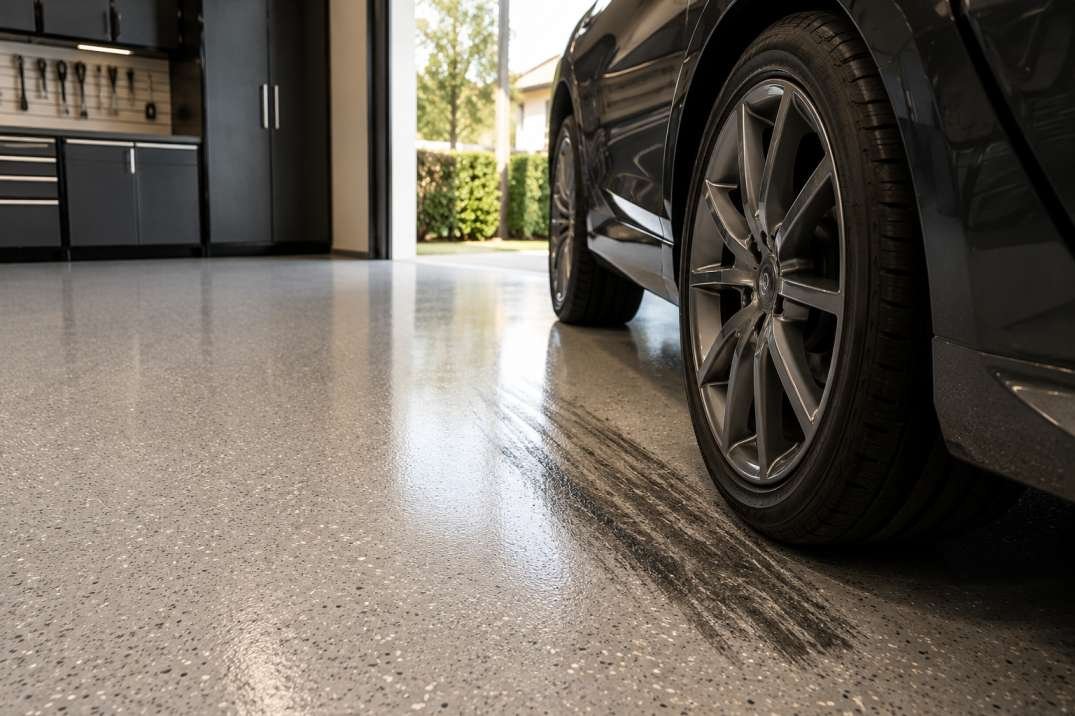
You park your car after a drive on a hot Queensland day. The next morning, you pull out and look at the garage floor — and there are tyre marks. Not oil stains. Not tyre rubber from spinning wheels. Permanent impressions in the surface, sometimes with the tread pattern visible, sometimes as faint distortions in the floor coating’s reflection. They don’t clean off because they’re not on the surface — they are the surface, deformed by heat and pressure.
This is hot-tyre pickup. It happens every summer across Brisbane, Gold Coast, Logan, Sunshine Coast, Toowoomba, Ipswich, and Northern NSW — and it’s one of the most common complaints Resin Masters hears from homeowners whose garage floors were installed by other companies. Not because epoxy garage flooring doesn’t work in Queensland. Because the wrong topcoat was specified for Australian conditions.
This guide explains exactly what hot-tyre pickup is, why it happens, which topcoat chemistries prevent it and which don’t, and why Resin Masters specifies UV-stable polyaspartic topcoat on every garage floor installation — not as a premium option, but as the only specification that makes a 7-year warranty achievable in Australian summer conditions.
What Is Hot-Tyre Pickup — What’s Actually Happening?
Hot-tyre pickup is the physical deformation of a floor coating film under the combined effects of elevated tyre temperature, coating softening from heat and UV degradation, and the adhesive and pressure forces of a stationary vehicle tyre on a softened surface.
The process is not mysterious — it follows a predictable physical sequence. A vehicle tyre in sustained contact with hot asphalt reaches elevated surface temperatures. The vehicle enters the garage and parks on a floor coating that has already been partially softened by ambient heat and UV degradation. The hot tyre contacts the softened coating under the vehicle’s full weight — distributed across four tyre contact patches typically 200–300mm in length. Over the 10–30 minutes the vehicle sits stationary, the coating under each tyre contact point deforms under the combined thermal softening and compressive force. When the vehicle leaves, the deformed coating retains the shape the tyre imposed — as permanent tread impressions, lifting patches, or surface distortion visible in the floor’s reflective quality.
The critical insight is that this deformation is physical, not chemical. Tyre rubber doesn’t dissolve or chemically attack the coating film. It softens the coating mechanically — and a softened thermoplastic film deforms under load the same way a warm piece of plastic deforms under pressure. Once cooled back to ambient temperature, the deformation is permanent. No cleaning product, no buffing compound, and no topcoat applied over the deformed surface reverses it. Resurfacing is the only remediation.
HOT-TYRE PICKUP vs TYRE RUBBER MARKS: These are two distinct problems often confused with each other. Tyre rubber marks are dark surface deposits left by spinning or skidding tyres — they sit on the coating surface and can often be cleaned with the right solvent. Hot-tyre pickup is physical deformation of the coating film under stationary contact — it is permanent and cannot be cleaned away. Most Queensland homeowners reporting ‘tyre marks that won’t clean off’ are experiencing hot-tyre pickup, not rubber deposits.
Why Standard Polyurethane Topcoats Fail in Queensland Garages
The core problem is a mismatch between product design temperature range and Australian garage operating conditions. Standard polyurethane floor topcoats — the product used by most budget garage floor installers and included in retail epoxy kit systems — use aromatic isocyanate chemistry. This chemistry was developed and optimised for European and North American industrial environments where peak ambient temperatures are significantly lower than Australian summer conditions and UV intensity is moderate by comparison.
Aromatic polyurethane begins to lose film hardness progressively as surface temperature increases above approximately 55–60°C under sustained contact load. On a peak Queensland summer day in an Ipswich or Toowoomba garage with a west-facing roller door, concrete surface temperatures reach this range before any vehicle arrives home. The topcoat is already partially softened by the time the hot tyres add their own thermal contribution.
UV exposure compounds the problem. The same aromatic chemistry that makes standard polyurethane thermally vulnerable also makes it UV-reactive — UV radiation breaks down the aromatic polymer chains over time, progressively reducing the film’s hardness, flexibility, and thermal resistance. A floor that has been through one or two Queensland summers shows significantly earlier and more severe hot-tyre pickup than a freshly installed floor — because the topcoat is already partially degraded by UV before the peak-temperature tyre contact events occur.
The Location Factor — Where Hot-Tyre Pickup Is Worst in SEQ
While hot-tyre pickup can occur at any of Resin Masters’ seven service locations during Queensland summer conditions, the severity varies significantly based on ambient temperature, UV intensity, and garage orientation.
|
Location |
Peak Concrete Temp. (est.) |
Hot-Tyre Risk Level |
Key Contributing Factor |
|
Ipswich |
55–65°C |
Extreme — highest in service area |
Inland position, no coastal moderation, extreme summer maxima |
|
Logan |
50–60°C |
Very High |
Inland position, dark asphalt roads throughout estate corridors |
|
Toowoomba |
48–58°C |
Very High |
Inland UV intensity, thermal cycling adds fatigue to topcoat |
|
Brisbane |
45–55°C |
High |
Suburban heat island, north/west-facing doors most affected |
|
Gold Coast |
42–52°C |
High |
Lower inland temp but salt air adds atmospheric topcoat degradation |
|
Sunshine Coast |
40–50°C |
Moderate–High |
Coastal moderation helps somewhat; north-facing doors still affected |
|
Northern NSW |
40–52°C |
Moderate–High |
Coastal UV, subtropical summer heat; Byron Bay inland properties higher |
The risk level at every location listed is sufficient to make standard polyurethane topcoat an inadequate specification for regular vehicle use. Even at ‘moderate–high’ Sunshine Coast conditions, standard topcoats on north-facing garages with sustained direct sun exposure will show hot-tyre pickup within 2–3 Queensland summers. Resin Masters does not offer a lower-grade topcoat option for ‘lower-risk’ locations — the correct specification is the same across the entire service area. Get a free Quote!
The Solution — Why Polyaspartic Topcoat Prevents Hot-Tyre Pickup
UV-stable polyaspartic topcoats solve both the UV degradation and the thermal softening problems simultaneously — because both problems have the same root cause in aromatic chemistry, and polyaspartic addresses that root cause by using aliphatic chemistry instead.
Aliphatic Chemistry — The Structural Difference
Polyaspartic coatings are classified as aliphatic polyurea products. The critical difference from standard aromatic polyurethane is in the polymer backbone structure: aliphatic polymer chains lack the UV-reactive benzene ring structures that drive photochemical degradation in aromatic systems. Without the UV degradation mechanism, the aliphatic film maintains its hardness, flexibility, and thermal resistance under sustained UV exposure — not just when freshly installed, but through multiple Queensland summers.
The thermal resistance of polyaspartic topcoats is meaningfully higher than standard polyurethane — maintaining film hardness at surface temperatures and contact pressures that cause standard polyurethane to deform. This is not a marginal improvement. In practical terms, it is the difference between a floor that shows tyre tracking within 18 months and one that shows none after 7 years under the same vehicle use pattern.
How Resin Masters Specifies This on Every Installation
Every Resin Masters garage floor installation across Brisbane, Gold Coast, Logan, Sunshine Coast, Toowoomba, Ipswich, and Northern NSW uses UV-stable polyaspartic as the standard finish coat. This applies to all three finish systems we install:
- Solid colour garage epoxy — UV-stable polyaspartic topcoat seals the colour coat. No yellowing, no hot-tyre deformation.
- Seamless flake garage epoxy — UV-stable polyaspartic topcoat seals the flake broadcast. The clear coat maintains optical clarity over the chips and prevents tyre tracking in the clear layer.
- Metallic and marble-effect garage epoxy — UV-stable polyaspartic topcoat seals the metallic pigment layer. The dimensional effect is preserved without the yellowing or deformation that would compromise the visual quality of a premium installation.
Topcoat Comparison — Choosing the Right Chemistry for Australian Garages
|
Property |
Aromatic Polyurethane |
Aliphatic Polyurethane |
Polyaspartic (Aliphatic Polyurea) |
|
Hot-tyre resistance |
Poor — deforms under Australian summer conditions |
Moderate — better than aromatic but below polyaspartic |
Excellent — resists hot-tyre contact under Queensland conditions |
|
UV yellowing resistance |
Poor — yellows within 12–18 months under Qld UV |
Good — stable under UV |
Excellent — colour-stable under sustained Australian UV |
|
Film hardness retention over time |
Decreases significantly under UV and heat cycling |
Moderate retention |
Strong retention under UV and thermal cycling |
|
Cure time to vehicle-ready |
48–72 hours |
24–48 hours |
12–24 hours |
|
Cost relative to aromatic PU |
Baseline |
15–25% higher |
Similar or slightly higher than aliphatic PU |
|
Resin Masters specification |
Never used |
Not used |
Standard on every installation |
THE CORRECT ANSWER TO ‘IS YOUR TOPCOAT UV-RESISTANT?’: Ask specifically — is it polyaspartic or standard polyurethane? A company that answers ‘UV-resistant polyurethane’ is describing a product with UV stabiliser additives that slow but don’t prevent UV degradation. Genuine UV-stable and hot-tyre-resistant performance requires aliphatic chemistry — polyaspartic is the commercially standard product delivering this for garage floor applications.
Resin Masters — Hot-Tyre-Resistant Garage Floors Across All 7 Locations
Every Resin Masters garage floor installation uses 100% solids low-VOC commercial-grade epoxy as the base and UV-stable polyaspartic as the topcoat — the combination that prevents both hot-tyre pickup and UV yellowing for the full 7-year warranty period and well beyond. We don’t offer a standard-topcoat option for clients who want to spend less on the finish coat, because a standard-topcoated floor cannot hold a 7-year warranty through Queensland summers.
If your current garage floor is already showing tyre tracking or yellowing, Resin Masters provides free on-site assessments for resurfacing and repair across all 7 service locations. We assess the existing floor, identify the root cause, and provide an honest recommendation on repair vs full resurfacing before any commitment.
|
Brisbane |
Gold Coast |
Logan |
Sunshine Coast |
|
Toowoomba |
Ipswich |
Northern NSW |
Free Assessment — 48hr Quote |
Also Read:- How to Prepare Your Garage Floor for Epoxy — A Step-by-Step Guide
 Call Resin Masters: +61 433 733 956
 Email: info@resinmasters.com.au
 resinmasters.com.au | 7-Year Warranty | Low-VOC Products
 Brisbane · Gold Coast · Logan · Sunshine Coast · Toowoomba · Ipswich · North NSW
Frequently Asked Questions — Hot-Tyre Pickup on Garage Floors
What causes hot-tyre pickup on garage floors — and why does it happen in Australian summers?
Hot-tyre pickup occurs when a vehicle tyre at elevated temperature contacts a floor coating that has softened to the point where it deforms under contact pressure and adhesive force. In Australian garage conditions — particularly across Brisbane, Gold Coast, Logan, Sunshine Coast, Toowoomba, Ipswich, and Northern NSW — the sequence runs like this: a vehicle is driven on summer asphalt that has been absorbing solar radiation all day. The tyre compound heats up through road friction and solar-heated surface contact. The vehicle arrives home and parks on a standard polyurethane-topcoated garage floor. The hot tyre contacts the floor coating at a temperature the polyurethane film was not formulated to resist. The coating softens, deforms under the tyre’s contact pressure and adhesion, and when the vehicle moves the next morning, the topcoat surface has permanently changed shape at the contact points — either lifting in patches, leaving tread-pattern impressions, or peeling in strips. This is hot-tyre pickup. The marks it leaves are not stains. They are physical deformation of the coating film, and cleaning cannot remove them.
Why do tyre marks appear on standard epoxy garage floors in summer but not in winter?
The temperature differential between seasons directly explains the seasonality of tyre tracking on standard-topcoated garage floors. In winter, summer asphalt temperatures are significantly lower, vehicle tyres arrive home at lower temperatures, and standard polyurethane topcoats remain hard enough to resist the contact pressure and adhesion at the lower tyre temperature. As summer temperatures build — particularly in inland SEQ locations like Ipswich, Logan, and Toowoomba where ambient air temperatures regularly exceed 38–40°C and concrete surface temperatures in open garages reach 55–65°C — the combination of ambient heat softening the coating and hot tyres arriving from heated road surfaces creates the conditions for deformation. The floor that looked perfect through six Queensland winters begins showing tyre marks in the first or second summer of operation. The topcoat chemistry was always inadequate — the Queensland summer conditions reveal it.
What is the difference between polyurethane, polyurea, and polyaspartic topcoats for hot-tyre resistance?
These three chemistry types sit on a performance spectrum for Australian garage conditions. Standard polyurethane (aromatic): the most commonly specified topcoat in lower-cost garage floor installations. Uses aromatic isocyanate chemistry that softens under the combination of UV degradation and thermal load created by Australian summer garage conditions. Produces both tyre tracking (physical deformation under hot contact) and yellowing (UV degradation of aromatic chromophores). Not the correct specification for any Queensland garage under regular vehicle use. Polyurea (aliphatic, fast-set): extremely fast reaction chemistry that cures in seconds to minutes. High thermal resistance and UV stability. Typically applied using plural-component spray equipment not available through standard coating contractors. The most technically demanding application method. Polyaspartic (aliphatic polyurea hybrid): combines the UV stability and thermal resistance of aliphatic polyurea chemistry with cure times compatible with professional roller or squeegee application — typically 1–4 hours to tack-free. This is the correct specification for Australian garage floors: UV-stable, hot-tyre-resistant, practically applicable, and durable for 12–20 years under Queensland conditions. Resin Masters applies UV-stable polyaspartic topcoat on every garage floor installation across all 7 service locations as the baseline specification.
Can industrial-grade epoxy coating prevent hot-tyre pickup on residential garage floors?
Industrial-grade 100% solids epoxy base coat significantly outperforms residential and water-based epoxy products for film build, adhesion strength, and chemical resistance — but the hot-tyre resistance of any floor system is determined by the topcoat, not the epoxy base coat. Even a correctly specified 100% solids industrial epoxy base coat will develop tyre tracking if it’s sealed with a standard aromatic polyurethane topcoat. The solution is not simply upgrading the epoxy base — it’s specifying the correct topcoat chemistry above it. Resin Masters uses 100% solids commercial-grade low-VOC epoxy as the base on every residential and commercial garage floor installation, and UV-stable polyaspartic as the topcoat. The combination provides industrial-grade adhesion and build from the epoxy base, and hot-tyre resistance and UV stability from the polyaspartic topcoat. Both layers are required to produce a floor that performs correctly under Australian garage conditions.
How do temperature and tyre type influence hot-tyre pickup severity?
Four variables determine how severe hot-tyre pickup is for any given garage floor installation. (1) Ambient air temperature — higher ambient temperatures pre-heat the floor surface before any vehicle contact, reducing the thermal reserve the topcoat has before softening. Ipswich and Toowoomba’s inland heat creates pre-heated floor conditions in summer that coastal Queensland locations don’t reach at the same magnitude. (2) Pavement surface temperature — vehicles driven on dark bitumen that has absorbed solar radiation all day arrive home with significantly higher tyre temperatures than vehicles driven primarily on lighter-coloured or shaded roads. (3) Tyre compound — softer, stickier tyre compounds (performance and summer tyres, particularly from European brands optimised for softer European asphalt) have greater adhesion to softened floor surfaces than harder all-season compounds. (4) Dwell time — a vehicle parked immediately after a long summer drive, with hot tyres sitting stationary on the floor for an extended period, creates more sustained contact pressure on the softened coating than a vehicle that is driven slowly into the garage and immediately moved. Polyaspartic topcoats from Resin Masters handle the realistic combination of all four variables across Queensland and Northern NSW summer conditions without deforming.
How much does a hot-tyre-resistant garage floor coating cost in Australia?
Resin Masters installs hot-tyre-resistant garage floor systems across Brisbane, Gold Coast, Logan, Sunshine Coast, Toowoomba, Ipswich, and Northern NSW at $50–$165 per square metre depending on the finish system. Solid colour with UV-stable polyaspartic topcoat: $50–$75/m². Seamless flake with UV-stable polyaspartic topcoat: $65–$90/m². Metallic with UV-stable polyaspartic topcoat: $90–$165/m². For a standard double garage (36m²), budget $1,800–$2,700 for solid colour, $2,340–$3,240 for flake, or $3,240–$5,940 for metallic. All prices include the UV-stable hot-tyre-resistant polyaspartic topcoat as standard — there is no additional cost for the correct topcoat specification because we don’t offer the alternative. Every Resin Masters installation includes a 7-year warranty and uses low-VOC to near-zero-VOC products throughout. Free on-site quotes available — call +61 433 733 956.
Can hot-tyre tracking on a garage floor be repaired — or does the whole floor need resurfacing?
Hot-tyre tracking damage creates permanent physical deformation of the topcoat film. Whether repair or full resurfacing is the correct approach depends on the extent of the damage. Isolated tyre tracking in a few zones — common in the early stages of deformation before it has spread across the full floor — may be addressable with targeted topcoat spot repair using compatible polyaspartic chemistry. However, if the underlying topcoat has been broadly compromised by UV degradation (which typically accompanies tyre tracking on standard-topcoated floors), spot repair over a degraded base produces poor adhesion between the repair material and the existing film. Full topcoat removal and re-application with polyaspartic is usually the more reliable approach for floors where tracking is extensive. Resin Masters assesses tyre-tracked floors during the free on-site inspection and recommends repair or resurfacing based on the actual condition rather than a default approach.
What maintenance practices help a polyaspartic topcoat resist hot-tyre pickup over time?
UV-stable polyaspartic topcoated floors from Resin Masters require straightforward maintenance to preserve their hot-tyre resistance over the 7-year warranty period and beyond. Regular sweeping removes abrasive grit that creates micro-scratches in the topcoat surface — accumulated micro-scratching reduces gloss and can eventually create surface pathways for chemical penetration. Mopping with a pH-neutral cleaner maintains the topcoat chemistry without degrading the aliphatic polymer surface. Avoid strongly acidic or alkaline cleaning products that attack the topcoat film over time. Prompt cleanup of fuel, oil, and solvent spills prevents chemical softening at spill points. For garages with extremely high vehicle traffic — multiple daily vehicle movements in peak summer heat — an annual inspection of the topcoat in highest-traffic zones is worthwhile. Resin Masters provides a written aftercare guide at every installation handover.
Are there eco-friendly, low-VOC garage floor topcoats that also resist hot-tyre pickup?
Yes — the UV-stable polyaspartic topcoat Resin Masters applies on every garage floor installation is also a low-VOC product. Unlike older solvent-based industrial topcoat systems that produce significant volatile organic compound emissions during application, polyaspartic topcoats use 100% solids or near-100% solids chemistry that emits minimal to no VOCs during curing. The performance benefits (UV stability, hot-tyre resistance, fast cure) and the environmental credentials (low-VOC, safe for occupied residential garages during application) are not in conflict — polyaspartic delivers both. Resin Masters provides full product data sheets confirming VOC content for any homeowner requiring documentation. Our 100% solids low-VOC epoxy base coat combined with UV-stable polyaspartic topcoat gives your garage floor the correct specification for Australian conditions and the environmental specification appropriate for residential use.
Can I apply a hot-tyre-resistant topcoat over my existing garage floor myself?
Applying a polyaspartic topcoat over an existing garage floor is technically feasible in some scenarios — but the conditions for a successful result are specific. The existing floor surface must be sound, well-adhered, and chemically compatible with polyaspartic chemistry. The surface must be mechanically abraded (sanding or light grinding) to create an adhesion profile for the new topcoat. The existing coating must be free of contamination, and the concrete beneath must not have elevated moisture vapour emission. Polyaspartic topcoats also have a significantly shorter working time than standard polyurethane — typically 15–30 minutes at Queensland ambient temperatures — which makes application more technically demanding than standard floor paints. For a garage floor that already has hot-tyre tracking damage (indicating the existing topcoat has degraded), the degraded film should be removed before any new topcoat is applied rather than applied over it. Resin Masters provides free on-site assessments for any homeowner considering topcoat upgrade — we assess the existing floor and advise whether topcoat-over-existing or full removal is the right approach.
Is there a non-slip hot-tyre-resistant topcoat option for garages with safety requirements?
Yes — Resin Masters achieves both non-slip specification and hot-tyre resistance in the same topcoat layer. Anti-slip aggregate (aluminium oxide, quartz, or carborundum) is broadcast into the wet polyaspartic topcoat during application, creating a textured surface that achieves the specified AS 4586 slip resistance rating while maintaining the aliphatic chemistry that provides UV stability and hot-tyre resistance. The aggregate broadcast density determines the achieved slip resistance — Resin Masters targets the appropriate rating for residential garages where everyday barefoot grip and wet-condition safety are the priorities, without over-texturing to the point where the floor is difficult to clean. For commercial garages requiring formal AS 4586 documentation, we test and record the achieved rating before handover. Non-slip and hot-tyre-resistant specification are not competing requirements — they are both achievable in the same polyaspartic topcoat layer.
Which companies in Australia specialise in hot-tyre-resistant garage floor coatings?
Resin Masters installs hot-tyre-resistant garage floor systems across Brisbane, Gold Coast, Logan, Sunshine Coast, Toowoomba, Ipswich, and Northern NSW. When evaluating any garage floor coating company for hot-tyre resistance, ask two specific questions: first, what topcoat chemistry do you use — polyaspartic or polyurethane? Second, is the hot-tyre-resistant specification standard on every installation, or is it an optional upgrade? Resin Masters answers: polyaspartic topcoat, standard on every installation, no optional alternative. A company that lists hot-tyre-resistant topcoat as an upgrade or a premium option is indicating that their standard product doesn’t provide this protection. For any Queensland and Northern NSW garage under regular vehicle use, the correct topcoat is non-negotiable — not a choice between ‘standard’ and ‘premium’. Call Resin Masters at +61 433 733 956 or visit resinmasters.com.au for a free on-site assessment.
How long does a hot-tyre-resistant polyaspartic garage floor last before it needs recoating?
A correctly installed UV-stable polyaspartic topcoat from Resin Masters lasts 12–20 years as the top performance layer under normal Queensland residential garage conditions. The 7-year Resin Masters written warranty covers any defect arising from our preparation or installation process — including any tyre tracking or adhesion failure attributable to the specified system under normal use conditions. Beyond the 7-year warranty period, the remaining lifespan depends on traffic intensity and maintenance practice. High-traffic garages (multiple daily vehicle movements, commercial use, or workshop environments with chemical exposure) will show topcoat wear sooner than light-use residential garages. When the topcoat shows visible wear or gloss reduction in high-traffic zones, Resin Masters can assess whether targeted topcoat maintenance or spot recoating is the appropriate response — extending the floor’s useful life rather than requiring full resurfacing.