Servicing : Gold CoastBrisbaneSunshine CoastToowoomba

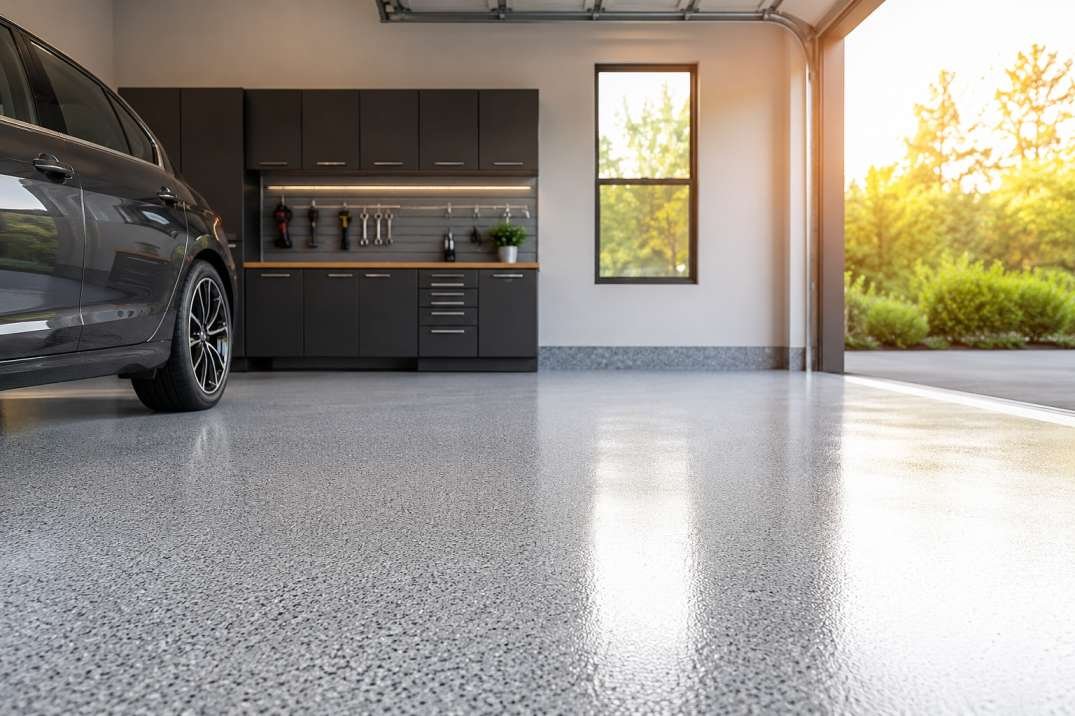
UV-Resistant Garage Epoxy — Why It Matters in Queensland’s Climate
Walk into most Australian garage flooring companies and ask about UV resistance. You’ll hear the same reassurance: ‘yes, it’s UV-resistant epoxy.’ What you won’t hear — unless you ask specifically — is whether that UV resistance comes from the topcoat chemistry or from marketing language on the label. The difference determines whether your garage floor looks the same in five years or starts yellowing and developing permanent tyre marks after the first Queensland summer.
At Resin Masters, we install garage floor epoxy across Brisbane, Gold Coast, Logan, Sunshine Coast, Toowoomba, Ipswich, and Northern NSW. We see the consequences of wrong topcoat specification every year — clients who contact us after their previous garage floor has yellowed, developed tyre tracking marks, or lost its gloss within 18 months of installation. The failure isn’t always the epoxy base coat. It’s almost always the topcoat.
This guide explains exactly why UV resistance matters in Queensland and Northern NSW’s climate, what UV-stable specification actually means at the chemistry level, and why Resin Masters specifies UV-stable polyaspartic topcoat on every garage floor installation — not as an optional upgrade, but as the only specification that makes a 7-year warranty achievable in Australian garage conditions.
Queensland’s UV Environment — Why Australian Garages Are Different
Australia records some of the highest UV Index values on Earth — regularly reaching UV Index 14–15 in Queensland during summer. For context, UV Index 11 is classified as ‘extreme’ by the World Health Organisation. SEQ’s subtropical latitude, low atmospheric pollution, and frequent clear-sky conditions combine to create a UV environment that is genuinely more intense than the conditions European and North American epoxy products are typically formulated and tested for.
The specific challenge for garage floor topcoats is not just UV intensity — it’s the combination of sustained UV exposure with high surface temperatures. East and west-facing garage roller doors create a solar collector effect during the morning or afternoon hours: UV radiation enters directly, heats the concrete slab surface, and creates thermal cycling from cool nights to hot days that stresses any coating film. Concrete slab surface temperatures in exposed Queensland garages reach 45–65°C on peak summer days — significantly above the ambient air temperature.
Add vehicle tyre contact to this picture, and you have the specific failure mechanism that accounts for most Queensland garage floor complaints. A vehicle driven from SEQ summer asphalt arrives home with tyre contact surfaces at elevated temperatures. Park that vehicle on a standard polyurethane topcoat softened by both heat and UV degradation, and the tyre deforms the topcoat permanently — leaving tracking marks that are physical deformation of the film, not surface contamination that cleaning can remove.
THE QUEENSLAND FAILURE PATTERN: A standard polyurethane topcoated garage floor installed in spring looks excellent. By the following March, the floor begins to yellow in UV-exposed zones. By the second summer, tyre tracking marks from parking appear and cannot be cleaned away. The floor looks 8 years old. It’s 2 years old. The installation wasn’t wrong — the topcoat specification was wrong for Australian conditions.
The Chemistry Behind UV Degradation — Aromatic vs Aliphatic Topcoats
Understanding why some topcoats degrade under UV and others don’t requires a brief look at polymer chemistry. The distinction that matters for garage floor performance is between aromatic and aliphatic polymer structures in the topcoat.
Aromatic Topcoats — Why Standard Polyurethane Yellows
Standard polyurethane topcoats use aromatic isocyanates in their chemistry — polymer chains containing benzene ring structures. Benzene rings are highly reactive to UV radiation: they absorb UV energy and undergo photochemical reactions that create chromophoric groups (chemical structures that absorb visible light). These chromophoric groups absorb blue-violet wavelengths and shift the surface appearance toward yellow. This process is irreversible — UV exposure progressively converts the aromatic polymer chains, and the yellowing accumulates over successive exposure cycles. The same aromatic chemistry that creates UV reactivity also reduces the film’s thermal resistance, contributing to the softening under hot-tyre contact that creates tracking marks.
Aliphatic Topcoats — Why Polyaspartic Doesn’t Yellow
UV-stable topcoats use aliphatic isocyanates — polymer chains without benzene ring structures. Without the aromatic groups, the UV absorption mechanism that drives yellowing doesn’t exist in the same way. Aliphatic chemistry maintains colour stability under sustained UV exposure, retains its gloss, and preserves its mechanical properties — including film hardness under thermal stress — for significantly longer than aromatic alternatives under Australian conditions.
Polyaspartic coatings are an aliphatic polyurea-based product that combines the UV stability of aliphatic chemistry with high thermal resistance, excellent abrasion performance, and fast cure times. This combination — not available from standard aliphatic polyurethane, which is UV stable but slower-curing and less thermally resistant — is what makes polyaspartic the correct topcoat specification for Queensland garage floors. Explore Garage Floor Epoxy
|
Property |
Standard Polyurethane Topcoat |
UV-Stable Polyaspartic Topcoat |
|
Polymer chemistry |
Aromatic isocyanate |
Aliphatic polyurea (polyaspartic) |
|
UV yellowing resistance |
Poor — yellows in 12–18 months under Qld UV |
Excellent — colour-stable under sustained Australian UV |
|
Hot-tyre contact resistance |
Poor — softens and deforms under vehicle tyre heat |
Excellent — maintains hardness under hot-tyre contact |
|
Gloss retention under UV |
Degraded — chalks and loses reflectivity |
Maintained — retains gloss for 10+ years |
|
Thermal resistance |
Limited — softens above ~55–60°C under load |
Strong — formulated for Australian temperature conditions |
|
Cure time |
48–72 hours to vehicle-ready |
12–24 hours to vehicle-ready |
|
Resin Masters standard? |
Never — not used on garage installations |
Yes — standard specification on every installation |
The Two Failure Modes UV Specification Prevents
Failure Mode 1 — Yellowing and Colour Shift
Yellowing from UV degradation is a gradual process that typically becomes noticeable within 12–18 months on Queensland garage floors with significant UV exposure. It’s most visible in zones with direct sunlight entry — the area near the roller door, south-facing garage interiors with natural light, and any garage with translucent roof sheeting. The yellowing is irreversible: UV degradation of the aromatic polymer is a one-way chemical process, and cleaning, polishing, or buffing the surface doesn’t reverse it. The only remediation is topcoat removal and re-application with UV-stable chemistry — restoring the appearance at additional cost and disruption.
UV-stable polyaspartic topcoat prevents this failure entirely. Resin Masters has installed polyaspartic-topcoated garage floors across Brisbane, Gold Coast, Ipswich, and the Sunshine Coast that have maintained their colour after multiple Queensland summers — the aliphatic chemistry simply doesn’t undergo the same photochemical degradation pathway.
Failure Mode 2 — Hot-Tyre Pickup and Tyre Tracking
Hot-tyre pickup typically appears before severe yellowing because the thermal contact of a single parking event can produce visible deformation of a softened topcoat. The mechanism is straightforward: high-temperature vehicle tyre contacts a topcoat film that has been softened by heat and UV degradation, and the contact pressure — from the vehicle’s weight distributed across the tyre contact patches — permanently deforms the surface at the contact points. When the vehicle moves, the deformed topcoat reveals the tyre tread pattern as a permanent mark.
This failure is particularly acute in Ipswich, Logan, and Toowoomba — inland locations where concrete surface temperatures are higher than coastal SEQ — but it occurs across all Resin Masters service locations during Queensland summer conditions. The prevention is identical to UV yellowing prevention: UV-stable polyaspartic topcoat with adequate thermal resistance for Australian garage conditions.
Why Resin Masters Applies Polyaspartic Topcoat on Every Installation
Resin Masters made the decision to specify UV-stable polyaspartic topcoat as our baseline — not an upgrade option — for a simple operational reason: the 7-year warranty we write into every garage floor quote is only achievable if the floor performs across Queensland summers. A standard polyurethane topcoat fails within one to two SEQ summers. A warranty claim on a floor that has tracked and yellowed after 18 months is not a manufacturing defect or preparation failure — it’s a specification failure. And a specification failure on a floor we’re providing a 7-year warranty for is entirely our problem.
By specifying UV-stable polyaspartic on every installation, we remove the specification variable from the warranty risk. Every Resin Masters garage floor installed across Brisbane, Gold Coast, Logan, Sunshine Coast, Toowoomba, Ipswich, and Northern NSW uses the same topcoat chemistry — and it’s the chemistry that prevents yellowing and tyre tracking for the full warranty period and beyond.
- Solid colour garage epoxy — UV-stable polyaspartic topcoat standard. Your chosen colour stays true for 15+ years under Queensland UV.
- Seamless flake garage epoxy — UV-stable polyaspartic topcoat standard. The clear coat over the flake chips maintains optical clarity and protects the flake from UV bleaching.
- Metallic and marble garage epoxy — UV-stable polyaspartic topcoat standard. The dimensional metallic effect shifts and moves as it should — not dulled by UV haze or compromised by yellowing over the metallic pigments.
Also Read:- How Long Does It Take to Epoxy a Floor? Toowoomba Timeline Guide
UV-Resistant Garage Epoxy Across All 7 Resin Masters Locations
Every location in our service area presents UV and thermal conditions that make UV-stable specification the correct choice. The specific failure risk varies — Ipswich’s extreme inland heat makes hot-tyre contact the most acute risk, while coastal Gold Coast properties face salt air atmospheric exposure in addition to UV — but no location is moderate enough for standard polyurethane topcoats under regular vehicle use. Contact us!
|
Brisbane |
Subtropical UV year-round. Heat island effect elevates garage concrete temperatures. Vast majority of garage floor topcoat failures in SEQ come from Brisbane’s sustained UV exposure on east and west-facing roller doors. |
|
Gold Coast |
Coastal UV plus salt air atmospheric exposure. Beachfront and waterfront garages face compound surface degradation from UV and salt. Resin Masters specifies coastal-appropriate polyaspartic formulations where atmospheric salt loading is a factor. |
|
Logan |
Inland position creates higher peak concrete temperatures than coastal Brisbane. Standard polyurethane failures from hot-tyre contact are common in Logan’s established garage stock — Resin Masters’ polyaspartic specification prevents this. |
|
Sunshine Coast |
High-frequency clear-sky days create sustained UV loading across the region’s extensive residential garage market. Sea-change renovation clients specifically value UV stability because they’re investing in long-term property quality. |
|
Toowoomba |
Lower humidity but intense inland UV. Thermal cycling from cold winters to hot dry summers creates additional stress on topcoat adhesion — our polyaspartic formulation handles both the UV and the thermal range. |
|
Ipswich |
SEQ’s highest peak concrete temperatures — regularly 55–65°C in peak summer. Hot-tyre contact resistance is the most critical single specification factor in Ipswich. Polyaspartic topcoat is non-negotiable. |
|
Northern NSW |
Subtropical coastal UV, environmentally conscious market. Our low-VOC to near-zero-VOC polyaspartic chemistry aligns with Northern Rivers’ environmental values as well as delivering UV stability. |
 Call Resin Masters: +61 433 733 956
 Email: info@resinmasters.com.au
 resinmasters.com.au | Free on-site assessment + 48-hour written quote | 7-Year Warranty
 Brisbane · Gold Coast · Logan · Sunshine Coast · Toowoomba · Ipswich · North NSW
Also Read:- Concrete vs Epoxy Floor for a Toowoomba Garage: Which Is Better?