Servicing : Gold CoastBrisbaneSunshine CoastToowoomba

How Long Does Epoxy Flooring Last in Brisbane’s Heat?
Quick Answer: Professionally installed epoxy flooring in Brisbane lasts 10–20 years in residential settings and 7–15 years in commercial or industrial environments. However, Brisbane’s intense UV, high humidity, and summer heat can shorten that significantly if the wrong products are used or corners are cut on installation. Read on for the full picture.
One of the most common questions Brisbane homeowners ask about epoxy flooring is whether it can actually handle Queensland’s conditions. The short answer is yes — when installed correctly with the right products for the Brisbane climate. The longer answer involves understanding the specific challenges our environment creates, and what separates a floor that lasts two decades from one that starts peeling at the two-year mark.
Expected Lifespan by Application Type
Not all epoxy floors are created equal. Lifespan varies significantly depending on where the floor is installed, how it’s used, and what products were used in the installation.
| Application | Expected Lifespan | Key Risk Factor | Brisbane-Specific Tip |
| Residential Garage | 12–20 years | Poor surface prep, oil contamination | Diamond grind, moisture test, UV-stable topcoat essential |
| Residential Interior | 15–25 years | UV exposure through windows | Use UV-stable topcoat on any floor exposed to sunlight |
| Commercial Kitchen | 10–15 years | Chemical exposure, heavy foot traffic | Food-safe specification, anti-slip additive, regular cleaning |
| Retail / Café Floor | 10–15 years | Trolley abrasion, scraping chairs | Add UV topcoat, choose higher-build system for durability |
| Warehouse / Industrial | 7–12 years | Forklift traffic, chemical spills | Specify industrial-grade system, consider polyaspartic topcoat |
| Outdoor / Exposed Areas | 5–10 years | UV degradation, temperature cycles | Polyaspartic recommended over standard epoxy for outdoors |
| Benchtop Resurfacing | 8–15 years | Heat from appliances, cleaning products | Specify heat-resistant formulation, avoid abrasive cleaners |
Why Brisbane’s Climate Is Hard on Epoxy Floors
Ultraviolet Radiation
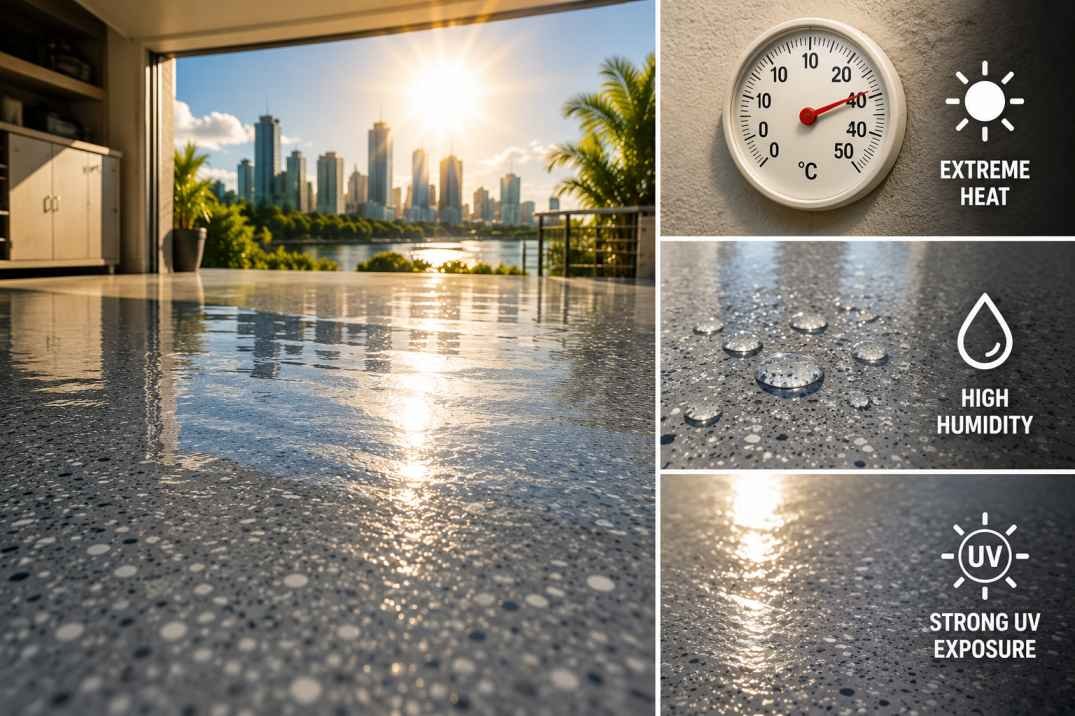
Brisbane receives some of the highest UV index readings in the world — regularly reaching 10–12+ in summer. Standard epoxy resins contain aromatic compounds that break down under UV exposure, causing yellowing, chalking, and eventual surface degradation. This is not a defect — it’s a known chemical property of standard epoxy.
The solution is straightforward: a UV-stable aliphatic polyurethane or polyaspartic topcoat applied over the epoxy base. These topcoats contain UV inhibitors that prevent the yellowing and degradation that would otherwise occur. Every reputable Brisbane epoxy installer should include this as standard on any floor exposed to natural light — including garage floors with an open roller door.
Heat and Thermal Cycling
Brisbane’s summer temperatures regularly reach 35–40°C, and concrete slabs can get significantly hotter when exposed to direct sun. This thermal cycling — heating and cooling daily — creates expansion and contraction in the slab that stresses any coating bonded to it.
Quality 100% solids epoxy systems are formulated to handle thermal cycling. However, epoxy systems that were not adequately bonded to the slab due to poor surface preparation are particularly vulnerable — the repeated expansion and contraction will find any weak adhesion point and exploit it.
Humidity and Moisture Vapour
Brisbane’s summer humidity — often above 80% — creates significant moisture vapour in concrete slabs, particularly in ground-level or below-grade applications. If moisture vapour emission from the slab is too high at the time of installation, the epoxy will fail to bond properly and will eventually delaminate.
Professional installers measure moisture vapour emission before every installation. If the reading is too high, a moisture-tolerant primer or vapour barrier system is used before the epoxy is applied. This step adds cost but prevents the most common cause of epoxy floor failure in Brisbane.
What Makes the Difference Between 5 Years and 20 Years?
The single biggest factor in epoxy floor lifespan is not the brand of epoxy, the colour, or even the system type. It’s the quality of the installation — specifically these five factors:
- Surface Preparation
Epoxy bonds to concrete mechanically and chemically. Diamond grinding creates the surface profile needed for a strong bond. Without it, adhesion is marginal, and the floor will eventually delaminate — regardless of product quality. Professional diamond grinding is non-negotiable for a floor that will last 15+ years.
- Moisture Testing
Installing epoxy over a slab with high moisture vapour emission is one of the most common installation mistakes in Brisbane. A proper moisture test before installation identifies whether a vapour barrier is needed. Skipping this step is a gamble that often fails within 1–3 years.
- UV-Stable Topcoat
As discussed, any Brisbane epoxy floor exposed to natural light needs a UV-stable topcoat. Without one, yellowing can begin within 12 months and accelerate rapidly.
- Product Quality
100% solids commercial-grade epoxy is significantly more durable than water-based systems. The difference in lifespan between a DIY water-based kit and a professional 100% solids system can be 10+ years in Brisbane conditions.
- Traffic and Use
The way a floor is used dramatically affects lifespan. A residential garage used for one car and light foot traffic will outlast the same floor specification in a commercial workshop with forklifts and chemical spills by a factor of two to three.
Also Read:- Epoxy Flooring vs Polished Concrete Brisbane: Which is Better?
Signs Your Epoxy Floor Needs Attention
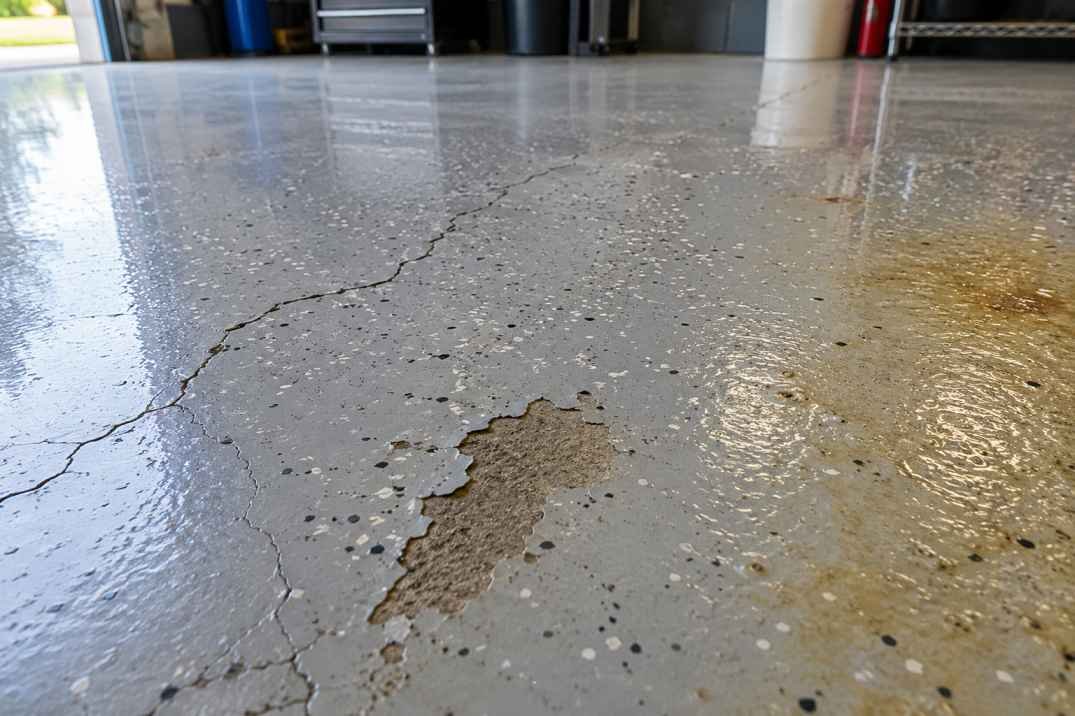
Even the best floors eventually show wear. Watch for these indicators that your epoxy floor may need a maintenance coat or full refresh:
- Yellowing or colour changes — usually UV-related without a proper topcoat
- Loss of gloss — normal wear, usually remedied with a maintenance topcoat
- Peeling or bubbling sections — typically adhesion failure from moisture or poor prep
- Surface scratches or scuffs — can be addressed with spot repairs or a full recoat
- Visible concrete through the coating — indicates the coating has worn through
In most cases, a deteriorating epoxy floor can be refreshed with a recoat — a new topcoat layer applied over the existing system — without requiring a full strip-back. This significantly extends the life of the original installation at a fraction of the original cost.
Also Read:- Best Epoxy Flooring Companies in Brisbane (2026 — What to Look For)
Frequently Asked Questions
Can epoxy flooring be used outdoors in Brisbane?
Standard epoxy is not recommended for exposed outdoor areas in Brisbane. For driveways, patios, and pool surrounds, polyaspartic coatings are a better choice — they cure faster, handle UV far better, and tolerate temperature extremes more effectively.
How long before I can walk on new epoxy flooring?
Most epoxy systems in Brisbane allow light foot traffic within 24 hours. Vehicles should be kept off for 48–72 hours. Full chemical cure typically takes 7 days — during which point loads and heavy equipment should be avoided.
Does Resin Masters’ 5-year guarantee cover UV yellowing?
Our 5-year guarantee covers defects arising from our installation process. All Resin Masters installations include a UV-stable topcoat as standard — so UV yellowing should not occur within the guarantee period when the floor is installed correctly.
Want an epoxy floor built to handle Brisbane’s climate? Resin Masters uses commercial-grade 100% solids epoxy with UV-stable topcoats on every job — and backs it with a 5-year guarantee. Get a FREE quote today: call +61 433 733 956 or visit resinmasters.com.au.